

The Department of Sustainability & Environment (DSE) yesterday released data on the number of housing transfers and mortgage lodgements/disharges across Victoria in June, which revealed ongoing weakness in both housing turnover and mortgage demand.
Looking at the transaction side of the market first, you can see that the number of transfers over June was 31% higher than the record low recorded in March 2013 (see next chart).
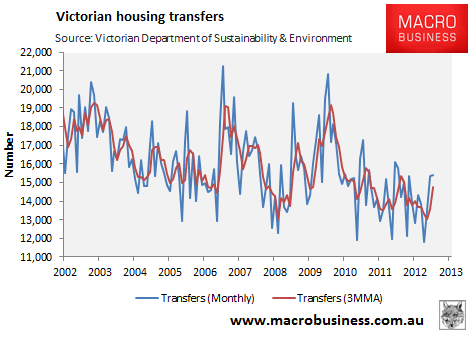
However, the data series is not seasonally adjusted and is, therefore, inherently volatile. Accordingly, it is presented below on a rolling annual basis, which allows comparison to the same month the year before, therefore, overcoming issues around seasonality (see next chart).

As shown above, the annual number of housing transfers in June (167,613) was only marginally above the record low recorded in the year to March 2013 (167,200). It was also 13% below the decade average.
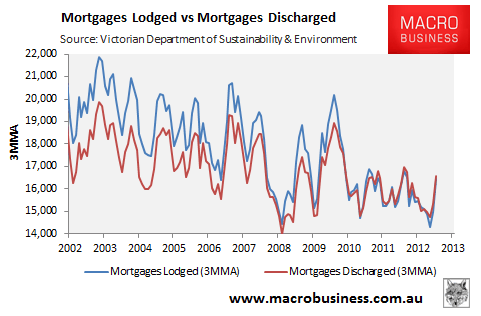
The DSE’s mortgage finance statistics are unique in that they provide data on both mortgage lodgements (i.e. new mortgages) and mortgage discharges (i.e. mortgages repaid in-full). Below is a chart showing both series on a 3MMA basis:
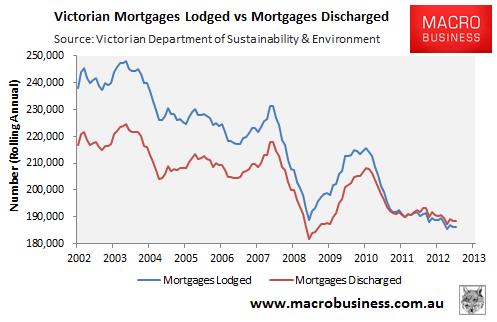
And the next chart shows the same data on a rolling annual basis:
And below is the number of net new mortgages created, calculated by subtracting mortgage discharges from mortgage lodgements:

According to the DSE, the number of mortgages lodged in the month of June was 116 more than the number of discharges. On an annual basis, however, the number of mortgages discharged (188,324 in June) continued to exceed the number of mortgage lodgements (186,066 in June), meaning that 2,258 mortgages were lost in the State of Victoria in the 12-months to June 2013, up from 2,177 mortgages lost in the year to May. This compares to the average of 12,095 annual net mortgage creations since the series began in 2002.
Despite the ongoing solid auction clearance rates for Melbourne, suggesting an increase in buyer activity, the aggregate data remains weak showing minimal improvement in either transaction volumes or mortgage demand. As such, the Victorian (Melbourne) housing market appears to remain on a fragile footing.
