

The Fed minutes overnight said that “about half” of the participants in the June 18-19 meeting of the Federal Open Market Committee thought the $US85 billion a month stimulus program should be wound up by the end of this year. But the minutes also said the following:
While recognizing the improvement in a number of indicators of economic activity and labor market conditions since the fall, many members indicated that further improvement in the outlook for the labor market would be required before it would be appropriate to slow the pace of asset purchases. …
Participants discussed how best to communicate the Committee’s approach to decisions about its asset purchase program and how to reduce uncertainty about how the Committee might adjust its purchases in response to economic developments. Importantly, participants wanted to emphasize that the pace, composition, and extent of asset purchases would continue to be dependent on the Committee’s assessment of the implications of incoming information for the economic outlook, as well as the cumulative progress toward the Committee’s economic objectives since the institution of the program last September. The discussion centered on the possibility of providing a rough description of the path for asset purchases that the Committee would anticipate implementing if economic conditions evolved in a manner broadly consistent with the outcomes the Committee saw as most likely. Several participants pointed to the challenge of making it clear that policymakers necessarily weigh a broad range of economic variables and longer-run economic trends in assessing the outlook. As an alternative, some suggested providing forward guidance about asset purchases based on numerical values for one or more economic variables, broadly akin to the Committee’s guidance regarding its target for the federal funds rate, arguing that such guidance would be more effective in reducing uncertainty and communicating the conditionality of policy. However, participants also noted possible disadvantages of such an approach, including that such forward guidance might inappropriately constrain the Committee’s decision making, or that it might prove difficult to communicate to investors and the general public.
Since the September meeting, some participants had become more confident of sustained improvement in the outlook for the labor market and so thought that a downward adjustment in asset purchases had or would likely soon become appropriate; they saw a need to clearly communicate an intention to lower the pace of purchases before long. However, to some other participants, this approach appeared likely to limit the Committee’s flexibility in adjusting asset purchases in response to changes in economic conditions, which they viewed as a key element in the design of the purchase program. Others were concerned that stating an intention to slow the pace of asset purchases, even if the intention were conditional on the economy developing about in line with the Committee’s expectations, might be misinterpreted as signaling an end to the addition of policy accommodation or even be seen as the initial step toward exit from the Committee’s highly accommodative policy stance. It was suggested that any statement about asset purchases make clear that decisions concerning the pace of purchases are distinct from decisions concerning the federal funds rate.
Participants generally agreed that the Committee should provide additional clarity about its asset purchase program relatively soon. A number thought that the post meeting statement might be the appropriate vehicle for providing additional information on the Committee’s thinking. However, some saw potential difficulties in being able to convey succinctly the desired information in the post meeting statement. Others noted the need to ensure that any new statement language intended to provide more information about the asset purchase program be clearly integrated with communication about the Committee’s other policy tools. At the conclusion of the discussion, most participants thought that the Chairman, during his post meeting press conference, should describe a likely path for asset purchases in coming quarters that was conditional on economic outcomes broadly in line with the Committee’s expectations. In addition, he would make clear that decisions about asset purchases and other policy tools would continue to be dependent on the Committee’s ongoing assessment of the economic outlook. He would also draw the distinction between the asset purchase program and the forward guidance regarding the target for the federal funds rate, noting that the Committee anticipates that there will be a considerable time between the end of asset purchases and the time when it becomes appropriate to increase the target for the federal funds rate.
Despite the whining across the financial press, this is good stuff from the Fed. The obviously unresolved debate, and more importantly, the determination to communicate it, still boils down to jawboning the end of QE, which is quite sensible in my view.
The Fed is clear on one point, that data will determine the outcome. So let’s stick with that. Bond markets sold off again with the ten and thirty year yields hitting new highs for the move: 2.68% and 3.69% respectively. Moreover, the 30 the thirty year mortgage rate rocketed this week as expected:
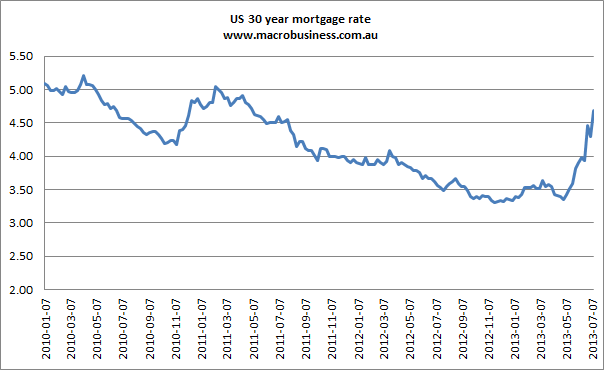
The US housing market has enjoyed the equivalent of almost six standard interest rate hikes in eight weeks (remember that’s less damaging than here because most mortgages are fixed) and it’s showing up big time in the Mortgage Banker’s Association weekly origination data also released last night:
The Refinance Index decreased 4 percent from the previous week. The seasonally adjusted Purchase Index decreased 3 percent from one week earlier.
And the charts. From Calculated Risk, refis are headed into the can as fast rates are rising and will shortly be back into the post-GFC malaise range:
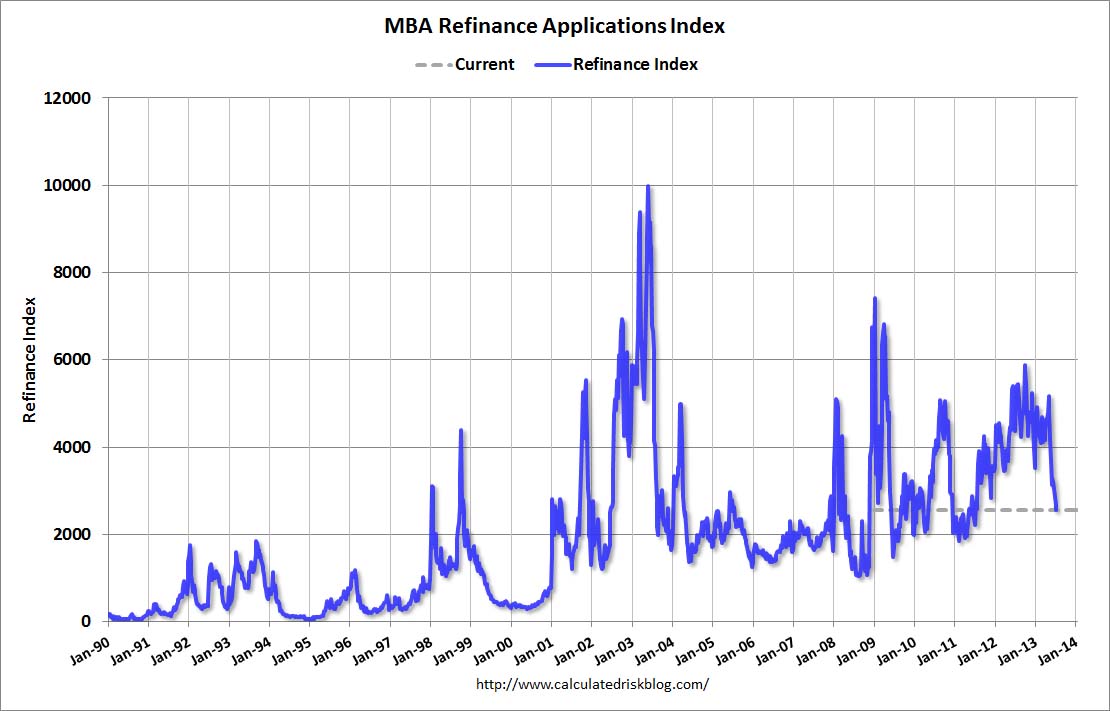
As I’ve said before, there is a strong correlation between refinancing activity and US house prices. Regular purchases have also rolled and put in a little double top and will probably keep falling from what was already a lousy recovery (not easy to see owing to the four week moving average):
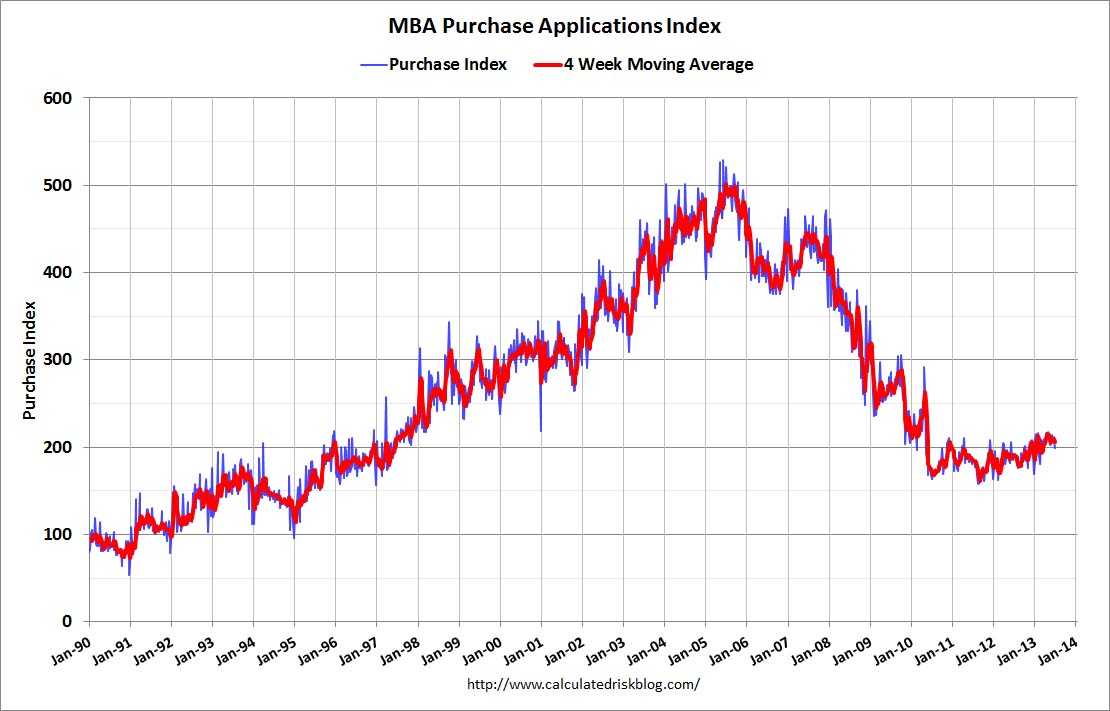
Nothing overnight changes my view that this move in rates will slow the housing and economic recoveries, and that we’re in for more jawboning and less taper than expected.
