From Bloomie:
The Federal Reserve will begin to slow its bond-purchase program, known as quatitative easing, in September, according to the majority of 54 economists in a Bloomberg News survey. Fifty percent of economists said the Fed will halt purchases altogether in the second quarter of 2014.
Following are the results of the most recent survey, conducted July 18-22.
2) When will the Federal Reserve first alter the pace of monthly purchases in its quantitative easing program (either by decreasing or increasing) from its current pace of $85 billion a month?
a) At July 30-31 FOMC meeting
b) At Sept. 17-18 FOMC meeting
c) At Oct. 29-30 FOMC meeting
d) At Dec. 17-18 FOMC meeting
e) In 2014 or later
========================================================
Response Count: 54 100%
——————————————————–
a 0 0%
b 27 50%
c 8 15%
d 15 28%
e 4 7%
========================================================4) In which quarter do you expect the Fed to end its quantitative easing entirely?
========================================================
Response Count: 54 100%
——————————————————–
3Q14 4 7%
1Q14 3 6%
2Q14 27 50%
3Q14 13 24%
4Q14 6 11%
4Q16 1 2%
========================================================
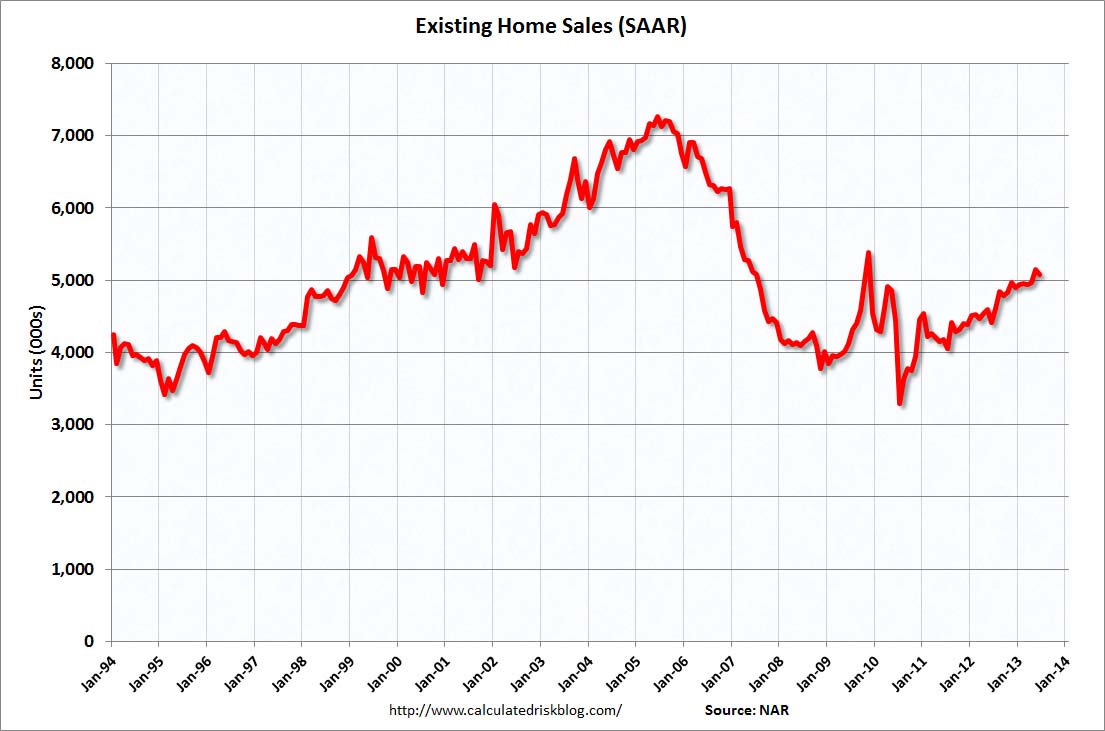
I remain cautious. There were more signs of slowing US housing activity last light with June US Existing Home sales missing consensus by a decent margin. Consensus was for +1.4% m/m but sales fell 1.2%. The stock of unsold homes rose slightly to a still-low 5.2 months of supply from 5 months in May. Sales of single-family homes as well as apartments were weaker in the month:
Total existing-home sales, which are completed transactions that include single-family homes, townhomes, condominiums and co-ops, dipped 1.2 percent to a seasonally adjusted annual rate of 5.08 million in June from a downwardly revised 5.14 million in May, but are 15.2 percent higher than the 4.41 million-unit level in June 2012.
Total housing inventory at the end of June rose 1.9 percent to 2.19 million existing homes available for sale, which represents a 5.2-month supply at the current sales pace, up from 5.0 months in May. Listed inventory remains 7.6 percent below a year ago, when there was a 6.4-month supply.
However, the chart from Calculated Risk shows a still solid trend:
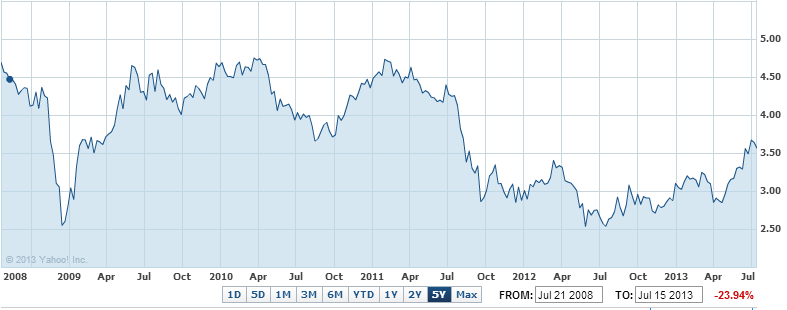
You would expect as well that June sales pre-date the big moves in mortgage rates which have at least calmed down. The benchmark 30 year bond is down 13bps to 3.55%: