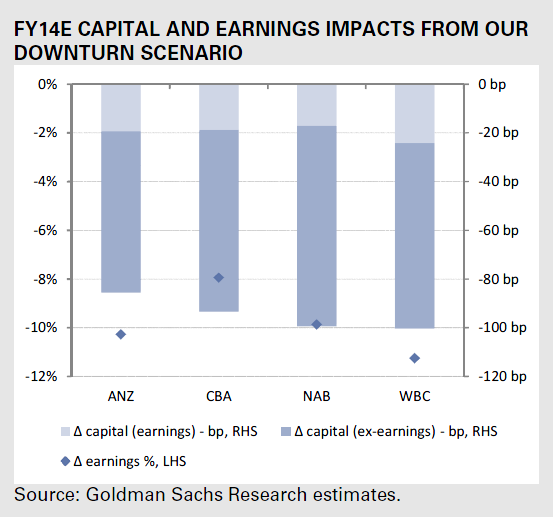
Goldman asks a useful question today about whether or not Australia’s major bank’s earnings would be the same in any downturn. The answer is more or less, with WBC coming off a close last:
Macro data points to weakening economy
Recent economic data points to a weakening domestic economy, with the unemployment rate rising and GDP growth slowing. While at this stage we maintain our more benign outlook for credit quality, the slowing macro environment has led us to stress test what this might mean for the sector’s earnings, capital levels and dividends.
Downturn scenario: 8%-11% earnings downside; close to 1pp capital decline
We have used Pillar 3 risk disclosures to gauge the impact on both earnings and risk weight intensity of a sharp, but plausible downturn scenario akin to 2008/09, which includes 30% of each of the disclosed risk bands in the corporate
portfolio being downgraded by one ratings notch and a 5% decline in house prices. Under this scenario, the combination of an 8%-11% earnings hit, coupled with higher capital intensity, would reduce CET1 ratios by between 86 bp to 100 bp (margin exhibit). While this would deplete capital levels to c. 8%, we do not believe this scenario would represent a risk to our current DPS forecasts.
CBA best placed; others closely bunched
Our downturn scenario sees CBA as the most resilient (i.e. smallest decline in CET1 ratio), due to its book mix and stronger organic capital generation. NAB and WBC’s CET1 ratios screen as the most sensitive to our scenario due to a combination of portfolio quality and mix.
However, factoring in organic capital generation, we would expect WBC and ANZ to see the largest decline in CET1 ratios, albeit WBC’s absolute ratio would still be the highest in the sector.
Pricing overestimates differences in risk
If we adjust our valuations for the impact of our downturn scenario on each bank’s earnings and capital, we find a spread in valuation movements of only 3%. However, current pricing implies a far greater spread in risk profiles, presumably based on perceptions driven by recent history. Thus even in our downturn scenario, NAB would remain the most attractive on a relative total return basis, implying that its current share price is overly discounting the relative risk of its portfolio.
The elephant in the room is for me is if such a downturn began, what would prevent it getting worse given monetary policy is already slipping. Stimulus would work for a while and then what?
David Llewellyn-Smith is Chief Strategist at the MB Fund and MB Super. David is the founding publisher and editor of MacroBusiness and was the founding publisher and global economy editor of The Diplomat, the Asia Pacific's leading geo-politics and economics portal.
He is also a former gold trader and economic commentator at The Sydney Morning Herald, The Age, the ABC and Business Spectator. He is the co-author of The Great Crash of 2008 with Ross Garnaut and was the editor of the second Garnaut Climate Change Review.