
How land-value windfalls could fund infrastructure

Anyone that has spent significant time in one of Australia’s major cities will recognise that infrastructure – be it roads, rail or other – is becoming stretched. Thanks to rapid population growth since the mid-2000s (see next chart) and decades of underinvestment by Australia’s federal and state governments, our roads are clogged and our public transport networks are overcrowded and lacking in scope, which costs all of us both in lost productivity and reduced living standards.
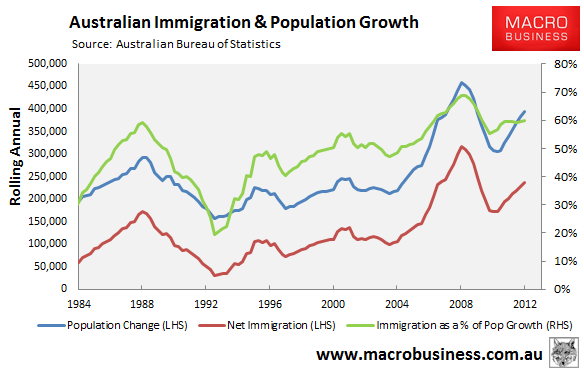
The situation is made worse by governments’ mindless addiction to budget surpluses and aversion to debt, which precludes them from financing infrastructure via long-term bond issuance, as was the norm during the pre and post-war periods when most of Australia’s urban infrastructure was built.
Last month, I argued that Australia’s infrastructure problems could be alleviated, in part, by extending land taxes currently applied on investment properties to one’s principal place of residence (in exchange for eliminating stamp duties on housing transfers).
Essentially, applying land taxes to all types of land would help to make infrastructure investments self-funding for governments, since any land value uplift brought about through increased infrastructure investment (e.g. new roads, trains, etc) would be partly captured by the government via increased land tax receipts. Accordingly, governments would be more likely to facilitate development, rather than act to restrict it in a bid to save on infrastructure costs.
Yesterday, Proper’s Gavin Putland published an interesting article explaining how land-value windfalls could be used to pay for new infrastructure, such as the proposed Doncaster railway in Melbourne:
The Herald Sun reports research by PRD Nationwide showing that on average, across all Melbourne suburbs, the presence of a railway station in a suburb adds about $48,000 to the value of the median “house” in the suburb. This average rises to $59,500 for the northern suburbs or $105,000 for the eastern suburbs.
Of course the increase in value is a locational advantage and is therefore attached to the land under the “house”, not to the building, because the value of the building is limited by construction costs, whereas the land has a locational value whether the building is present or not.
Technicalities aside, what does this say about the viability of the Doncaster railway?
To be conservative, let us classify Doncaster as a northern suburb (although it’s more like E/NE) and suppose that the uplift is $60k per “house”. Let us suppose that there will be 10 new railway stations, each of which will raise “house” prices within a 1km radius, within which there are 2 square km of “house” sites at a density of 15 per hectare, i.e. 1500 per square km. That gives 3000 houses per “suburb” served by a railway station. On these assumptions, the total uplift in “house” prices is
10×3000×$60k = $1.8 billion.
The most recent estimate of the cost of the Doncaster railway is $840 million. If that sum were clawed back from the lucky property owners, they would still be a net $960 million better off, and the rest of us taxpayers would not need to contribute a cent.
Australian cannot expect to enjoy ever-increasing living standards as long as it continues to force more people onto the pre-existing infrastructure network, worsening congestion and travel times, as well as lowering productivity.
The funding options are available for new infrastructure, whether via old-fashioned long-term bond financing or implementation of broad-based land taxes. All that is required is the political will and community pressure to pursue such reforms.
unconventionaleconomist@hotmail.com
