
So the OECD has cut Australian growth to 2.5% this year. But next year it still sees 3%+ as low interest rates boost house prices and consumption:
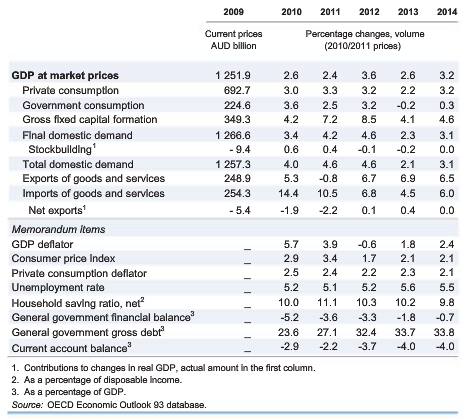
Interestingly, there’s little expected from net exports.
The group also recommended hiking the GST and lowering company tax rates to aid the recovery and praised the easing off of fiscal consolidation. That’s all to the good but what’s the point of cutting company tax rates for a bunch of over-consolidated rent-seeking businesses that will just return the money to shareholders as rents? We don’t need general tax cuts, we need specific tax reform that boosts investment.
That’s the point today missed by Michael Stutchbury, editor of the AFR, who picks up a pen again to suggest Australia should follow New Zealand’s lead:
Like all established media, the Financial Review has to cut costs. The Sydney subs desk, traditionally part of the fabric of the newsroom, has been shut and articles such as this are now subbed by a Fairfax Media team in Auckland.
…The flip side of Australia’s high cost base is its relative prosperity. Over the past two centuries, Aussies have rarely been this much more prosperous than Kiwis, thanks to the mother of all resources booms in Western Australia and Queensland.
Yet a side trip to Wellington confirmed that this trans-Tasman disparity has likely peaked. Australia’s resources boom luck is ending and we’re about to pay for its mismanagement. While New Zealand’s bad luck is about to turn for the better, it also will reap the benefits of its more disciplined policy-making.
New Zealand didn’t have a mining boom to shield it from a global financial crisis recession. The February 2011, the Christchurch earthquake flattened much of the country’s second biggest city. Then came a drought. Elected in late 2008 at the start of this bad luck, John Key’s National government also had to deal with the legacy of nearly a decade of a back-sliding and big spending Labour government.
This is Panglossian stuff. New Zealand did have a mining boom. It’s called Australia, New Zealand’s largest export market and source of capital. As the IMF warned this week, the real secret of NZ’s budget and is that it’s house prices have continued to ever higher levels, building both financial and economic risk for the not too distant future. That would not have been possible without the shield of Australian mining revenue protecting NZ banks. It will be interesting to see how our Tasman cousin fares if things become more difficult for Australia.
We don’t need to follow New Zealand or the simplistic platitudes of the OECD. What we need is a new national project aimed at reviving non-mining exports and to follow the kind of productivity drive outline by Ross Garnaut, as well as building as much productivity targeted infrastructure as debt limits allow. That means specific and targeted tax reform aimed at reducing the value of the dollar and shifting investment from dead assets like housing to debt-eating assets like factories, offices chock full of services exporters and silos full of agriculture set for shipping.
It also means competition. Lots more competition. And tackling the rent-seekers that dominate the house price inflation model espoused by Stutchbury, as well as protected by his paper.
