

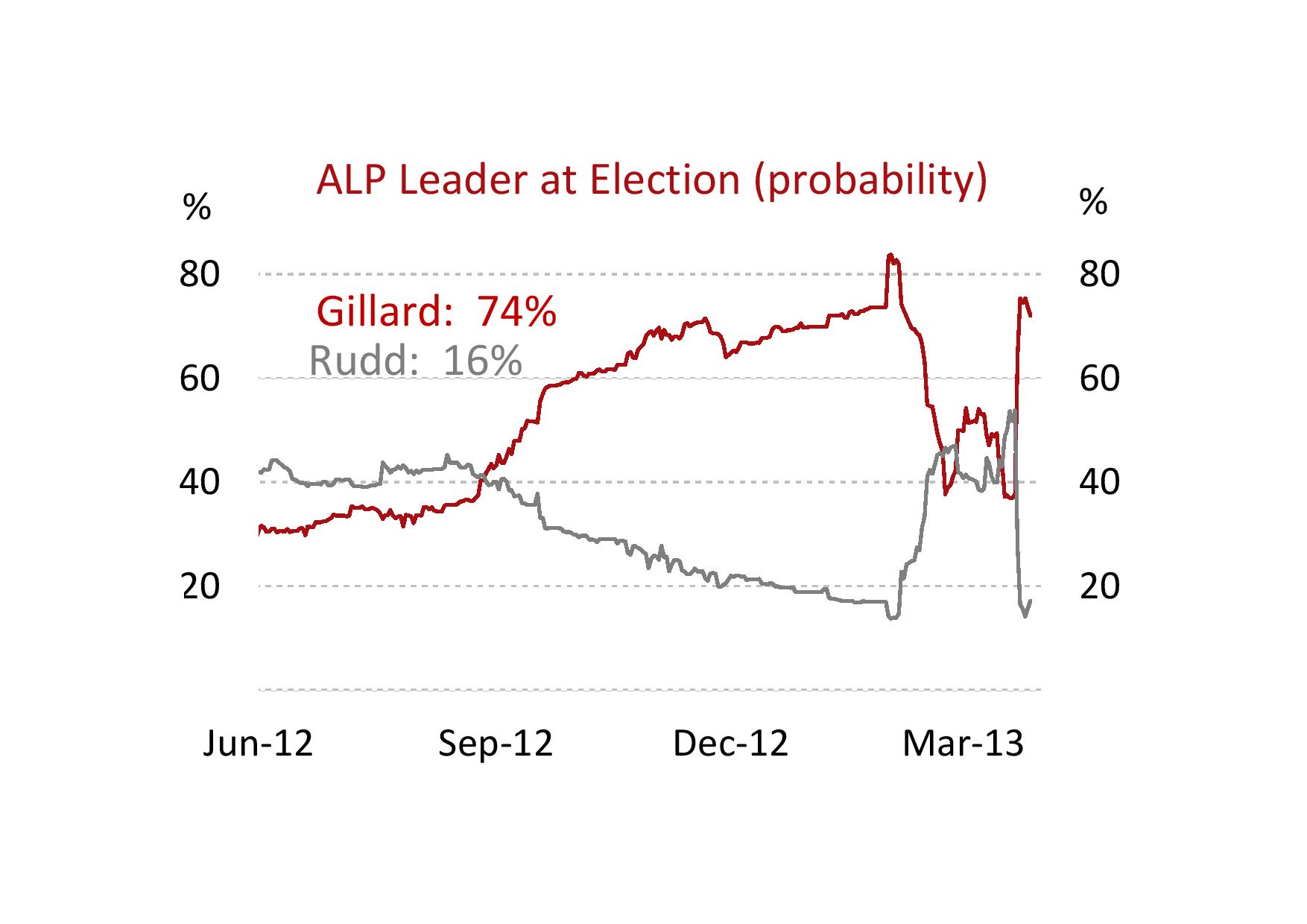
The failure to change leaders on March 21 has seen Labor’s perceived election chances hit a new low. Data extracted from online betting markets currently imply the ALP’s chance of victory to be below 16 per cent, lower than at any point over the past twelve months. Gillard is once again the most likely candidate to lead Labor to the next election, with markets are now giving Rudd only a 15 per cent chance of regaining the leadership.
Labor’s chances had jumped to almost 25 per cent when Simon Crean called upon Julia Gillard to hold a leadership ballot last Thursday.
Markets at the time gave Rudd a 3 in 4 chance of being leader, suggesting that, despite later commentary to the contrary, Rudd had a good chance of securing the vote. But ever since the news that Rudd would not be contesting, Labor’s perceived chances have gone into reverse.
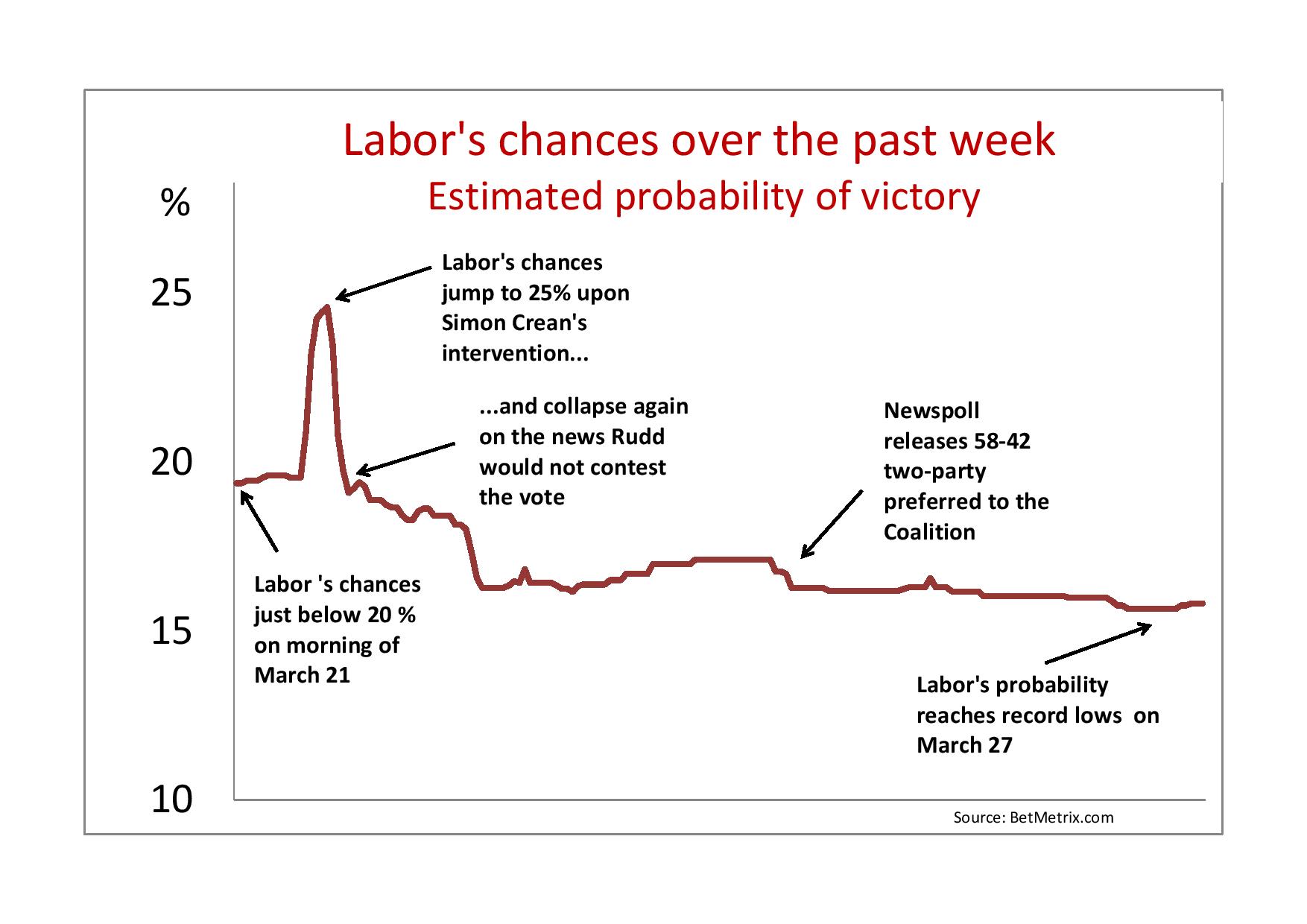
Labor’s chances fell further when Rudd clarified his position, declaring that there were ‘no circumstances’ under which he would return as leader ‘in the future’.
While the markets are not entirely convinced that a Rudd return is out of the question, Julia Gillard has once again been cemented as the clear favourite to lead Labor to the next election. Unlike Labor’s chances of winning, Rudd’s odds of rising ot the leadership have not quite hit new lows:
Labor’s support among marginal seat voters has crashed in Queensland and Western Australia to levels similar to NSW, exposing it to the loss of all 24 marginal seats it holds across Australia and risking up to 15 more semi-marginal electorates.
The poll by JWS Research also finds that, despite the bleak outlook for Labor, most marginal seat voters would prefer it to win the election than Tony Abbott’s Coalition.
But so disillusioned have voters become “there are many people intending to vote for the Coalition, even though it is not their preferred outcome’’, JWS research director John Scales said.
The poll, exclusive to The Australian Financial Review, surveyed 4070 voters across the nation’s 54 marginal seats – those held by margins of 6 per cent or less.
…Since the last JWS Research marginal seat poll in January, the two-party-preferred swing against Labor in the 54 marginal seats since the 2010 election has almost doubled, from 4.8 per cent to 9.3 per cent. This is a move of 4.5 points in two months.
In January, Labor stood to lose 18 of the 24 marginal seats it holds. If an election were held now it would lose all 24, including those held by six ministers, including Treasurer Wayne Swan, Defence Minister Stephen Smith and Schools Minister Peter Garrett.