

The Age newspaper yesterday ran an article providing a stark warning of what might await Australia once the mining investment boom peaks later this year and capital works wind-up.
The Age article claims the the Victorian economy risks grinding to a halt because of the pending completion of large-scale infrastructure projects, which threatens to cause large scale job losses in the construction industry – the state’s fourth biggest employer:
VICTORIA is coming to a standstill with more than 12,000 construction jobs lost and thousands more at risk as big infrastructure jobs such as the desalination plant finish and the pipeline of major building projects dries up.
The state’s large building companies – including Thiess and John Holland – have already laid off more than 5000 employees as work on projects such the M80 Ring Road Upgrade draws to a close.
The companies expect to shed thousands more jobs in the next few months as the building industry grinds to a halt…
The jobs losses add to a record slump in the new housing sector that has contributed to the largest decline in construction jobs since the early 1990s.
The decline in building puts thousands more Victorians in related fields under pressure, with suppliers of building materials such as Boral and leading design companies laying off hundreds of engineers, surveyors, workers and contractors…
A unanimous chorus of industry leaders – from lobby groups, peak bodies, unions and economists – say capital spending is the lifeblood of the Victorian economy, which is under increasing strain because of the building decline.
They are calling for the state and federal governments to fast-track funding for the next round of big-ticket projects…
The director of the Victorian branch of the Australian Industry Group, Timothy Piper, said it was one of the most significant economic issues for Victoria, and a lack of ”cranes on the skyline” represented poor economic health…
The state secretary of the Victorian Branch of the Australian Workers’ Union, Cesar Melhem, said there were lots of ”very grim” construction workers looking for employment, but some were changing jobs or moving interstate.
”Even if the government starts stimulating new projects, there is still going to be a lag of at least 12 to 18 months where I’m anticipating there is going to be a disastrous drop in construction jobs in Victoria. It is not looking good at all.”
”It’s very grim, there are heaps of construction workers looking for work and not many projects so a lot them are changing jobs or going to other states.”
Looking at the most recent quarterly ABS employment data, you can see that the construction industry employed around 255,000 workers in Victoria as at November 2012, representing around 8% of the state’s workforce. Curiously, construction employment levels increased by 34,000 in the November quarter of 2012, although they remained -13,000 lower compared to November 2011 (see next chart).
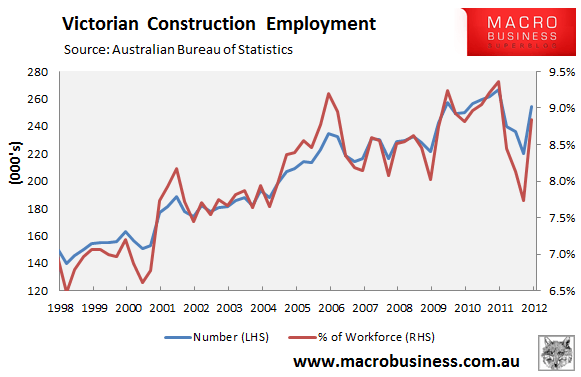
In addition to the completion of various big ticket infrastructure projects, the state is also facing a hit in new house construction, with both house approvals and new house sales falling sharply since mid-2011 (see next chart).

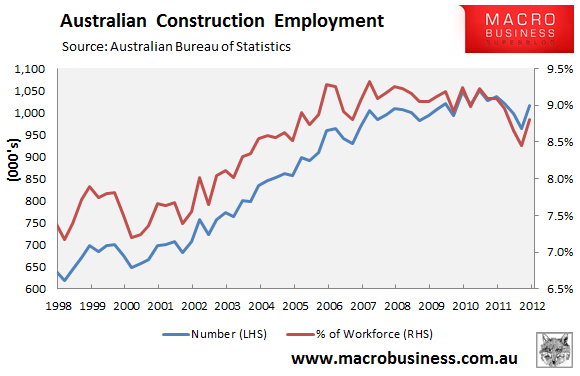
Nationally, the construction industry employs nearly 9% of the workforce, with the employment share having increased sharply since 2003 as the mining boom took hold (see next chart).
Victoria is fast becoming a little China with all of the shortcomings of that growth model. When fixed-asset expenditure drives growth it must increase each year or withdraw from activity, hence sooner or later bridges end up being built to nowhere. Not that Victoria is there yet but if investment is directed only at building for its own sake, rather than productive factories or capital deepening, you simply have to keep building to grow.
With the mining investment boom soon set to peak, and the new house-and-land market remaining in the doldrums, there is the risk that the situation playing-out in Victoria could soon be replicated across other parts of the country.
