
Sorry, missed this yesterday. The quarterly ACCI was out yesterday and showed weakening manufacturing conditions in the December quarter:
The Westpac–ACCI Actual Composite declined to 50.7 in the December quarter, from 51.9. The deterioration in the Composite highlights the pressure manufacturers are under given the strong dollar and soft non-mining sector.
- The Expected Composite also moderated in the December quarter, from 53.3 to 52.5. The level of this Composite suggests that manufacturers expect further (albeit modest) growth in the March quarter.
- Expectations of ‘general business conditions’ deteriorated in the December quarter, with a net 1% reporting that they expect the business environment to deteriorate in the coming six months. The current outcome is well below the prior quarter, but around the average of the series.
- Overall, the activity indicators point to modest growth in the manufacturing sector in the December quarter, and an expectation of further near-term growth. That said, it is clear that respondents are concerned over the outlook.
- The Labour Market Composite increased modestly, solely due to a jump in actual overtime. It remains consistent with modest employment growth, and a stable unemployment rate. Labour was also seen as being slightly harder to get, suggesting a potential skills mismatch in the sector.
- Despite the strength of the Australian dollar, export conditions improved a touch in the quarter; they are expected to improve further in the March quarter. Both of these series remain well below their long-run averages; also, export expectations are often disappointed.
- Australian manufacturers’ profitability remains under pressure. Profit expectations deteriorated sharply in the December quarter, from a net balance of 13% to –9%. Cost increases are being felt across the sector. Soft demand and a high Australian dollar are impairing firms’ ability to maintain margins. Soft wage growth and lower commodity prices are two positives for the sector.
- With activity pulled forward into the September quarter, and given soft activity growth and margin narrowing, it is not surprising that the December quarter saw a deterioration in investment intentions. Spending is expected to decline in 2013, consistent with the 2012/13 manufacturing CAPEX estimate from the ABS.
- Australian manufacturers have certainly benefited from the past year’s rate cuts. This is particularly true for those in the sector who are exposed to the housing market, which is now in an uptrend. However, with conditions soft, further monetary accommodation is required.
The ACCI is a bigger survey than the monthly AiG PMI so the results are somewhat encouraging that manufacturing has been faring better than the perpetual recession apparent in the PMI.
Still, there is one chart that shows things are not at all well and is a serious concern for next year when mining investment begins to decline. It is this one, investment intentions:
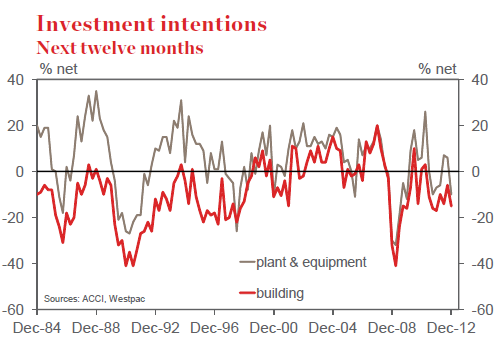
These are recession levels and are reinforced by similar readings in the ABS capex survey. Manufacturing is not prepared (yet at least) to contribute to any rebound in non-mining investment.
