
There’s no doubting the chutzpa of the Minerals Council of Australia (MCA). In 2010 it led the campaign against the RSPT that ended with the downfall of Kevin Rudd and the rebooting of the mining tax as the waste of time called the MRRT. If Rio Tinto can self-confessedly produce iron ore for $24 a tonne, the tax now kicking in somewhere above $120 gives you a idea of the absurdity of it all.
Now, I had my problems with the structure of the mining tax, it was overly-complex and bordered on expropriation in its structure. But that was a tactical objection not strategic. We should still have had a mining tax, a more simple and better managed one, to address the following:
- delivering a fair dividend to the Australian people for depleting non-renewable assets
- to provide a fiscal mechanism to help contain the dimensions of the boom
- to channel funds offshore and help control the dollar
Each of these outcomes would not have cured the growing pains experienced because of the boom but would certainly have helped.
One of the leading economic figures in the campaign to destroy (as opposed to restructure) the RSPT was the economist Henry Ergas. Now he is back. This time in the open pay of the MCA, producing a new document “Rebooting the Boom” which is a series of demands of the government to fix many of the problems arising from mining growing too fast:
- rising labour costs
- delayed project approvals
- infrastructure
- fiscal Federalism
…even within the current equalisation framework, there must be questions about the treatment of mining revenues. Those revenues are associated with sale of a depletable resource; they are, in other words, a balance sheet transaction rather than current income. The income component of sale is the change in the present value of State assets, not the receipts from royalties; to include all of those receipts in the revenue base that is equalised penalises those States whose primary assets are exhaustible resources. Moreover, by doing so, it can undermine their ability to undertake investments that would maximise the value of the State’s assets.
Taxing non-renewable assets is desirable so long as it benefits mining profits it seems.
Finally, if you want to know the magnitude of the growth drag ahead for Australia if no new mining projects come online (and some will, just not iron or gas), check this out:
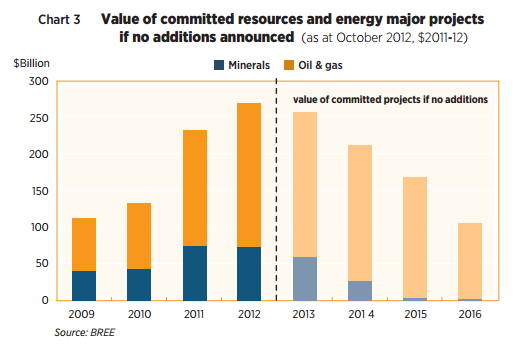
This is the stock, not flow, of projects but gives you an idea. That’s a roughly $175 billion draw down in the stock of mining investment over the next four years, some 15% of GDP. Better get building those houses.
