

For many years, too much focus in the investment industry has been on the return on your capital, or upside risk, which is to be expected given the nearly 30-year-long bull market in equities and houses; a typical Australian investor’s core source of wealth. The only trend towards a more productive use of this capital has been reducing the fees on the investment managers and advisors, which is why industry-run super funds and DIY investing have become so popular.
Yet most investors’ focus on the known downside has not been extended to the unknown downside. While we’ve been focussed on saving a portfolio’s steady 1% erosion by fees and commissions, most of us have not given thought to eliminating the unknown, but not uncommon, 10-20% falls that can strike at any time: the so-called tail risk.
This is where the concept of opportunity cost really comes into play, because over a very long time period, such as in a superannuation environment where a 20% loss requires a 25% return to get back to even, with hedging you could have been making 5-6% p.a. during the losing periods:
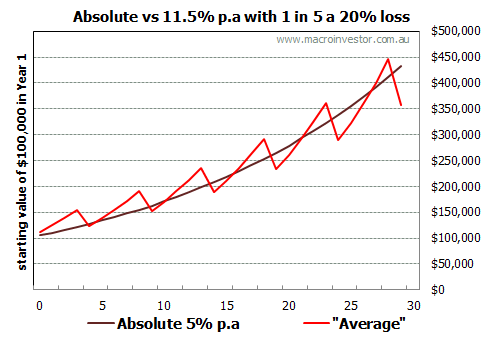
As we can see in the above, someone who has limited their downside – say to no more than 5% – can make this up relatively quickly but doesn’t require the additional outsized returns.
So how do you hedge your portfolio? The range of short instruments (i.e. instruments with the ability to sell the value of something and profit on a fall in price) available to the Australian retail investor is much more limited than overseas. There is one relatively simple ETF, provided by Betashares, called the BEAR Fund, which is worth looking at.
Though catchy, the name is a misnomer as the demand for this product should come from bulls, not bears. Bears already have a perfectly good strategy – staying out of the market – but bulls will benefit as they now have a simple and relatively low-cost way to hedge the downside volatility of their share portfolios.
The BEAR is not strictly an exchange-traded fund, but a rules-based managed fund, with around 90% of its funds in cash/cash equivalents and the remainder in ASX SPI (share price index) futures. It provides a simple inverse position in the ASX200 by shorting these SPI contracts, and being a very large market (they provide wholesale investors and institutions the ability to hedge their own positions) they are also very liquid.
Using this structure, for every dollar the underlying ASX200 index goes up or down, the BEAR goes down or up inversely with a small margin of error due to daily rebalancing; something to be noted if you have a large position or require precise returns.
The BEAR is otherwise traded just like a share during the day (and that’s its ASX Code: BEAR) using any major broker. The minimum investment is $500. As for other ETFs, liquidity is not an issue as Betashares is a market maker and must provide units at the prevailing Net Asset Value (NAV), but a small spread between the buy and sell quotes of about 3 cents can be expected.
There has been no objection by the ATO to the use of the BEAR by superannuation funds because there is no charge or borrowing involved. The way the product is structured, unlike futures or other derivatives, the maximum loss the investor can take is the purchase price of the unit.
Nonetheless, given this product is designed to be used in a shorting strategy, your risk management must be tighter and more prudent than usual. And with higher than usual fees and relatively opaque internal costs, this is something worth noting.
Unlike an index fund or any other exchange traded fund that only needs to directly buy or sell its underlying investment to maintain a balance, the BEAR does so with futures contracts, which implies a higher level of management skill and responsibilities. That said, the current total annual fee of 1.38% does seem very high for what is effectively a plain-vanilla strategy.
To give an example, if you purchased $25,000 worth of BEAR units in late May 2011, when the ASX200 crossed below 4600 points, and held them for a year this would be the outcome:

While perhaps increased popularity could reduce costs, as funds under management increase and hence expenses reduce, its entry into the market could have been done at the top in the current cycle, as funds under management increase and hence expenses reduce. There are two points to note about this cost however. The first goes to the average longevity of an investment in BEAR, where it is more likely to be of a medium-term than long-term in nature. The second is in comparison with other products like CFDs and options the costs involved are less transparent, including spreads and borrowing costs.
As for the risks, obviously the biggest one is if the share market shoots up in price. This negative correlation is something that might take many investors some time to get used to, and the best way to mitigate that risk is to set a stop loss before you make an investment, i.e. decide how much you are willing to lose.
With the failure of MFGlobal and PFGBest (not to mention their regulators) in mind, the counterparty risk must also be closely examined. In the case of SPI futures, Betashares are dealing with the ASX Clearing Corporation, and are backed by Mirae Asset Global Investment Group, based in Seoul. Even though both are reputable and Mirae has over $50 billion in funds under management, in this day and age it is clear that you cannot guarantee the returns of your funds, so I would place the counterparty risk of the BEAR Fund alongside that of any CFD or option contract. Under the Macro Investor capital management rules, this would mean no more than 10% total portfolio exposure.
Chris Becker is an investment strategist at Macro Investor, Australia’s leading independent investment newsletter covering stocks, trades, property and fixed interest. Macro Investor provides daily trading updates, as well as allocation advice for effective portfolio hedging. A free 21-day trial is available. This is an op-ed in the Fairfax press.