


As H&H mentioned yesterday it’s time again for the the Mid-Year Economic and Fiscal outlook. The headline news was that since the budget was announced approximately 6 months ago slowing economic activity and falling commodity prices have led to a $3.9 billion fall in tax receipt estimates for this financial year, and a $21 billion downgrade over forward estimates.
With its on-going promise to bring the budget back to surplus in the 2012-13 FY the government has again announced spending cuts and tax hikes in order to fill the fiscal gap. This time around the adjustments include changes to company tax schedules, adjustment to private health insurance, cuts to family tax payments and a decrease in R&D investment. I’m not going to go through the entire list of changes, but if you are interested you can find them here , here and here.
I’ve been covering both the budget and the MYFEO for a few years now and this latest document is certainly on-trend in terms of what we’ve seen Wayne Swan deliver previously. To give you an idea of what I’m talking about this is what I said when appraising this year’s budget back in May:
Over the last 12 months I mentioned numerous times that I thought the Treasury was continually under-estimating the effects of the disleveraging public while overestimating the offsetting strength of the capital investment boom. There isn’t much in last night’s Budget to suggest that they have adjusted their forecasts that much. My assumption is that there is now an expectation that the lowering of interest rates and some focussed fiscal stimulus will get middle Australia back on the “borrowing path”, but this is quite big ask in my opinion. Although Treasury has somewhat acknowledged the global environment in its estimates it doesn’t seem to have acknowledged the effect of its own fiscal tightening. A 3.1% GDP turn-around in budget will not be without flow-on effects.
….
The saving in the budget are quite strategic, with major spending cuts focussed on overseas payments while low-to-middle income earners get a bit of stimulus, which, ironically, may actually delay some of the rate cuts that also assumed in the Budget. Ultimately if the households and businesses of Australia aren’t willing to pick-up the fiscal slack then it is quite possible that the next MYFEO will be as disappointing as the last.
And here we are, discussing yet another round of fiscal trimming.
Over the last few years Treasury has made a habit of making optimistic predictions based on the idea that overall growth and household expenditure is going to return to something like pre-GFC “normal”. This obviously hasn’t transpired which has meant that forward estimates continue to get pushed out while new taxes and spending cuts are announced with every revised budget release.
Below is the budget projection chart from April 2011 showing forward estimates of a predicted turn-around of the deficit by $14.2 billion over 11-12/12-13 under the assumption of 4.0% growth over 2011-12:
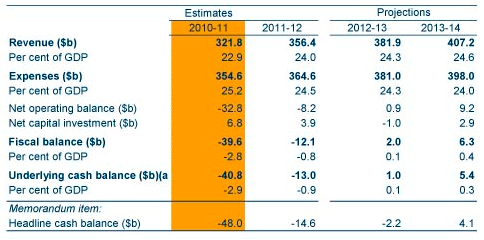
This obviously didn’t occur and if you compare this to a similar chart from the latest budget you can see the significant slippage in the fiscal balance over the 10/11 and 11/12 period. Yet, even with lower GDP estimates, the fiscal turnaround is now expected to be nearly 3 times larger:
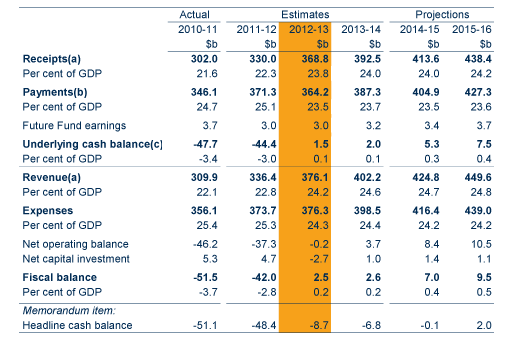
The latest MYFEO once again displays the same trends:
Since the 2012‑13 Budget, the Government has made a further $16.4 billion in targeted and responsible savings to return the budget to surplus in 2012‑13 and deliver small but growing surpluses across the forward estimates. These decisions have contributed to the small change in real growth in payments in 2012‑13 compared with the 2012‑13 Budget. In total, real growth in payments is estimated to be ‑4.4 per cent in 2012‑13, compared with ‑4.3 per cent in the 2012‑13 Budget.
So in the face of falling terms of trade and an associated rising current account deficit there appears to be an on-going expectation that the government can simply tighten the fiscal screws in order to push the budget back into surplus. Penny Wong said as much yesterday:
Earlier on Monday, Finance Minister Penny Wong said spending cuts in the budget update would give the RBA room to cut interest rates if necessary. Senator Wong said the government was mindful of the potential impact on economic growth that higher taxes and spending cuts could have on the economy. But she said Labor was still committed to returning to surplus.
In other words the government expects the RBA to lower rates and therefore the private sector to dis-save and borrow to fill the growing fiscal gap even though there is mounting evidence that this may not be the corresponding response. The risk is that as the positive terms of trade effect fades this “unexpected” non-response will become even more prominent. I note in the MYEFO that Treasury is estimating only a minor uptick in unemployment over forward estimates but my opinion is that this is underestimating the income effect of the mining boom ( see here for more ) along with the fallout from fiscal tightening at both a State and Federal level.
In summary, this MYEFO suffers from the exact same issues as previous budgetary documents. The government still appears to think that the private sector has an appetite to actively expand its balance-sheet and therefore its own plans will have a limited and/or no effect on overall economic output. The fact that this has proven incorrect over the last few years and therefore the budget isn’t performing as expected doesn’t appear to have trampled that resolve.
I have seen this all before. In peripheral Europe.