
There is a reason why mining so completely dominates the hearts and minds of the Australian business and economic debate. Beyond the fact that prospecting fits the national love of gambling that reason is the Minerals Council of Australia.
Yesterday it produced another of its agenda-setting commissioned research reports that have a habit of appearing with exquisite timing to lend (a paid for) third party endorsement to whatever agenda it happens to be pushing on behalf of its members.
Yesterday’s Port Jackson Partners report on what Australia needs to do to recapture its mining competitiveness got a great run all day and a rubber stamp from the Mining Minister.
The report agues that rising wages and falling productivity jeopardises another phase in Australian mining investment and recommends the following:
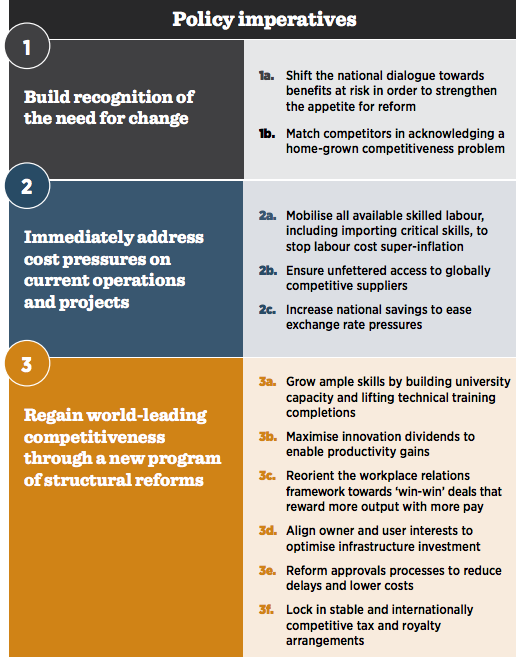
Aside from the self-serving demand for less tax, what self-respecting economist would argue with these suggestions?
Yet, there is a wee problem here. Although I agree with most of the above recommendations, I do not agree that it has anything – at all – to do with mining. These are generic economic challenges that need to be addressed and should not be placed within a context of targeting mining investment. Rather they should be about making the Australian economy more competitive for every sector.
Does it matter? Well, yes, it does. When the Minerals Council brands this agenda it presupposes that mining is the principle sector in need of these reforms and that the mining specific dimensions of the reform are part and parcel with that agenda.
That, it seems to me, is what economic discussion likes to call “picking winners”. Mining already dominates the national economic discussion and capturing this debate as well is not healthy. Take, for example, the description of what is required for Australia to prosper in the years ahead by Paul Kelly after last week’s boffinfest at the China Century pow wow:
With the peak of the commodity price boom over, Australia’s task is to maximise the resources trade yet diversify its economic strategy to agriculture, food and services cognisant of the expanding Asian middle class off the back of China’s industrial revolution.
That looks like a pretty narrow set of options to me.
And then there is the ongoing obsession at the AFR that seems to assume that only mining has a cost problem. I could pick any number of examples of stories from the past few weeks but today’s uncritical approach from Jennifer Hewitt is typical:
Certainly the Minerals Council of Australia, which commissioned the report, was unlikely to ever argue that current policies are making the most of Australia’s opportunities in resources. Nor does it mean that Australia ever can or should compete with anything like wage levels in developing countries.
But the recent record still challenges any comfortable assumptions that Australia’s magnificent natural advantages mean the resources boom will underpin prosperity and jobs indefinitely. Or that the nation’s reputation of just a few years ago – as a relatively efficient, low-cost producer – will ever return even if the demand for minerals remains strong for the next few decades.
Well sure, but what of the irony that Hewitt is discussing a Minerals Council report which is itself putting mining at the centre of our assumptions about future growth (again), comfortable or otherwise?
The obsession with picking a mining winner is also distorting the debate in two other important ways. This debate has been triggered by falling commodity prices. It is quite possible that many of these prices are falling because the demand-growth assumptions associated with China’s rise have been over-estimated by miners. That is, that some material portion of the current investment boom is, in fact, mal-investment, and will need to be rationalised, globally. This is the possibility that is being cotemplated by the smartest economists I know and if it’s the case then picking a mining winner at this stage is pretty damn stupid.
What we should be discussing right now is how to lower the Australian dollar. It is by far the single most uncompetitive factor in our economy. If the dollar were falling, as it should be, to 90 cents or so, then tradeable profits would surge, labour costs tumble and investment become infinitely more attractive for all sectors. If mining does face a reckoning then we’ll need other tradeables to grow into the proverbial deficit left behind by Dutch disease.
Instead, in part because we’re obsessed with picking a mining winner, it’s as if we see ourselves as a peripheral European nation, trapped in someone else’s structurally overvalued currency with the only option being internal deflation to increase competitiveness of the fading boom sector.
Australia does not need to be bending over backwards to attract mining investment. It needs to be bending over backwards to restore competitiveness, innovation and productivity, period.
