

The Australian Bureau of Statistics (ABS) has just released the labour price index for the June quarter of 2012. According to the ABS, in trend terms total wages (excluding bonuses) increased by 0.9% over the quarter, with private sector wages rising by 1.0% and public sector wages increasing by 0.8%.
Over the year, total wages (excluding bonuses) have increased by 3.9% in trend terms, with private sector wages rising by 3.9% and public sector wages growing by 3.1%.
A chart plotting the growth rates over time is presented below.
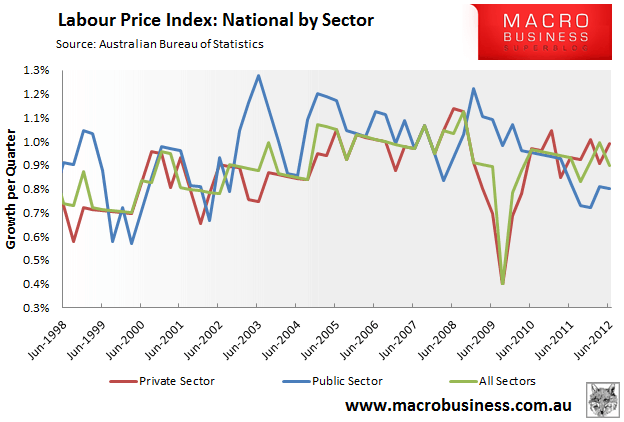
For me, the most interesting aspect of this chart is that public sector wages had until recently grown at a faster rate than private sector wages. As expected, public sector wages growth is also far more stable, experiencing little downwards adjustment during the Global Financial Crisis, although it has started to trend down recently as state governments began trimming their budgets.
At the state level, data is only provided in original (non-seasonally adjusted) terms, which makes it very volatile. Accordingly, the below chart tracks wages growth in the mainland states on a six month moving average basis:
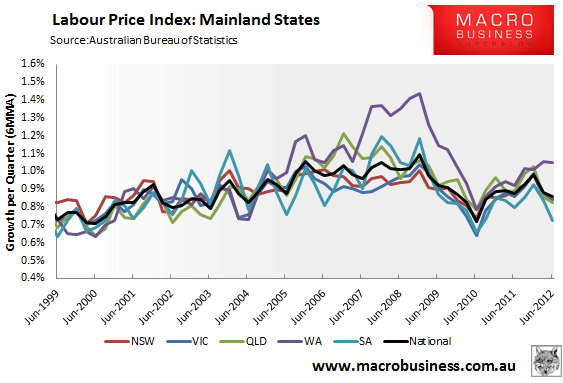
Not surprisingly, wages growth in Australia’s resources capital, Western Australia, has typically exceeded the national average. And reflecting this fact, wages in the mining and construction sectors – which are both dominated by Western Australia – have also grown the fastest over the life of the series:
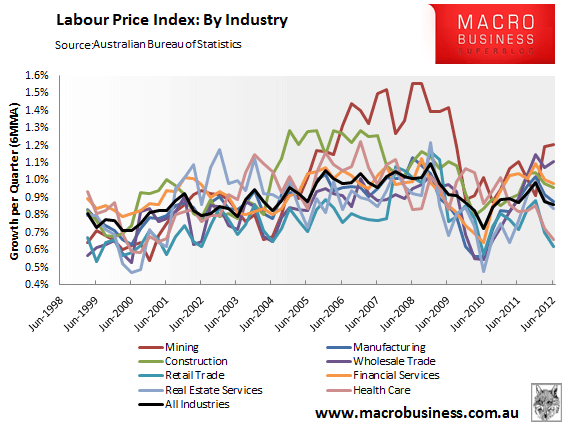
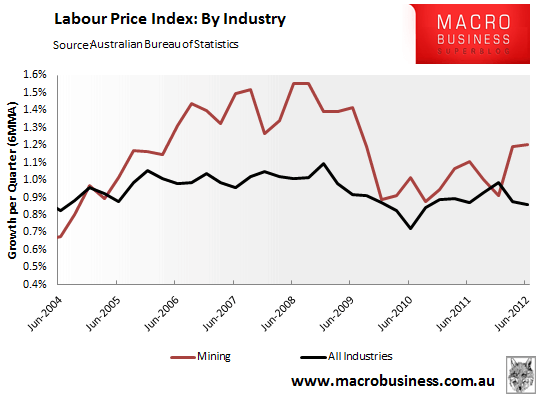
If you look closely at the above chart you will see that wage growth in every major sector, with the exception of mining and wholesale trade, has decelerated over the June quarter. Mining wages growth has also grown at a rate well above average since Australia’s commodity price boom commenced, increasing by 49% since March 2004 versus 36% for the economy as a whole:
Twitter: Leith van Onselen. Leith is the Chief Economist of Macro Investor, Australia’s independent investment newsletter covering trades, stocks, property and yield. Click for a free 21 day trial.
