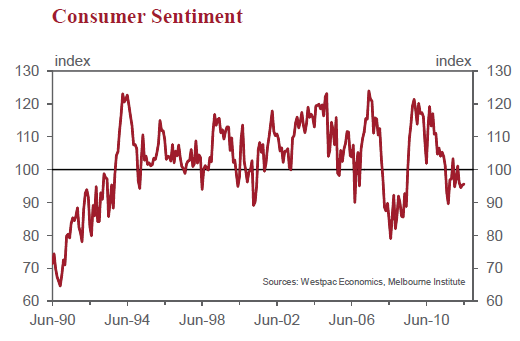
Westpac Consumer Confidence for June is out and shows a measly 0.3% increase in confidence to 95.6. Here are the survey internals:
Bill Evans sums it up better than I can:
This is another disappointing result. It follows a second consecutive cut in the official cash rate by the Reserve Bank. Sentiment has risen only 1.1% from its April level and remains 1.7% below the level recorded in October last year despite a 125bp reduction in the cash rate that has brought the average standard variable mortgage rate down by nearly 1%.
Clearly other factors are dominating rates in the minds of consumers – those factors are concerns about the domestic economy and international conditions.
The June survey included additional questions on ‘news’ categories recalled and whether news was assessed to be favourable or unfavourable. The results show negative news around the economy and international conditions dominated. By far the highest recall was on news about ‘economic conditions’ (67.1% of respondents) and ‘international conditions’ (40.4%). The recall level on economic news was the highest since 2009 and roughly double that of news items on ‘interest rates’ (31.8%) and ‘Budget and taxation’ (34.7%). The recall on ‘international conditions’ was second only to the record high registered in December last year. Consumers continued to view news on both ‘economic’ and ‘international’ conditions as very unfavourable with the latter seen deteriorating sharply since March.
Across the five sub-indexes of consumer sentiment, two improved and three deteriorated. Lower interest rates saw a solid rise in the sub-index tracking responses on ‘family finances vs a year ago’ (up 4.6% after a 17% rebound in May), and ‘time to buy a major household item’ (up 7.5%). However, June saw a significant deterioration in the sub-index tracking consumers’ forward views on their family finances (down 7.7%) and the sub-index tracking views on the economic outlook over the next 5 years (down 3.8%). Notably though, responses on family finances continue to track at very weak levels 7.6% below their pre rate cut levels in October last year.
Responses to questions on ‘time to buy a dwelling’ and ‘time to buy a car’ both showed an improvement in June, with these indexes rising 8.2% and 7.5% respectively. Lower interest rates and lower prices are clearly improving affordability and buyer sentiment on both fronts although buyers will tend to be reluctant to follow through on purchases while there are concerns about the economic outlook and job security.
The Reserve Bank Board next meets on July 3. On May 31 Westpac revised down its forecast for the low point of the official cash rate in this cycle from 3.25% to 2.75%. That was in response to a further deterioration in the global economic outlook and our assessment that confidence in the domestic outlook had continued to soften despite further rate cuts. Evidence from today’s survey confirms the fragility of confidence and the critical role played by the global economic situation in impacting confidence.
Our interest rate view includes a likely further cut at the meeting in July. However, with the surprisingly strong GDP print for the March quarter the Board may choose to delay the next move until after the next inflation report due out on July 25. That decision will be heavily dependent on global developments over the next three weeks. At this stage we are comfortable in maintaining the July call while emphasising that the case for an eventual cash rate of 2.75% remains robust.
David Llewellyn-Smith is Chief Strategist at the MB Fund and MB Super. David is the founding publisher and editor of MacroBusiness and was the founding publisher and global economy editor of The Diplomat, the Asia Pacific's leading geo-politics and economics portal.
He is also a former gold trader and economic commentator at The Sydney Morning Herald, The Age, the ABC and Business Spectator. He is the co-author of The Great Crash of 2008 with Ross Garnaut and was the editor of the second Garnaut Climate Change Review.