

There is nothing quite like an industry sponsored economic study to exersise the Australian media. Today it’s the oil and gas sector, more specifically LNG, that has ye old lady of the night plumping its bosom. First up it’s the AFR:
A report, prepared ahead of a Canberra resources conference today has found that $185 billion of spending in the oil and gas industry is trickling down to states not directly linked to the resources boom.
“There is this feeling in the public discourse about the patchwork economy – that this is a bad thing,” said Australian Petroleum Production & Exploration Association chief executive David Byers.
“But we need to ensure the well-performing sectors, like oil and gas, are not held back,” he said.
…The APPEA report, by Deloitte Access Economics, said eight of the 14 gas liquefaction plants under construction or fully committed around the world were in Australia.
The industry would invest an average $23 billion a year between 2009 and 2017. By 2020, those projects would be adding about 3.5 per cent to the economic growth, up from 2.1 per cent last year, the report said.
…As the investment phase of the LNG boom intensifies, employment in the industry is forecast to peak this year at 103,000 full-time equivalent jobs, before falling to 11,500 by 2025.
The spending estimate looks reasonable but there’s some inconsistency here, obviously. If the boom is so inflationary, why is employment going to peak this year and then lose 7,000 jobs per on average? Also, to date, BREE, the government entity responsible for tracking these projects, with whom I had along chat last week, reckons that there are currently seven not eight major projects that they consider committed. That means they have capital in place, government approval and signed sales contracts. According to Bree, the construction phase is on average five years. BREE listed the seven for me with start dates and total expected capex:
- Gorgon, Sep 2009, 43 billion
- B&G, Sep 2010, 20 billion
- Santos Gladstone, Jan 2011, 15 billion
- Shell Prelude, May 2011, 10 billion+
- Origin’s Australia Pacific LNG, July 2011, $14 billion
- Chevron’s Wheatstone, Sep 2011, $29
- Inpex’s Ixthys, Jan 2012, $34 billion
An analysis commissioned by the industry finds that by 2016 investment in liquefied natural gas will add 2.2 per cent to gross domestic product growth.
…At present amounting to 2 per cent of Australia’s GDP, by 2020 when production and prices peak, oil and gas should be worth 3.5 per cent of the economy.
Capital expenditure is expected to average $23 billion in capital outlays per year until 2017. Output of oil and gas is expected to peak at $46 billion in 2020. The report says that as a result, GDP should increase ”significantly above the reference case”. By 2016 GDP is expected to be 2.2 per cent higher than it otherwise would have been. The finding implies pressure to push growth up from its long-term average of about 3.25 per cent to near 5.45 per cent, well above the level with which the Reserve Bank is traditionally comfortable.
Hmmm, there’s some more dodgy arithmetic here. How do we get from 3.25 to 5.45 GDP? Presumably we take trend growth and add the estimate of the output of the expanded sector. The question is, why on earth would you make such a silly calculation? If the past eighteen months is any guide, trend growth will be well below average in most of the economy and even when it breaks out in sum, it’ll be driven by the inclusion of the vast capex investment, not added on top. This is a text book example of what is wrong with all of these industry commissioned studies. They distort reality by using what economists call “partial analysis”.
Meanwhile, at The Age, the same “study” was somehow attributed to the RBA:
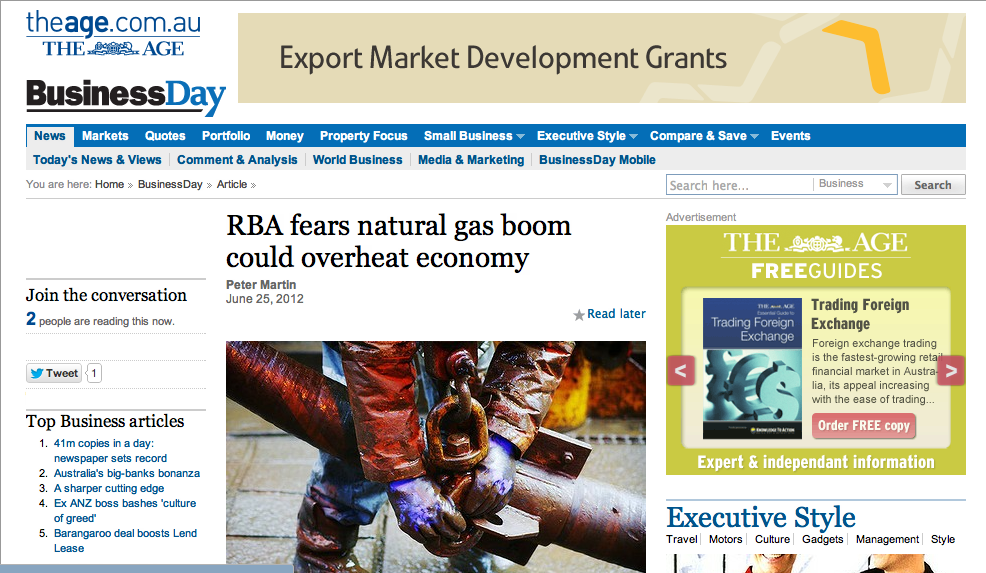
Noice! Especially since it was the RBA who recently shifted downwards its medium term framework for the effects of the mining boom on inflation, based largely on the LNG boom not delivering owing to a heavy reliance on imports. From Phil Lowe:
So, to summarise, the overall picture is one in which aggregate demand has grown strongly, and is expected to continue to do so. However, a higher-than-average share of that growth in demand is being met through imports, not only because of the high exchange rate but also because of the heavy weight of resource sector investment in overall demand. Partly as a result of this, as well as the direct effects of the exchange rate appreciation on the prices of imported goods, the recent inflation outcomes have been subdued.
…The overall conclusion from this work is that given the huge pipeline of mining investment and the current relatively low unemployment rate, it is likely that conditions will continue to vary significantly across industries for some time to come. This work also serves as a reminder that improving productivity growth remains the key to strong output growth in the non-mining-related parts of the economy. It also suggests that there is some scope for non-mining-related demand to grow a little more quickly than has been the case in the recent past.
THE number of resource projects under construction will drop from 98 now to just 13 by 2015 if the worsening global outlook prevents further projects getting the go-ahead.
This estimate by the federal Bureau of Resources and Energy Economics underlines the vulnerability of the investment boom that is lifting Australia’s economy above its global peers.
…The pipeline of projects in the planning stage and awaiting go-ahead has remained at about $250bn since 2009, with new projects filling the gaps as the big LNG projects moved to construction. The backlog includes another 12 LNG projects worth about $45bn, 33 iron ore projects worth $50bn and 73 coal projects worth $40bn.
…The build-up of of liquefied gas projects in Australia means investment will keep rising over the next year. But beyond that the level of business investment in the resources sector will start to recede from its all-time peak of 9 per cent of GDP, subtracting from economic growth.
The BREE estimates…the value of projects under way will fall from this year’s $261bn to $149bn by 2015 and to just $34bn by 2017.
This marks the most extreme possible fall in investment…
LNG wants to let other industries collapse so that it can have cheaper labour. If you think the gas boom goes forever that makes sense for the nation. If you don’t, it doesn’t. Sense lies with the latter, in my view. But on today’s media effort you’d never know: APPEA 1, national media 0.
