Last week I wrote a post about a stumbling US economy:
In mid November I wrote a piece called Can the US consumer carry us all. It was following the release of good October retail sales growth and argued the following:
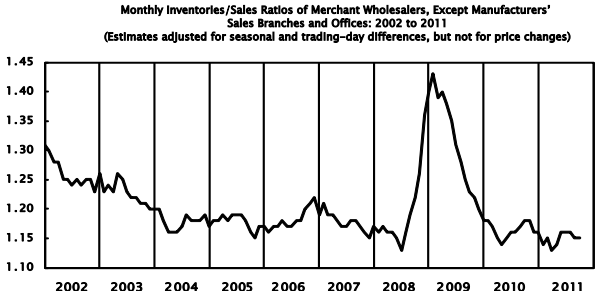
This demand appears to have caught producers off guard, or, they have been managing inventories rather well. The September wholesale inventory number last week was low and the inventory sales ratio is also subdued:
This suggests that the unexpectedly strong (relatively) demand, will have to be met with an upswing in production rather than existing stocks. In turn, we could see extra jobs created that will add to the Christmas hiring season that has already matched pervious years.
I can see this mini-cycle continuing to make a small dent in unemployment (as well as support Chinese exports through year end). It is, not, however, a resilient bounce. Check out these personal finance charts from the US Department of Commerce.
Personal income growth is running at about 3%, below inflation. Note as well that personal savings have begun to fall. Outside of cars and student loans, consumer credit has fallen in the last three months so I conclude that the current round of consumption is funded largely from a savings rundown, following the big spike post GFC. We’ve been here before, of course, and such cycles can run for longer than anyone expects so we can’t discount that possibility.
As we look back, this proved a remarkably accurate assessment. Q4 GDP was driven largely by a big inventory rebuild which boosted the regional Fed manufacturing indexes from their Q3 slump and we’ve also seen a nice burst in employment.
Note that I described this as a mini-cycle because in the new normal such bursts of consumer spending cannot sustain a high growth virtuous cycle. Without asset price inflation to drive consumers’ sense that their wealth is growing faster than their debt, savings rundowns always reverse.
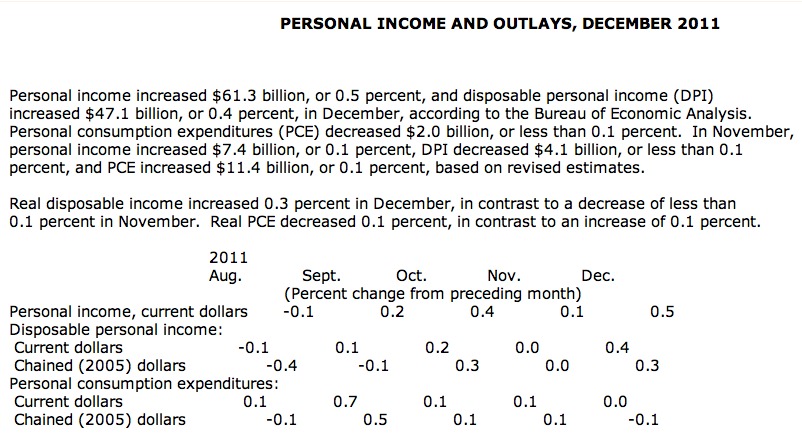
And now it appears we are there again. Last night’s release of Personal Income Expdenditures (PCE) showed that that give back began in December. From the BEA:
That’s a nice bounce in incomes, well up from the October growth rates, which suggests that the US certainly remains in recovery. But consumer spending has stalled as consumers return to tucking away this income boost as savings. Also from the BEA:
Personal saving — DPI less personal outlays — was $460.1 billion in December, compared with $407.8 billion in November. The personal saving rate — personal saving as a percentage of disposable income — was 4.0 percent in December, compared with 3.5 percent in November.
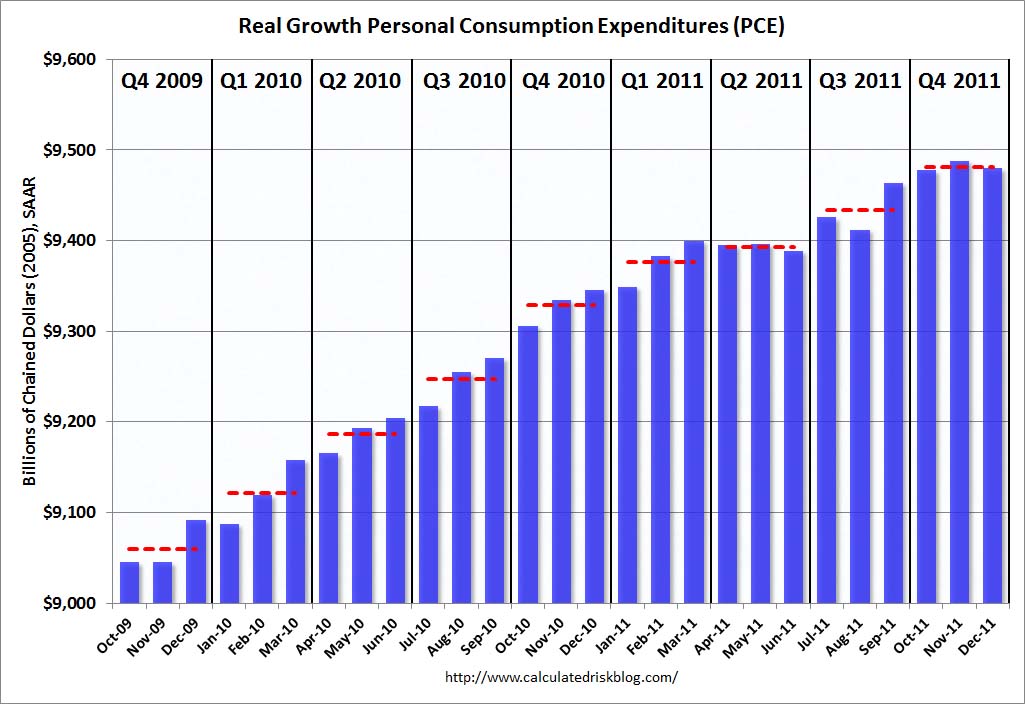
Here is a handy chart from Calculated Risk that illustrates the stalled spending point nicely:
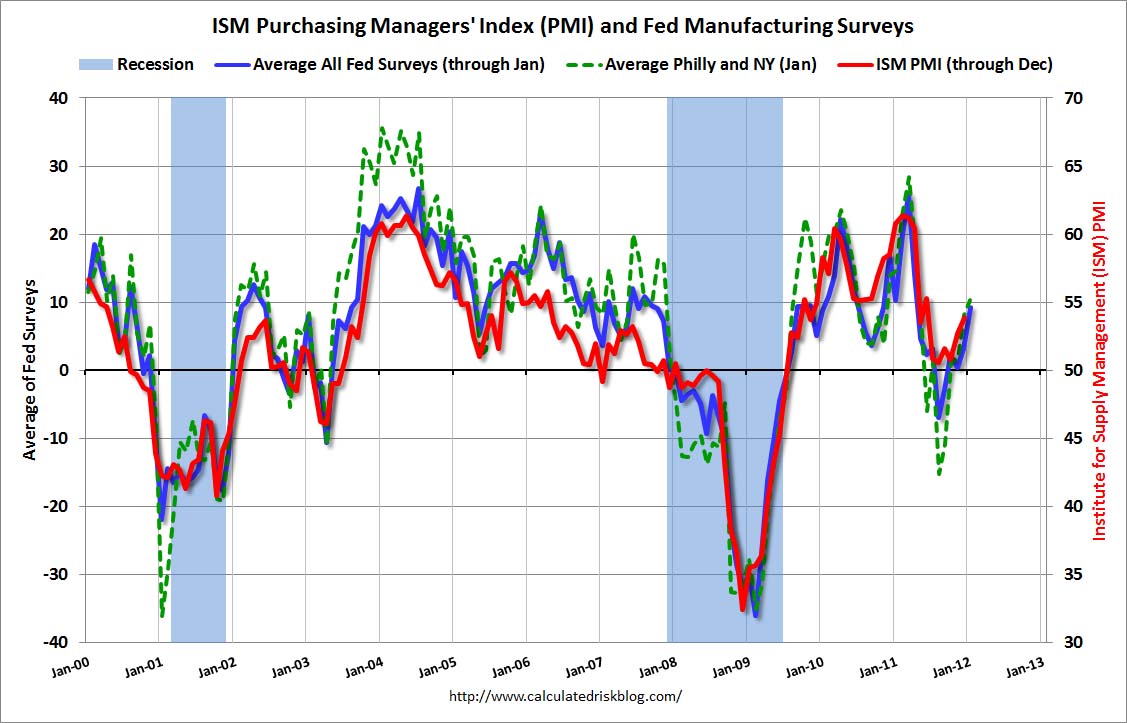
That is not a very nice tapering and with inventories now largely rebuilt you have ask what will now drive growth in the 3% range in the next quarter. Although inventories may not now run down again, they are also unlikely to rise unless consumers resume their dissaving. That’s not going to happen without house price rises and that’s still some way off in my view. That says to me that the mini-cycle in the Fed regional manufacturing indexes, which has been pretty muted relative to past bounces, hasn’t got much further upside either, especially so given the weak demand abroad. Another chart from Calculated Risk makes the point:
We’ll certainly see a decent ISM reading this month but I will not be at all surprised to see the indexes weaken in the next month or so. The upside looks capped.
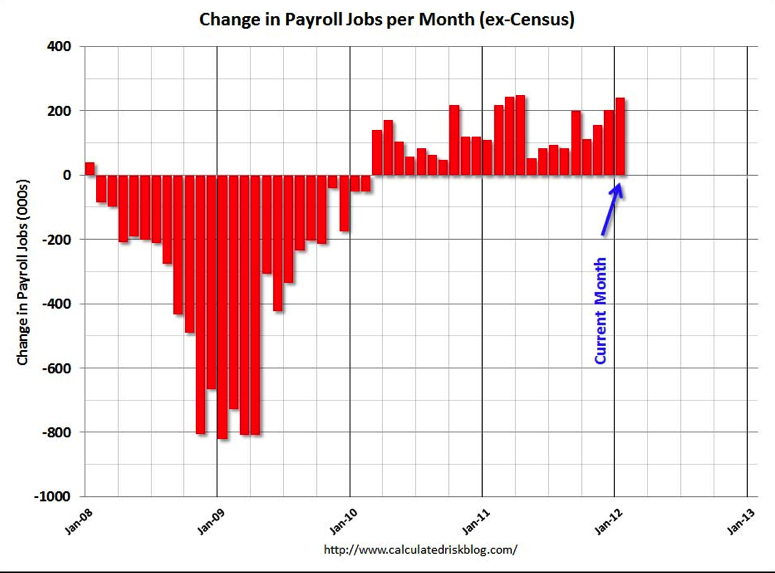
On Friday, to my complete lack of surprise, the BLS released nice jobs numbers for January following this mini-cycle. From Calculated Risk:
Advertisement
However, it’s an open question whether or not this can transform itself into a virtuous cycle of accelerated recovery. I can certainly see the stock market going hog wild, after all, right now it’s got the mini-cycle to party on, improved industrial data globally and the recently reiterated Bernanke put standing behind it. And, in a traditional cycle, you expect such a rally to be answered in the real economy as wealth effects take hold.
However, we are not in a traditional recovery. We are in an epic post-bubble secular deleveraging cycle in which savings have become a very important component of consumer wealth. I do not expect the fizzy stock market to lead a bounce in spending nor do I expect the US housing market to rush back this year.
Am I open to the possibility of the US economy accelerating? Yes, if consumers run down their savings and resume borrowing. Do I think it’s going to happen? No, I don’t. Is there enough evidence to say it’s happening now? No, we have evidence for a mini inventory cycle following the debt-ceiling freeze. We need several good months of income and employment growth to convince that this is now self-sustaining virtuous cycle.
David Llewellyn-Smith is Chief Strategist at the MB Fund and MB Super. David is the founding publisher and editor of MacroBusiness and was the founding publisher and global economy editor of The Diplomat, the Asia Pacific's leading geo-politics and economics portal.
He is also a former gold trader and economic commentator at The Sydney Morning Herald, The Age, the ABC and Business Spectator. He is the co-author of The Great Crash of 2008 with Ross Garnaut and was the editor of the second Garnaut Climate Change Review.