I noticed an interesting common theme in a number of the posts this morning which I think is worth highlighting to readers as it is one of my key areas of concern over 2012.
In assessing the impact of the ECB’s actions, some commentators focus on the size of banks’ deposits with the ECB as a measure of their effectiveness. If these deposits are rising, the assessment is that the ECB’s actions aren’t working, because the banks are just parking their money at the ECB and not lending it to the real economy.
Such an assessment is inaccurate. The size of the banking system’s deposits with the ECB is completely determined by the ECB’s liquidity operations. On the ECB’s balance sheet, the assets it generates by lending to the banking system must also appear on the liabilities side as bank deposits with the ECB. That is, once the ECB has done its liquidity operations, the size of ECB balance sheet is what it is. The amount of deposits provides no real information above and beyond the net amount the ECB has injected into the system, which is already known. It does not tell you anything about what the banks are doing with the funds they have borrowed from the ECB. Or about how many times those funds circulate before ending up back at the ECB.
This is true of all central banks, not just the ECB. A similarly misleading statement is often made about the Fed, with bank deposits ‘piling up’ at the Fed supposedly indicating that the Fed’s policy actions are ineffective. Again, the size of banks’ deposits at the Fed is the mirror image of the Fed’s liquidity operations.
Although Mr Debelle is correct and there has been some fairly misleading analysis of this point, he has left out a key piece of information. In regards to reserve management, the ECB, like other central banks, provides a number of facilities. One of these is the deposit facility which is a mechanism that, in normal times, provides a floor on interest rates. As he rightly points out this facility is expected to grow because rising reserve levels is the desired outcome of the LTRO. However, the ECB also provides another facility called the margin lending facility (the discount window) which is used by banks for overnight lending at times when they are unable to source reserves in the inter-bank market. As I have explained previously:
Advertisement
Although the LTRO does seem to have done some good for short term sovereign debt via supporting direct purchases, or at least the perception of them, it doesn’t appear to be helping in the area that central bank operations actually target. That is, interbank market stability.
The latest ECB data shows that banks parked a near record 446bn Euro in the ECB’s deposit facility, but this in itself isn’t a problem. What is the problem is that the increasing use of the ECB’s marginal lending facility shows that not all of these parked reserves are actually “excess to market requirements”.
What appears to be occurring is that banks are hoarding reserves instead of providing them to the interbank market. If I took a guess I would suggest that this being caused by deposits flowing out of periphery banks into the core (and probably some non-Euro markets). These flows require the periphery banks to recoup some of their lost reserves which they would normally do in the interbank market.
At a time when there are large amounts of reserves in the banking system you would expect this facility to be being used at a minimum level, preferably not at all. However since the beginning of this year this facility has been used quite heavily. Over the last few days banks have still been rolling over 1.2bn Euros worth of overnight loans in the facility and, although this is down considerably from the new year high of 14.8bn euro (which was boosted by end of year window dressing), it still suggests that there is a level of stress in the euro interbank system.
Guy Debelle goes on to mention lending in the private sector, which he rightly points out is contracting:
Advertisement
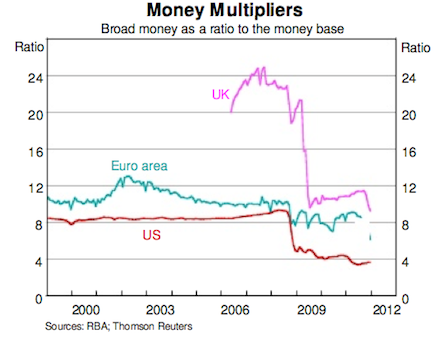
One possible way to gain a handle on the impact of these operations, and the extent to which the liquidity has circulated, is to look at money multipliers. Graph 2 shows money multipliers for the euro area, the US and the UK. The money multiplier is the ratio of a broad measure of the money supply to the money base, which is the part that is more or less under the control of the central bank. The graph shows that there have been large declines in the money multiplier in all three regions.
Although the euro area figure clearly shows contraction, as usual, a broad view of the euro area hides much of the detail. A closer look at monetary aggregates across the euro area shows that there is an acute reduction in lending occurring in the periphery and this will be exacerbating the already fragile economies of the weakest areas of Europe.
The other point that Mr Debelle missed is the unintended consequences of the ECB’s actions. As I have pointed out recently the 3 year LTRO provides temporary solvency to banks who would otherwise require corrective action. Therefore, although the facility will provide short term support for the banking system it is delaying the necessary regulatory action to remove systemic risk. What appears to be occurring is that the banks are using the temporary facility in order to support their own deleveraging, which ultimately means the banks can “stay alive” but will provide limited amount of normal banking functions to the real economy. The New York times reported on this concern just this week:
Advertisement
Few would begrudge Mario Draghi his boast last week that he and the European Central Bank had prevented a disastrous credit crisis by showering banks with cheap loans in December.
But beneath the gratitude toward Mr. Draghi, the president of the central bank, lurks a fear that the easy money could simply be creating the conditions for another banking crisis several years from now.
Because of the central bank’s cheap financing, some economists warn, sick banks now face less pressure to confront their problems — to clean out bad loans and other impaired assets, or even wind down operations if there is no hope of a turnaround. The European Central Bank, they say, could inadvertently spawn a cohort of “zombie banks,” burdened by nonperforming loans and assets that remain on the books, like the ones that helped make the 1990s a lost decade for Japan.
This will not be a new concept for MacroBusiness readers, I have discussed Zombification of the European banks previously. The issue is that, IMHO, the markets (and RBA) are confusing this short term support with longer term removal of systemic risk which is not what the LTRO can provide. The carry trade available from LTRO just isn’t big enough to wash away the previous sins of Europe, and the outcomes of the deleveraging cycle have really only just begun. In fact the recent S&P downgrade of Spain suggests that private sector deleveraging has a very long way to go:
… the deleveraging process will stretch over time for at least three more years.
Advertisement
And it isn’t just euro area countries that are having these issues. Denmark is also struggling with the similar issues:
Denmark’s credit crunch is getting worse as businesses accuse banks of withholding funds and the financial regulator warns that deteriorating asset quality may put more lenders out of business.
“When we ask our companies, small- and medium-sized, they say they are experiencing a credit crunch and it has become worse in the last month,” Karsten Dybvad, chief executive officer of the Danish Confederation of Industry, said in an interview in Copenhagen.
Dybvad’s group, which represents 10,000 Danish firms, wants the financial regulator to give banks more leeway in meeting capital requirements so they don’t call in loans and fuel a vicious circle that’s stifling the $300 billion economy.
The LTRO will be supportive of the banks in the short term, however it is ultimately a dangerous game because a rapid slow down in lending in the real economy will very quickly effect the asset side of their balance sheet.
Advertisement
Moody’s noted this exact point in a recent paper on the subject:
… Furthermore, if banks extend less credit to governments, businesses and households, this can curb economic activity, with adverse implications for borrowers’ payment ability and ultimately for bank asset quality and solvency.
I have little doubt that those statements played a part of today’s broad downgrade of Europe.