


The Eurozone monetary aggregates for January came out overnight and it was a mixed bag:
Regarding the main of M3, the annual growth rate of M1 increased to 2.0% in January 2012, from 1.6% in December. The annual growth rate of short-term deposits other than overnight deposits (M2- M1) increased to 2.6% in January, from 1.9% in the previous month. The annual growth rate of marketable instruments (M3-M2) increased to 4.3% in January, from -0.5% in December. Among the deposits included in M3, the annual growth rate of deposits placed by households increased to 1.7% in January, from 1.4% in the previous month, while the annual growth rate of deposits placed by non-financial corporations increased to 0.3% in January, from -0.9% in the previous month. Finally, the annual growth rate of deposits placed by non-monetary financial intermediaries (excluding insurance corporations and pension funds) increased to 5.7% in January, from 0.9% in the previous month.
That sounds quite positive and there has been some improvement from December which suggests that we could be seeing flow on from the ECB LTRO operations into the real economy:
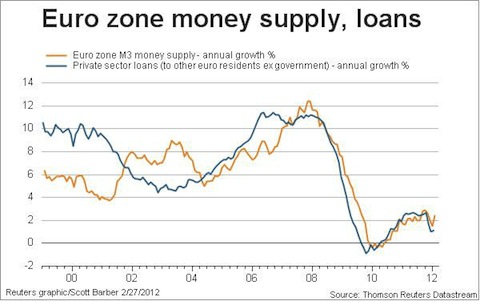
However, as the chart above shows, the overall figures are still historically very weak and credit growth remains very subdued, especially in the area of household lending:
Turning to the main counterparts of M3 on the asset side of the consolidated balance sheet of Monetary Financial Institutions (MFIs), the annual growth rate of total credit granted to euro area residents increased to 1.4% in January 2012, from 1.0% in the previous month. The annual growth rate of credit extended to general government increased to 4.8% in January, from 3.5% in December, while the annual growth rate of credit extended to the private sector increased to 0.7% in January, from 0.4% in the previous month.
Among the components of credit to the private sector, the annual growth rate of loans stood at 1.1% in January, compared with 1.0% in the previous month (adjusted for loan sales and securitisation, the rate increased to 1.5%, from 1.2% in the previous month).
The annual growth rate of loans to households decreased to 1.3% in January, from 1.5% in December (adjusted for loan sales and securitisation, the rate increased to 2.1%, from 1.9% in the previous month). The annual growth rate of lending for house purchase, the most important component of household loans, decreased to 1.8% in January, from 2.3% in the previous month.
The annual growth rate of loans to non-financial corporations decreased to 0.7% in January, from 1.1% in the previous month (adjusted for loan sales and securitisation, the rate decreased to 0.8% in January, from 1.2% in the previous month). Finally, the annual growth rate of loans to non-monetary financial intermediaries (excluding insurance corporations and pension funds) increased to 2.3% in January, from -2.0% in the previous month.
As I said last month this isn’t the sort of data that the ECB would hope to see given that rates are at 1%, it gave the banking system an extra €210bn in reserves last month and there is a free ride on the “sovereign carry trade” train available. But there does appear to have been a small abatement in the recent downward trend and this will be welcomed by the ECB.
However, as I have pointed out many times previously, the Eurozone aggregate data hides large and growing imbalances across the region. So while the aggregate data looks to show small improvements, most likely led by the recent strength of Germany, last night’s data from Italy, the only periphery nation to separately report its data on the same day as the ECB, shows signs of a continuing credit crunch:
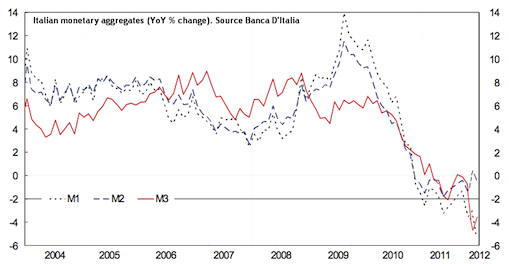
This is a concern because, although the Italian government’s costs of funding continue to show signs of improvement, the monetary aggregate data suggests that the economy will continue to contract which, as I have stated previously, is a major concern for the rest of Europe. The latest data on Italian business confidence suggests that this weakness has continued into February:
Italian business confidence unexpectedly fell to a two-year low in February after the economy entered its fourth recession since 2001 under the weight of austerity measures to fight the sovereign debt crisis.
The manufacturing-sentiment index fell to 91.5, the lowest since November 2009, from 92.1 in January, Rome-based national statistics institute Istat said today.
We have to wait a little longer for the aggregate data from the other periphery nations but, with the exception of Portugal, the continuation deposit outflows from their banking systems suggests weakness remains:
Firms and consumers continued to pull their money out of Greek banks at a rapid rate in January, European Central Bank data showed on Monday, underscoring the ongoing lack of trust the country’s banking system faces.
Private sector deposits in Greek banks fell by almost 3 percent in January after a slight increase in December, with the total falling to 174.9 billion euros, the lowest level since November 2006. They are now about 28 percent below their peak in December 2009.
Private-sector deposits in Portugal and other countries in the middle of the debt crisis fared much better, however. In Portugal, they increased fractionally, to 233.2 billion. Deposits fell slightly in Italy, Ireland and Spain.
The ECB will be hoping that this week’s LTRO stage 2 will provide enough new capital to the periphery banking system to support a return to stronger lending. Let’s hope that is the case because, as I said above, early signs from stage one do not look that positive. In the meantime it would appear that others are becoming concerned about the LTRO’s zombification effects:
“The worry is it may act to keep afloat institutions that aren’t exactly viable,” said Stewart Robertson, chief European economist at Aviva Investors in London, which manages more than $425 billion. “This buys time for banks, but does it really provide them with an incentive to sort out their books? The worry is it doesn’t.”
Overnight we also saw the German parliament vote on the Greek bailout. As expected the result was a convincing “Yes” vote but not without casualties:
The comfortable 496-90 victory, with five abstentions, was inflated by centre-left opposition support, but only 304 of Merkel’s 330 centre-right coalition lawmakers backed the motion.
Seventeen coalition rebels voted “No” this time, compared to 13 who defied her last September in a vote to boost the euro zone rescue fund.
Analysts said the outcome could weaken her politically and make it harder for her to agree to strengthen Europe’s financial defences just when international pressure on Germany is rising.
“Merkel is losing her powers to convince, and the members of the Bundestag are losing their belief that everything will go according to plan,” said Gero Neugebauer, a politics professor at Berlin’s Free University.
We now wait for similar votes from Finland, the Netherlands and Italy along with information on the PSI take up rate and the corresponding action by the Greek government. In related news, Portugal will get the results of its latest bailout exam tomorrow.