

Paul Bloxham, HSBC’s Chief Economist for Australian and New Zealand has resolutely left the bullhawk flerd with an important opinion piece in the AFR this morning:
Skydiving instructors will tell you that it is not the fall that kills you – it’s the sudden stop. In finance, it’s not the asset price crash that gets you – it’s usually the leverage.
If the value of your asset falls, you are having a bad day. But if the value of your asset falls below the amount you owe on it, your bad day just got a whole lot worse, and so has the bank’s.
If there is one key lesson from the global financial crisis, it is that high leverage can be very dangerous. Much like in the rest of the developed world, households in Australia have become much more aware of this, and are in the process of what officials call “deleveraging”.
You could call this disleveraging Mr Bloxham, as MacroBusiness has done so throughout all of 2011 so welcome aboard!
Private credit, the engine of the economy, is still purring along – not outright deleveraging, but growth at 30 year plus lows as debt decelerates and private savings return to the pre-late 1990’s trend:
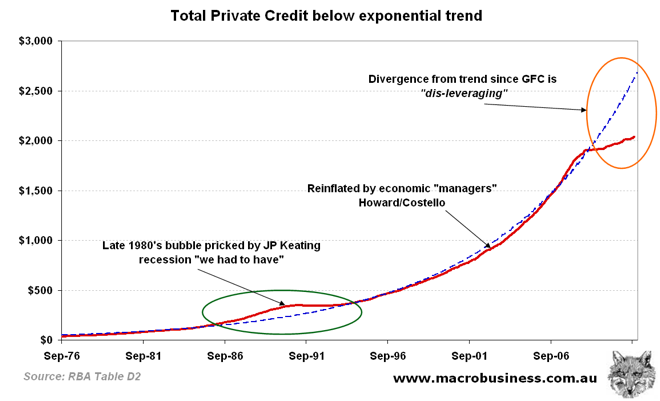
It’s great to see another mainstream economist after Bill Evans last year acknowledge deleveraging as a reality. Mr Bloxham continues and well deservedly paints the current context, misread by his fellow bullhawks last year:
Rather than withdrawing equity from housing, households are now injecting it. Rather than spending all their income, they are now saving at their highest rate in more than two decades (about 10 per cent). Rather than borrowing to upgrade their houses, many are downsizing.
This is in stark contrast to the way households were behaving back in the late 1990s and early 2000s.
Back then house prices were rising at double-digit rates and stock prices were also climbing, so people did not feel the need to save much of their income.
Capital gains were doing the saving for them. Now, with house prices in modest decline (down 4 per cent over the year) and stock prices going nowhere, households realise they need to save out of income for their retirement or for a big purchase down the track.
This shift to higher rates of savings and ‘downsizing’ is partly a response to the gradual shift to retirement of the Baby Boomer generation, as the Unconventional Economist covered extensively last year.
Given the backdrop of Mining Boom Mk2, with national income surging, due to a record high Terms of Trade from record high commodity prices, is this the perfect time to deleverage?
Mr Bloxham thinks so:
In Australia’s case, the rise in saving is happening at just the right time. Households have increased their savings levels and are deleveraging at a time when household income growth has been strong and unemployment low.
And at the same time that households are saving more, there is one part of the economy doing a lot of spending: the mining sector. Thanks to very high commodity prices, Australia is enjoying a massive mining investment boom.
Given the timing, you could say that Australia is experiencing the best kind of deleveraging. People have jobs and are saving more. This is a much better situation than when unemployment is rising while households are trying to pay down debt – the problem faced by a number of developed economies at the moment.
Australians are reducing risk in the system at the right time.
Indeed the timing is fortunate as Australia remains one of the luckiest countries in the developed world as a result of the boom. But as Houses and Holes said last year, its the management of this luck that matters.
The large incomes from the wholesale selling of national assets could provide future national income (through higher tax revenue and/or SWF), as once the boom ends, the nation will no longer own most of the assets that were created in this “massive investment” phase, with over 80% owned by foreign interests.
So we come to the greatest flaw in Mr Bloxham’s piece: the omission of the real risks of deleveraging. He contends that not only will it be quite manageable, but that we can rely upon the RBA to repeat history:
Of course, the ultimate insurance policy is that the RBA still has a lot of room to cut interest rates further if it needs. As the 2008-09 experience showed, this can very quickly boost the housing market, given that most mortgages are at variable rates. As we have seen in the past two months, the RBA has already pulled the ripcord and is attempting to glide in for a soft landing.
And if it becomes clear the economy is slowing more than the RBA has in mind, more cuts will no doubt be made. We believe that rates will fall by a further 50 basis points in early 2012. This will provide support for the housing market.
The Australian residential property market is dependent upon sustained capital growth of at least 1-3% per annum in nominal terms, because of the 1.1 million Australian investors who are negatively geared. That capital growth is dependent upon not just the cost of credit, but the availability both to mortgage borrowers and to the banks funding, both of which are far from assured in a post GFC economy and where the latter are very protective of their excess profitability, regardless of public jawboning about funding costs.
Any ongoing or even modest fall in real terms like we saw in 2011, threatens a run on the market where a “lucky leveraging” can become an outright deflation.