
In December 2010, David Murray, Chairman of the Future Fund and former CEO of the Commonwealth Bank, issued a stern warning on Australia’s high level of net foreign liabilities, which had reached nearly 60% of GDP:
…the assumption that Australia could maintain a high level of foreign borrowings because the economy was underpinned by the mining boom and demand from Asia was worrying. “That’s a very risky position”. Australia’s foreign debt position relative to the size of the economy is higher than that of the United States or France.
Mr Murray admonished politicians for glossing over the risk posed to Australia’s economy from foreign indebtedness. Instead, he said, they had chosen to focus voters’ attention on abolishing government debt. “The debate is all being run at a level that completely ignores this vulnerability”.
If Australia’s economy were to slow, the ability to service those foreign borrowings could be affected. There is also the risk that the cost of foreign capital could rise further, which would be felt by many through higher domestic mortgage rates. Banks’ foreign borrowings have funded Australia’s housing boom…
Then in March 2011, Mr Murray warned that Australia’s high house prices make the economy vulnerable to overseas events, particularly a sharp fall in commodities prices:
Australian house prices are high by world standards and have made the economy vulnerable to overseas events that may cause a sudden decline in their value, the head of the Future Fund says…
‘‘The relationship between house prices and incomes is uncomfortably high,’’ Mr Murray said in a televised panel discussion, hosted by The Australian newspaper and Sky News…
Mr Murray said that Australia was vulnerable if interest rates rose around the world, which in turn would prompt commodity prices to fall and leave the country exposed with high house prices.
A fall in commodity prices would cut the income flowing into Australia, reducing the pay of many, and make it more difficult for people to service home loans.
‘‘Hopefully that won’t happen and we can work through it,’’ Mr Murray said. ‘‘But by any set of normal measures, house prices in Australia are high”.
And speaking at the Australian Business Economists’ annual conference in Sydney last week, Mr Murray launched possibly his biggest attack yet, admonishing the complacency evident amongst Australia’s policy makers as well as the debt-fuelled housing addiction that has compromised Australia’s economic future:
“I would have thought what’s happening in Europe would be one of the most timely wake-up calls in Australia’s history and it is being completely ignored because we’ve had 20 years of growth and the size of complacency here is outrightly dangerous…
I don’t see initiatives that are designed to push the productivity of the economy, in fact I see some trends which are working in the opposite direction…
The lending system for housing has resulted in a house price which is higher than it should be and part of the net foreign liabilities that are higher than they should be.
I believe that will be worked through by a stabilisation of house prices and steady increase in incomes and hopefully that’s the outcome but based on a price to income test, house prices in Australia are higher than they should be.
The regulations in the banking sector significantly promoted that outcome because the risk weight on housing is very low, so the gearing for housing is high. Historically the write-off rate’s been low. People believe that will last forever, which is always a worry. And this is purely with the benefit of hindsight, particularly on my part.”
It is heartening to hear these views expressed publicly by Mr Murray, even if he is one of the people responsible for Australia’s housing/debt addiction. When Mr Murray was at the helm of the CBA in the late 1990s, he ignited a price war amongst the banks by slashing CBA’s variable mortgage rate (remember ‘equity mate’?). Let’s also not forget that the CBA is the second largest issuer of offshore wholesale debt as well as Australia’s second largest mortgage lender behind Westpac.
Nevertheless, Mr Murray is right to be concerned. Australia’s over dependence on China and the politico-housing complex are its key vulnerabilities, and the utter ignorance and complacency displayed on these matters by Australia’s politicians and policy makers is culpable.
Mr Murray is also correct to attack the Basel Capital Adequacy Framework, which has incentivised banks to borrow heavily offshore to pump housing at the expense of productive businesses. The end result being that Australia’s homes are now over valued on every measure and Australia’s net foreign debt is tracking at around $700 billion, with the lion’s share borrowed by Australia’s banks for housing:
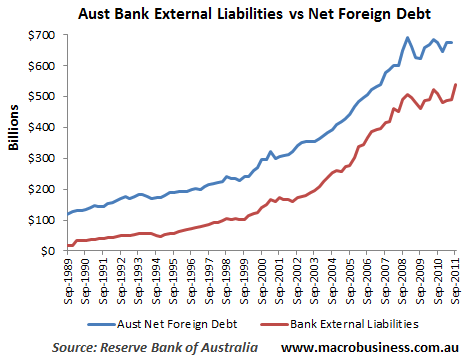
At the end of the day, the banks’ exploitation of the Basel capital rules has left Australia vulnerable to the whims of international finance – in particular adverse changes in the cost and availability of global capital – and all we as a nation have to show for it is a bunch of expensive houses.
The larger risk is that the ongoing squeeze in offshore funding costs is accompanied by a stumble in our biggest export market – China.
unconventionaleconomist@hotmail.com
