
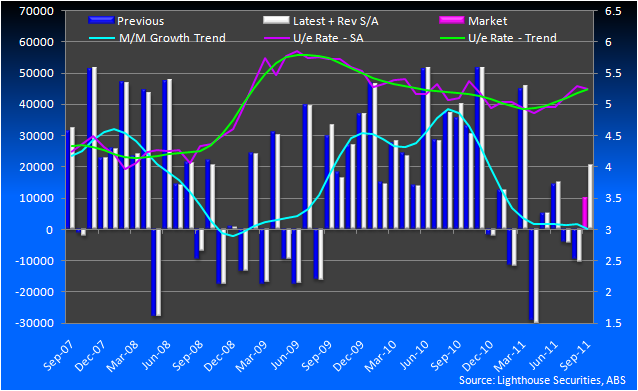
So, unemployment fell from 5.2862044% to 5.2477873%. Following are the charts.
First, the larger picture. As you can see, for the past year job creation has been very patchy. If anything, it resembles the GFC period:
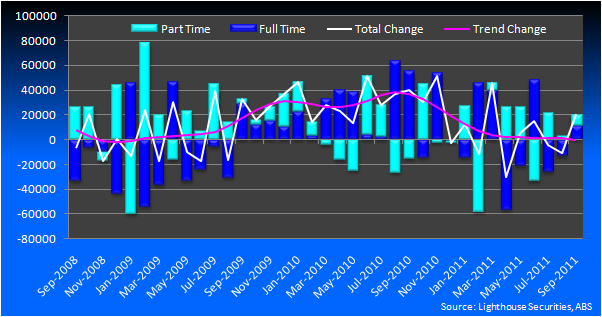
Below is the split of part and full time jobs. There has been a lot of churning between the two all year, possibly suggesting that labour hoarding unwinding slowly:
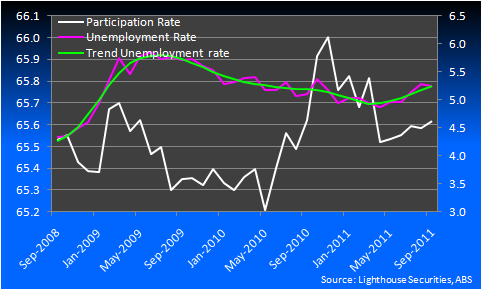
The trend in the unemployment rate is firmly up:
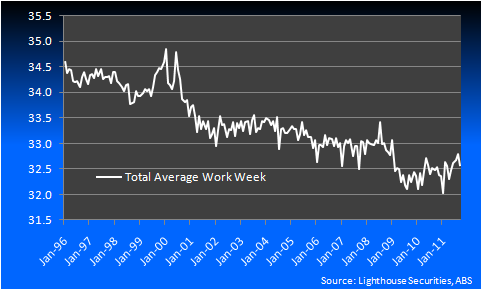
And the hours worked was down. I expect, however, for this to continue to rise as labour hoarding unwinds and full timers get more hours at the expense of part timers.
There are a couple of bank reports out on the data too. The first is a measured assessment by Westpac and makes the interesting observation that Australia has not seen three consecutive rises in unemployment since 2000. They describe the bounce as “statistical”.
The second is HSBC and is more swayed by a single month of data, concluding that the “sun shines downunder”.
Meanwhile, CBA has dumped its rate hike call and expect the cash rate to sit at 4¾% throughout 2012. Apparently, “the rate cut case is incomplete and the medium-term outlook still favours higher interest rates.” Believe that when I see it.
Westpac:
Westpac Economics: first impressions Sept labour force unemployment rate holds above 5%.
The September labour force survey had the statistical bounce were looking for rising 20.4k. The composition matches this with full-time employment rising 10.8k and the unemployment rate now rounding down to 5.2%. This is still a weak report, total jobs growth over the last three months was just 5.4k (just under 2k per month) and the unemployment rate has lifted from a recent low of 4.9% in April.
We have not seen three back to back negative from the labour force survey since the post GST correction in 2000. Even thought we thought the labour market is soft, we did not think it was going through the same magnitude of volatility that it did in 2000. Even the recent GFC was not a strong enough negative to generate three in row negative prints in the labour force survey. As such, we think that it is best to look through the recent volatility; total employment has risen just 5.4k in the last three month (less than 2k per month) and so far this year the economy has generated just 41.1k jobs (an average of 4.1k per month) which has not be enough to hold the unemployment rate down. From the low in April of 4.9% the unemployment rate is now 5.2%. Some may be tempted to say today is a robust jobs number. We would argue the contrary and say it confirms a soft labour market and the rising trend in unemployment.
And the state split highlights this trend. The improvement in jobs this month was particularly pronounced in WA and QLD which is what you would expect give the once in a century resources boom we are experiencing. In particular, we have been surprised by the recent softness in the WA labour market so we are not surprised by the improvement there. Nevertheless, the labour market in NSW and Vic appear to have reached a turning point; NSW has lost 17.3k jobs over the last 6 month while Vic has been broadly flat (–0.7k). We would need a startling strong outperformance in WA (possible given resources boom) and Qld (harder given the downturn in tourism and construction) to drive an improvement in the labour market from here.
HSBC:
Australian sun still shines
Employment rose in SeptemberToday’s labour report was positive and follows a number of sentiment indicators published this week which also showed stable conditions. The unemployment rate fell from 5.3% in August to 5.2% in September and employment rose by more than expected: +20k jobs against consensus of +10k. The move was broadly in line with other indicators of the labour market, including job advertisements, and reminds us that the sun is still shining in Australia. Attention will now turn to the Q3 CPI on 26 October. We still expect an elevated underlying CPI reading and for the RBA to remain on hold for the rest of this year.
Facts
- Employment rose by +20k jobs in September which was more than the consensus and HSBC’s expectation for +10k jobs. Employment grew by 1.1% y-o-y.
- The unemployment rate fell slightly to 5.2% in September down from 5.3% in August (consensus and HSBC had expected a steady 5.3%).
- The participation rate was steady at 65.6%, as expected.
- Both full-time and part-time employment increased in the month by similar amounts.
- Confidence indicators released over the past few days have shown that sentiment has generally stabilised at slightly below average levels.
Today’s labour market report was positive news, particularly against the global backdrop of continued woe. While the global cooling is clearly having some impact on Australia – particularly in terms of weaker confidence in recent months – the sun still shines downunder.
Employment rose by a bit more than expected in the month (+20k vs. +10k) and the unemployment rate ticked down slightly (to 5.2% from 5.3%). Stepping back from the month’s data, the trends in the labour market are broadly as we expected.
Employment continues on the modest upward path it has been travelling since the end of last year. Importantly, today’s report suggests that the recent jump in the unemployment rate from 4.9% to 5.3% from April to August was not the beginning of the kind of monotonic rise in unemployment rate which typically characterises significant downturns.
Indeed, the sharp rise in the unemployment rate in recent months may have been somewhat of a red herring, particularly if the trend rise was extrapolated. We clearly dodged a bullet here, as a further rise in the unemployment rate would have significantly increased the chances of an RBA cut.
This is not to say that we will not see further labour market weakness, particularly if there are further negative shocks from the world economy. But, for the moment, the Australian data look stable. This characterisation also extends across the business and consumer confidence indicators, for which we got updated readings this week.
Looking forward, our central expectation remains that the unemployment rate stays in the low fives, which will help to reduce the inflation problems that Australia was otherwise facing with a tight labour market putting upward pressure on unit labour costs.
Indeed, the modest loosening up of the labour market in recent months is much of what the RBA needed in order to consider lowering their underlying inflation forecasts back into the target band (recall that the RBA’s August forecasts had inflation above the band for most of the forecast horizon).
But, as we have been point out recently, the hurdle for actual rate cuts still remains high, as the RBA would need to be able to revise its forecasts such that inflation heads into the lower half of the target band. We do not think that this hurdle has been met yet, and today’s labour force numbers provide further support for this view.
The next critical piece of data to look out for is the Q3 CPI, due on 26 October. We continue to expect underlying inflation to be elevated, keeping the RBA on hold this year.
The labour market steadied in September, after loosening up in previous months.
The rise in recent months is enough to take some of the heat out of the inflation outlook, but not enough to see the RBA cutting rates.
We expect the RBA to continue perfecting the art of doing nothing and to remain on hold for the rest of this year. Watch out for Q3 CPI on 26 October to affirm this view.
