
In the long history of Australia’s housing prices, intervention to support housing prices from the government or the Reserve Bank has never been far away from the market when prices were falling significantly.
From first home buyers grants to support the market during the Global Financial Crisis to repeated crash dives in interest rates, a positive catalyst for the housing market coming from policymakers has become all but an expectation for market participants.
Even now, amidst what some are suggesting are the swiftest falls for the housing market in 40 years, there is still the expectation that prices will be supported by the continued imbalance between housing supply growth and housing demand growth.
Or, to put it in less politically palatable terms, migration will continue to run at a rate that significantly outstrips the ability to build homes and resolve the housing deficit.
Now, following the changes to negative gearing and the capital gains tax discount on existing properties, sustained high inflation and interest rates high relative to what borrowers have become accustomed to in recent decades, there is a perfect storm facing the housing market.
One has no doubt that intervention will come from policymakers, arguably first from the federal government given its greater scope for supporting the market, but how long will it be before that positive catalyst comes to pass and is successful?
Which raises an interesting question: what if it’s months or even a year before policymakers can arrest the falls in housing prices?
In order to explore this, we are going to commit one of the cardinal sins of economics.
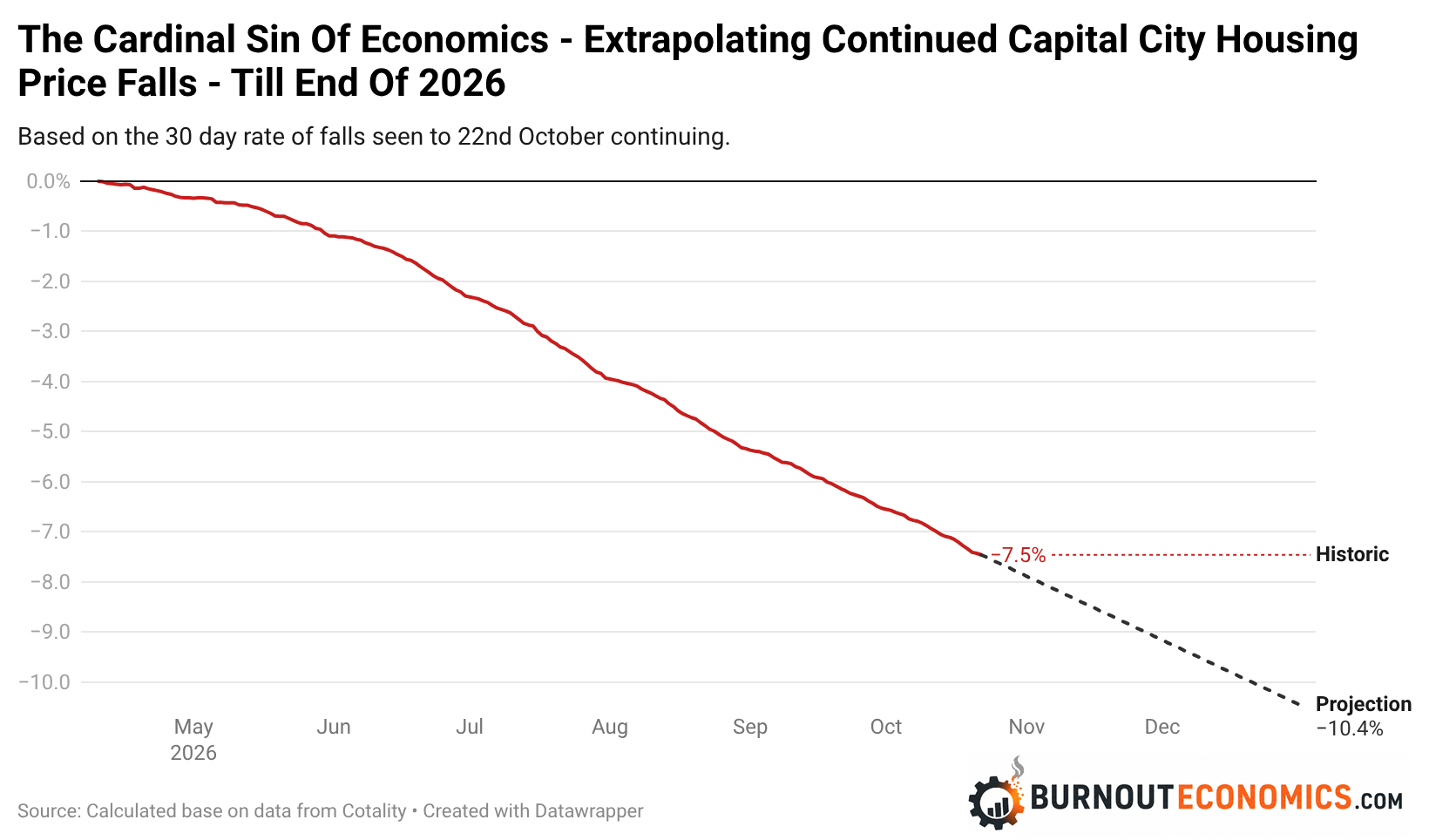
For the purposes of today’s analysis, we will assume that housing prices will continue to fall at the same rate as the last 30 days across the range of forward estimates.
If the current rate of price falls continue until the end of the year, prices would be down 10.4% from the peak at a capital city level.
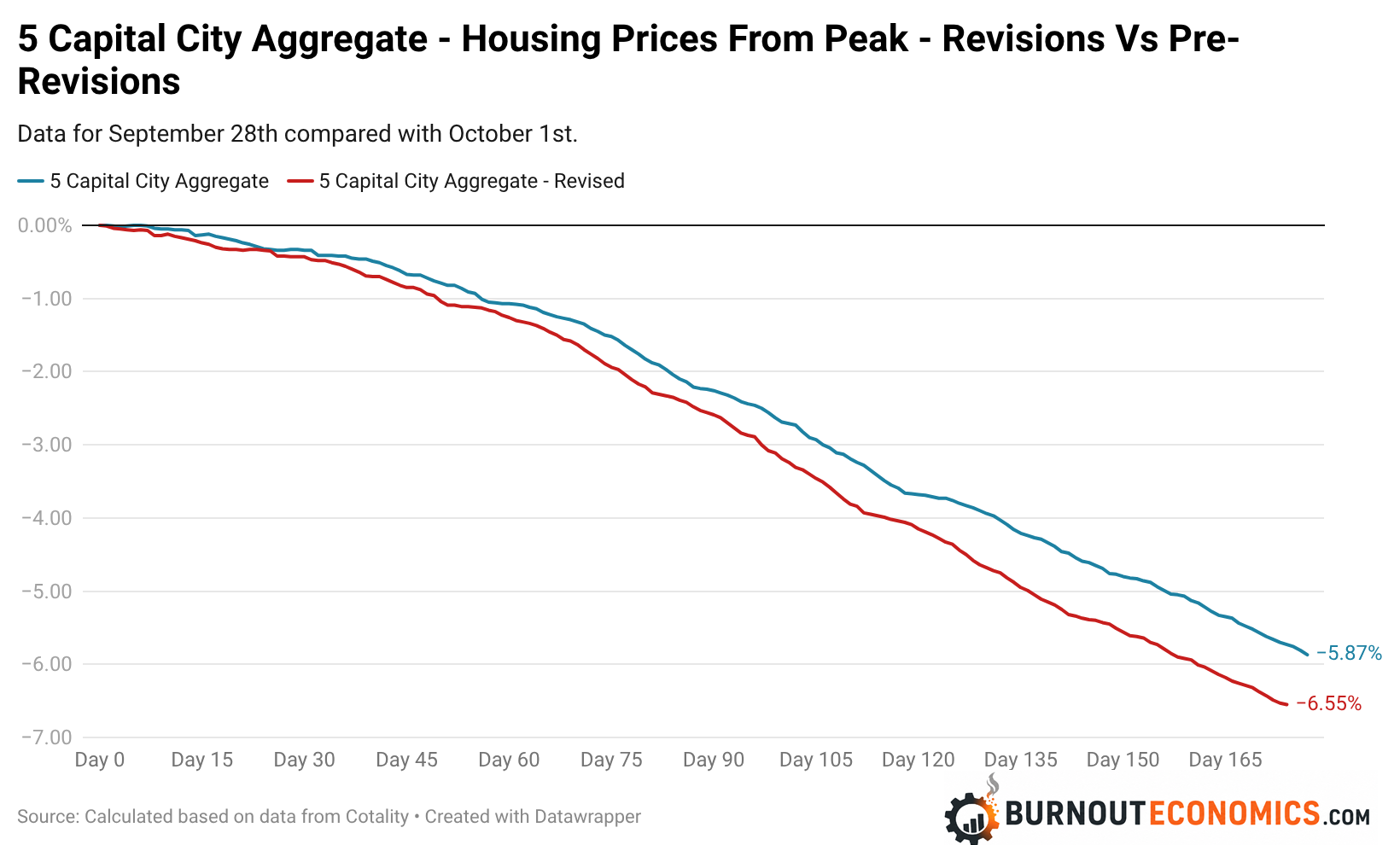
It’s also worth noting that updates to the various price indices could revise the magnitude of price falls higher, as has happened in several of Cotality’s last monthly updates.
There are also arguably further downside risks.
In the words of SQM Managing Director Louis Christopher on social media platform X (formerly known as Twitter) recently:
“Sydney’s final clearance rate last week fell to an effective record low (ex covid) of 27.1%.
Melbourne was 40.8%.
The preliminaries widely quoted on the weekend are absolutely masking the real extent of this housing correction.
100% Sydney housing prices will be now falling at an accelerated rate compared to just two month ago.
Melbourne I think is fairing better. Probably due to offering better value right now compared to other cities and the expected change of state government.”
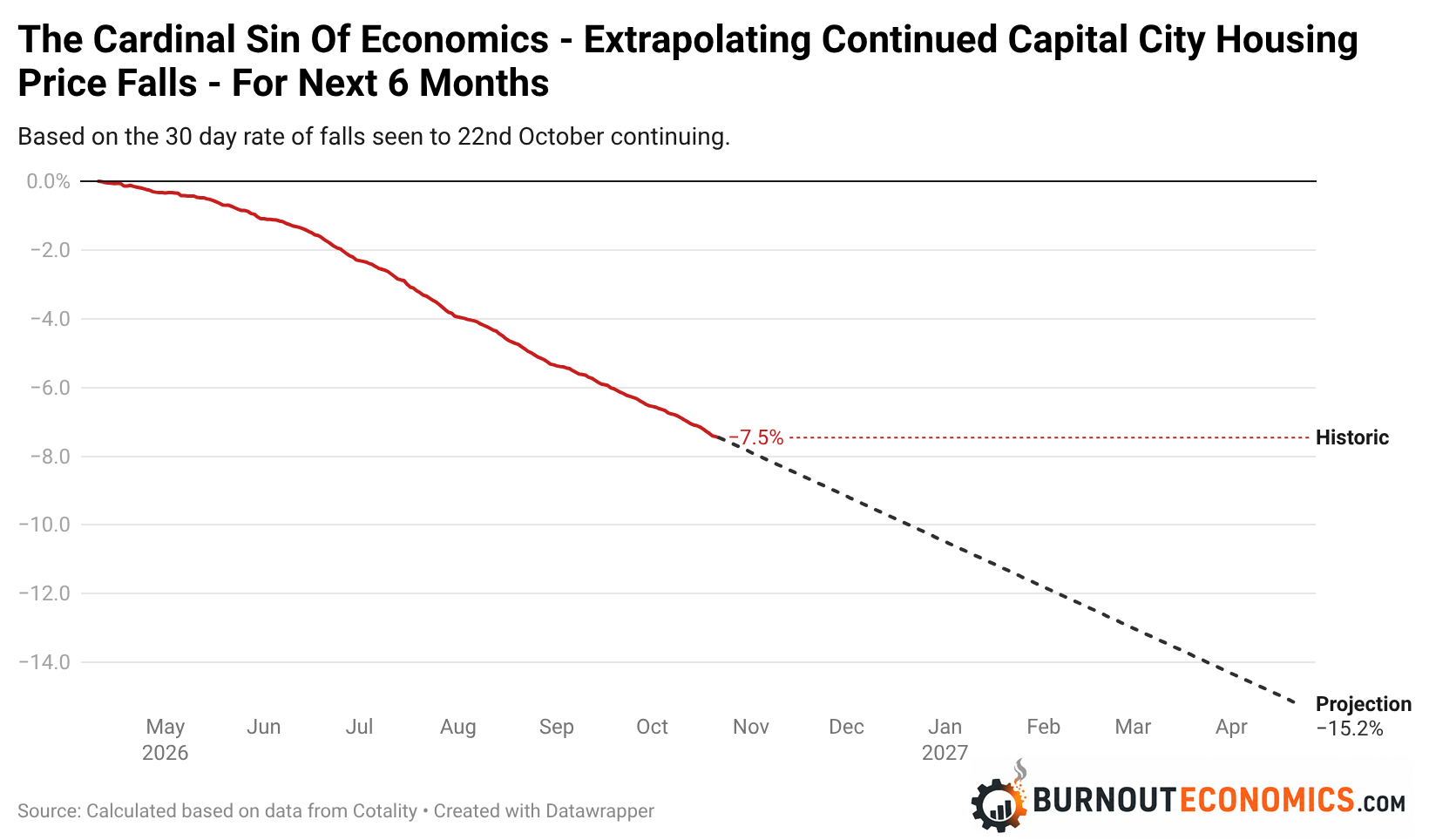
If we extend the extrapolation of price falls to six months of falls from today following the current trend, the peak-to-trough fall would be 15.2%, well towards the top end of estimates for housing market downside shared by economists.
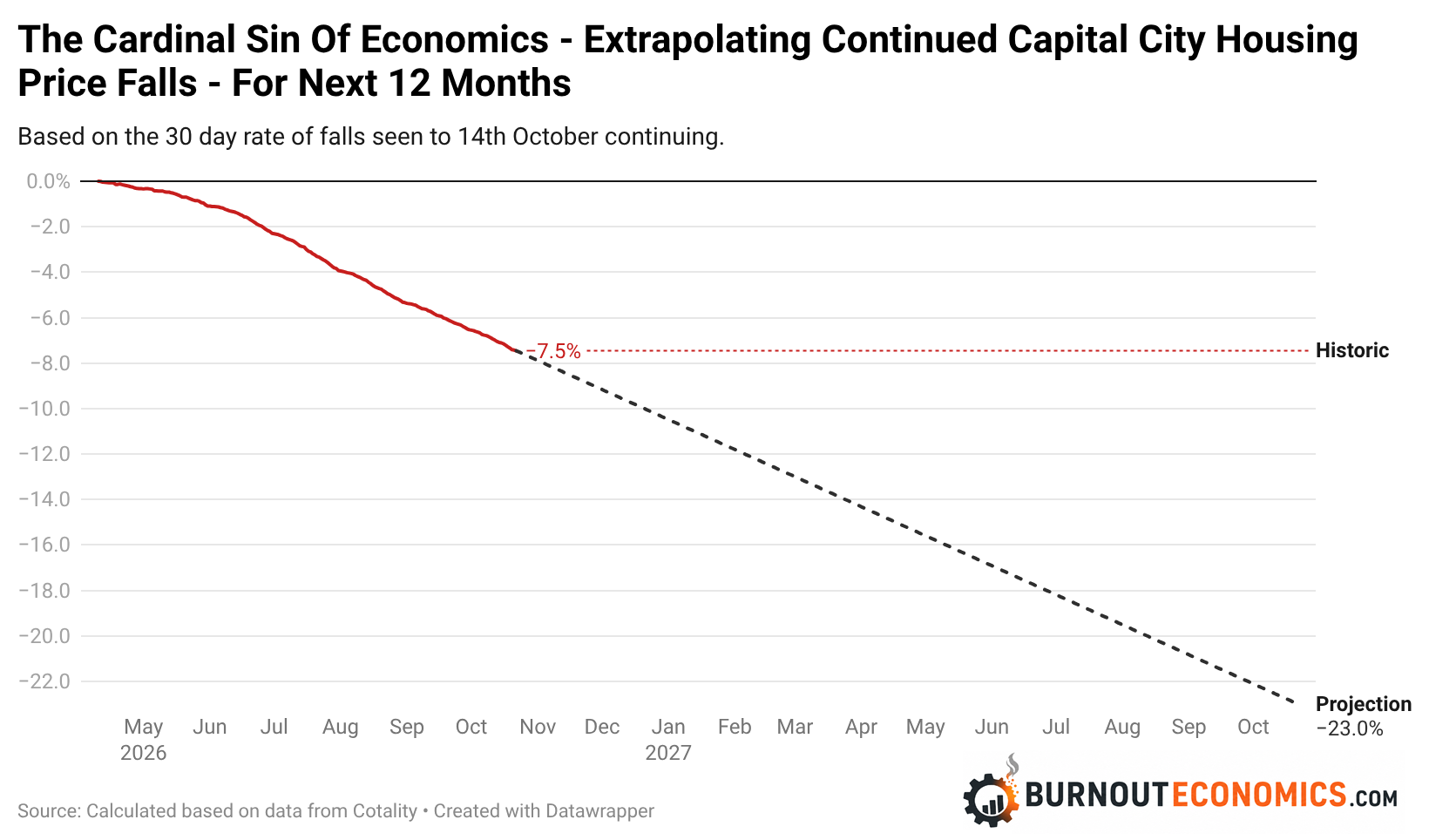
And finally, if for some magical reason housing prices were to continue to fall at the same rate as the last 30 days, by this time next year housing prices would be down 22.2%, a drop greater than the New Zealand average and getting on for the ballpark of the U.S. housing crash depending on one’s chosen housing price data provider.
The Takeaway
While these are naturally unrealistic scenarios in terms of uniform price falls over a sustained period, they illustrate how fast the market is currently deteriorating.
Revisions could also see price falls worsen further, and today’s hypothetical exercise could look somewhat optimistic in hindsight, at least over a short-term time horizon.
Ultimately, Australia’s property market is in uncharted territory: price falls without the RBA having the ability to ride the rescue and the level of support for the market from property investors dramatically reduced, potentially for years or even decades to come.
