
Chemonics on building the primary care workforce the Indo-Pacific needs to reach SDG 3

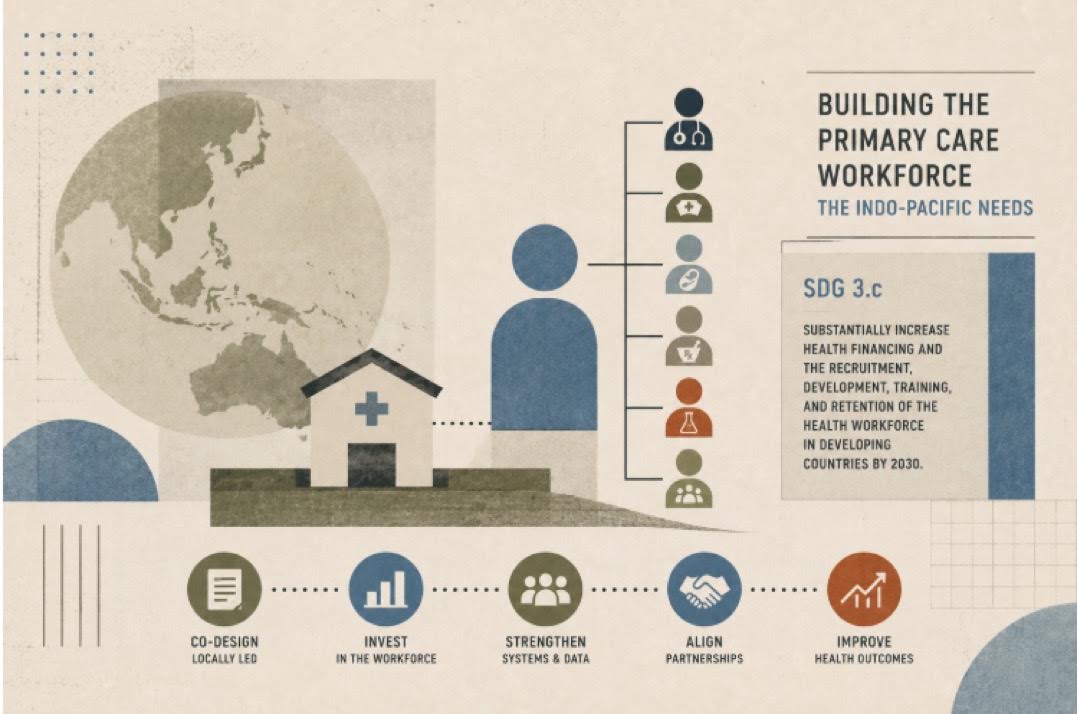
The world is still projected to be short roughly 10 million health workers by 2030. That is the World Health Organization’s most recent reassessment, published in 2022 and revised down from earlier projections of 18 million. It carries two findings that matter for the Indo-Pacific: nearly all of the remaining gap falls on low- and middle-income countries, and small island states, including many Pacific nations, are closing their shortages more slowly than the rest of the world.
Across much of the Indo-Pacific, that shortage already shapes who can see a nurse, reach a midwife, or get a child immunised. Sustainable Development Goal 3.c sets the marker: substantially increase health financing and the recruitment, development, training, and retention of the health workforce in developing countries by 2030.
Numbers are only part of the problem. Many countries also face uneven distribution, skills mismatches, and performance gaps among the workers they already have. On the frontline, this is felt most acutely in primary care, where nurses, doctors, midwives, pharmacists, laboratory technicians, and community health workers deliver essential services, watch for emerging diseases, and hold the line during floods, mpox outbreaks, and cholera.
Meeting that need is rarely a question of training alone. It cuts across education, finance, health, and labour policy, which is pushing governments and their partners toward broader, more coordinated approaches.
The primary care workforce gap across the Indo-Pacific
Chemonics has spent years working on these questions alongside national governments. Through the U.S. Government-funded Human Resources for Health 2030 (HRH2030) Program, the company supported 34 countries on health workforce challenges, from national policy and strategy to labour market analysis, evidence-driven tools, and competency frameworks. One lesson stands out from that work: support is most useful when it moves past short-term, ad hoc fixes toward solutions a country can sustain on its own.
Training is a familiar example. Standalone, in-service training sessions can build knowledge in the moment, but delivered as one-off events they quietly pull health workers away from the patients who need them, and the gains fade without supervision, follow-up, and a system ready to put new skills to use. The more durable path tends to run through two connected commitments.
Co-designing strategies through locally led development
HRH strategies hold up best when they are shaped by, and led by, the countries that will carry them out. That is the heart of locally led development: responsive to local context, owned locally, and built to last.
Through a technical partnership with the Global Financing Facility (GFF), Chemonics supported the development of an HRH Agenda built around six global recommendations that each country can tailor. Among them: centring HRH within health financing, improving HRH data quality, and developing the community health workforce. How that plays out depends on the setting. Indonesia, one of the Indo-Pacific systems carrying the heaviest share of the regional shortage, is a good example. Its Human Resources Information System (HRIS) already worked but sat disconnected from other key information systems, so the program focused on interoperability, linking workforce data to the systems that plan and pay for care. In Ethiopia, by contrast, the same program centred on fixing data weaknesses and the barriers to collecting and using quality information at all. Same goal, two locally shaped paths.
That multisectoral grounding, spanning public financial management and domestic resource mobilisation for the primary care workforce, including community health workers, is where locally led design pays off most.
Coordinating partnerships across donors
Urgent health needs can tempt donors and implementing partners to prioritise getting started over coordinating, which leaves several funders working on the same issue while others go untouched. Strong partnerships are the corrective.
The Mashako Plan in the Democratic Republic of the Congo offers a useful illustration. Facing stagnant childhood vaccination coverage and a severe measles epidemic, Gavi worked with the Ministry of Health, Acasus, UNICEF, the Gates Foundation, and WHO on a shared diagnostic of the immunisation programme. Workforce motivation turned out to be one of five barriers behind the system’s underperformance, and the partners moved to strengthen support and incentives for nurses and managers. Between 2018 and 2020, zero-dose children fell from 700,000 to 300,000, and the number of fully vaccinated children climbed from 900,000 to 1.6 million. That emphasis on collaboration and accountability now runs through Gavi’s 6.0 strategy.
The DRC sits outside the Indo-Pacific, but the partnership lesson travels: aligned donors, a shared diagnosis, and a single plan tend to outperform parallel efforts.
What stronger primary care partnerships can deliver
Health worker shortages and their effect on a country’s ability to deliver quality care call for action at several levels at once. The encouraging part is how much is within reach when the pieces connect: strategies co-developed and country-led, and donor partnerships aligned to limit duplication.
For the Indo-Pacific, where Australia and its neighbours share a stake in resilient regional health systems, that combination is what turns a workforce gap into a workforce plan. The payoff is a primary care team in every community: one equipped to deliver high-quality care, support health security, and respond when the next flood or outbreak arrives.