
Contained within the federal budget are forecasts that stretch for a decade, often providing a far rosier longer-term perspective on the trajectory of the nation’s fiscal balance than more near-term estimates.
Within this year’s federal budget, there were a number of, shall we say, optimistic outlooks on which the eventual return to surplus in 2034-35 is built.
Three of these major factors were:
- Massive cuts to the expected spend on the NDIS
- A huge reduction in the size of the federal public service
- The assumption that the spend on grants to the states will shrink
Earlier this year, ABC News conducted an analysis of the expected cost of the NDIS through 2032, based on projections in the 2022-23 budget.
They concluded that by 2032, the NDIS would be on track to cost $128.0 billion a year.
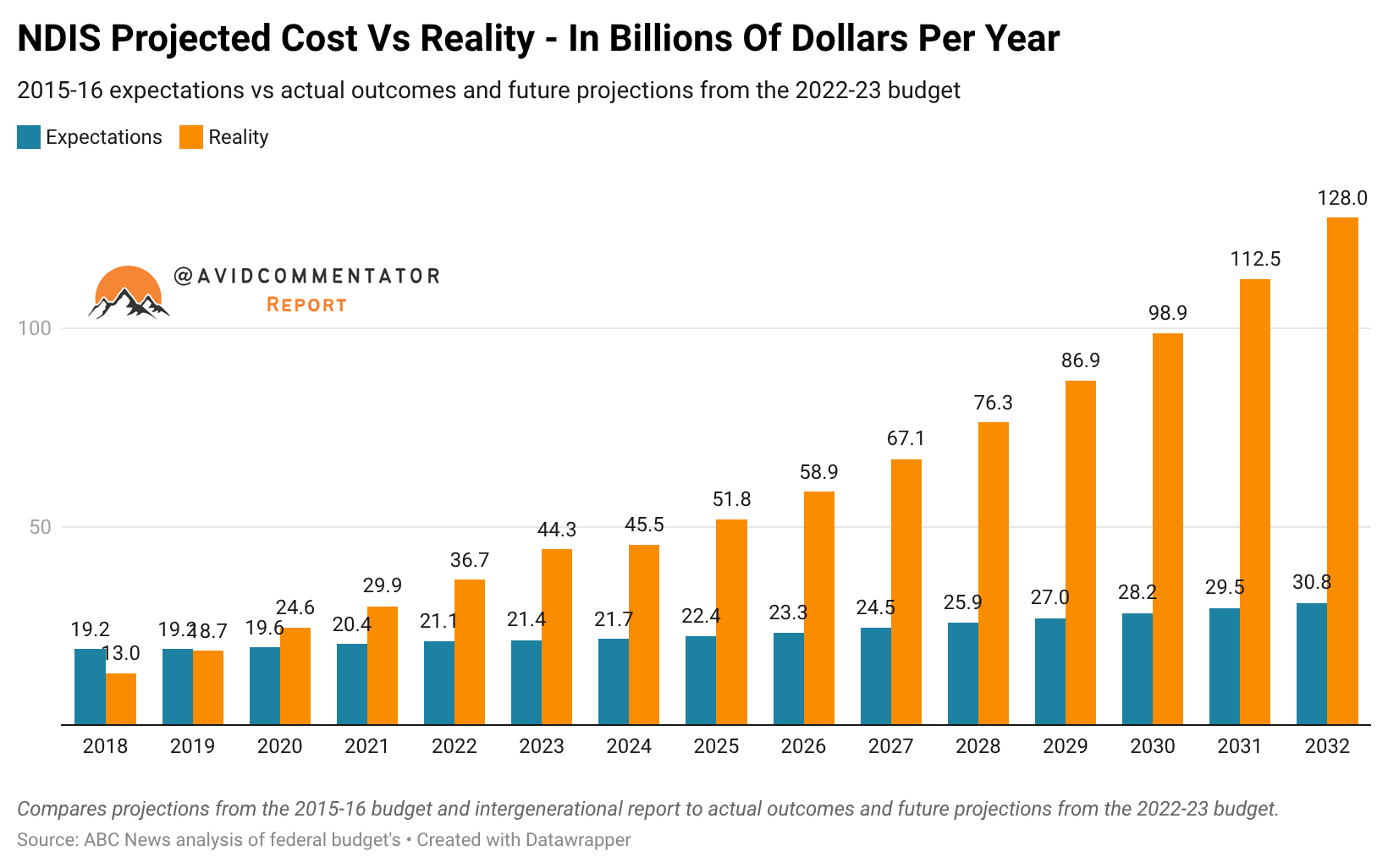
The expectation in the budget is that NDIS spending growth gets slashed dramatically, with growth rates dropping from around 10% annually to 2% in the short term, before eventually rising back to 5%.
Looking at the numbers from the Parliamentary Budget Office on the baseline for NDIS spending on the road ahead, it makes for quite a stark contrast with the ABC News analysis based on the previous pathway.
Instead of spending $128.0 billion in 2032, the spend will now be $60.1 billion.
If that sounds entirely unrealistic to you given the historic talent for underestimating the growth in the cost of the NDIS, you are most certainly not alone.
Meanwhile, the expectation within the budget is that the size of the federal public service will shrink dramatically in the years to 2036-37, with the cuts ironically broadly in ballpark with those proposed by former opposition leader Peter Dutton.
Currently the federal public service (excluding the military) has 217,300 full-time equivalent employees, with that expected to fall to 189,000 by 2029-30 and to 176,000 by 2036-37.
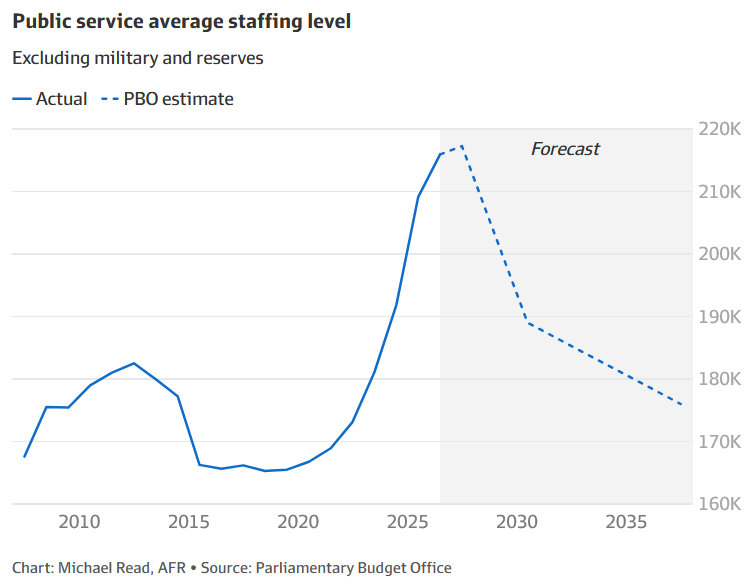
Chart: Michael Read AFR
How exactly that is meant to unfold as the population gets larger by almost 4 million additional people, I will leave to you to conclude.
Grants to the states and territories for infrastructure and other purposes are expected to dwindle in nominal terms over the next decade, despite the effects of inflation and population growth.
As of the completed 2024-25 financial year, infrastructure grants (road and rail) were $12.7 billion, while “other grants” to the states and territories were $22.4 billion.
What is the expected level of expenditure in 2036-37?
“$11.2 billion on infrastructure grants (road and rail) and $17.8 billion for “other grants”.
So the government intends to expand the population to over 31.6 million people, but somehow it will spend less in nominal terms on transport infrastructure and other grants.
Even just adjusted to inflation at the middle of the RBA’s target band at 2.5%, that would leave infrastructure grants at $17.1 billion in 2036-37, along with “other grants” $30.1 billion.
The Takeaway
Independent economist Chris Richardson called the government’s approach to the budget “INDUSTRIAL STRENGTH GASLIGHTING” on social media platform X.
And he is entirely correct in his diagnosis.
Spending less on infrastructure in nominal terms a decade from now as the population continues to expand is absurd.
While cutting waste and bloat from the federal public service is possible, evidence suggests it may not be competently or successfully executed.
Instead it’s likely that inertia will see the federal public service continue to remain bloated and attempts at a dramatic downsizing fail to be realised.
As a good friend of Macrobusiness, Martin North of Digital Finance Analytics likes to say “Turkey’s don’t vote for Christmas”.
Ultimately, the budget is built on a sandy beach amidst a rising tide, one that will see it washed away by the realities that were always going to bring it undone.
