
Net migration: Don’t limit the intake; accelerate the outflow
Australia is bursting at the seams. Net migration numbers just keep rising, the government seems unable to get them under control. Caps on international student enrolments and limits on working holiday visas have had little effect. The influx seems never-ending.
What most people don’t realise is that new visa grants to people who want to come to Australia are actually stable or falling. The problem is that many foreigners who are supposed to be in the country “temporarily” simply aren’t leaving.
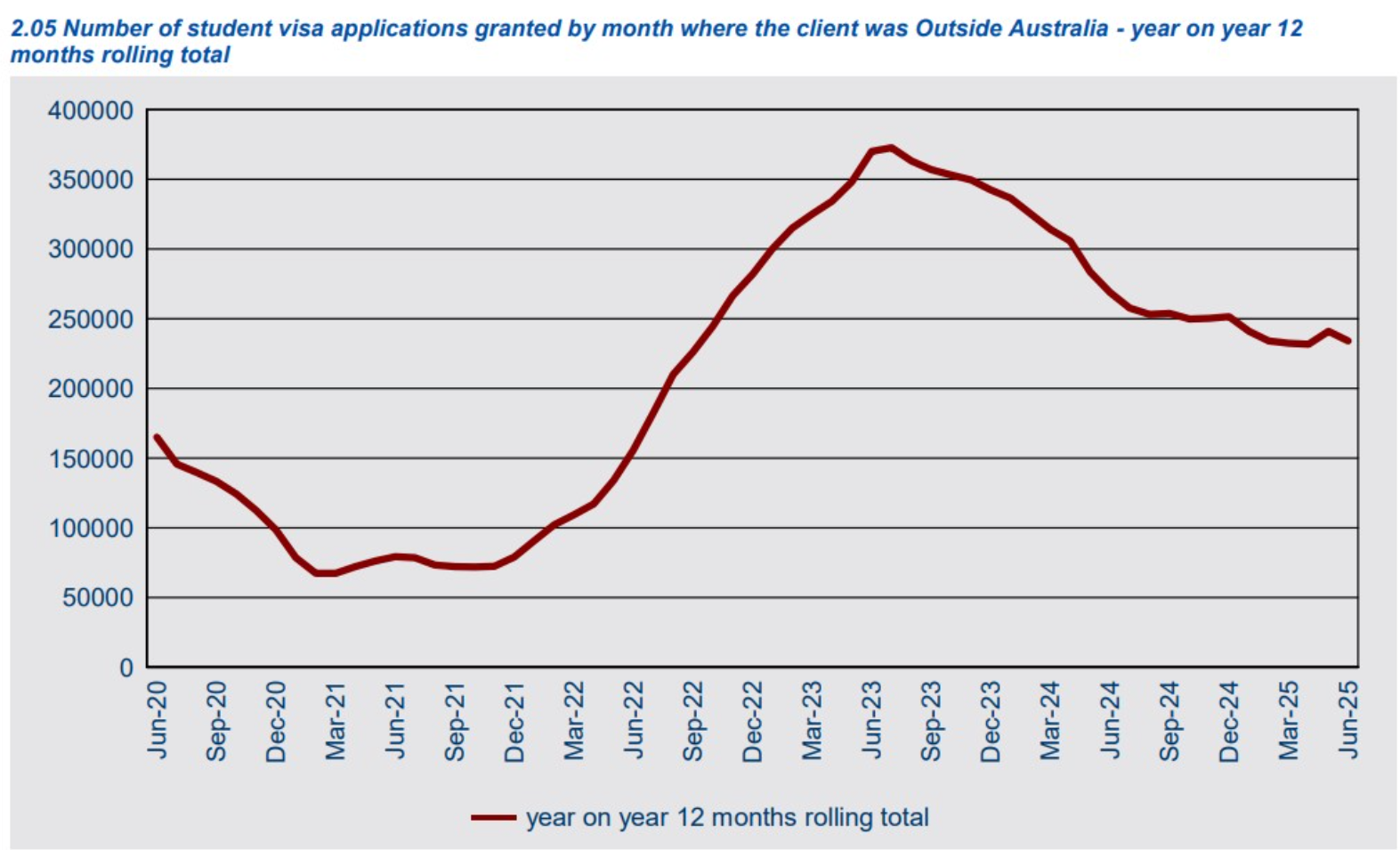
The bigger problem isn’t an excessive intake; it’s a deficit of outflow.
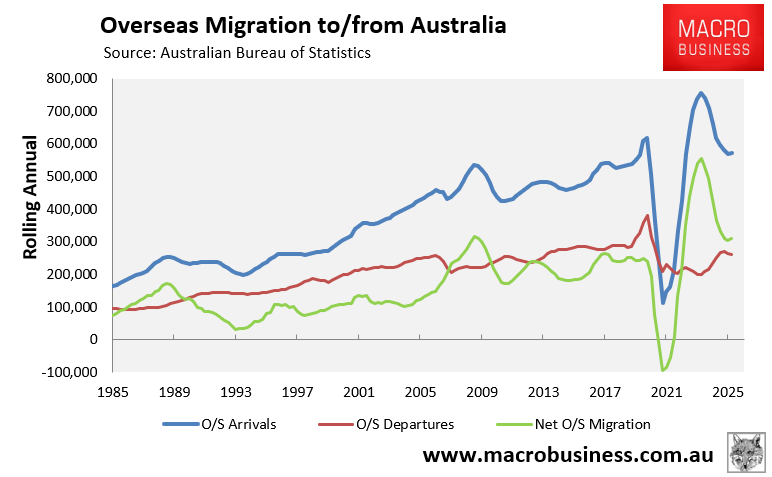
Australia’s resident population will hit 28 million in the next few months (if it hasn’t already), up from 25.5 million in 2019. Leaving aside the COVID disruption, that’s the equivalent of “adding a Perth” in just seven years. And as net migration continues to outstrip projections, the government doesn’t seem to know how to get the politically sensitive number down.
Politicians spend far too much time talking about the 185,000 permanent migration intake. Professionals know that the real issue is temporary migration—temporary, but seemingly never-ending. As of March 31, there were nearly 1.9 million temporary residents in Australia (not including tourists and New Zealanders). That’s roughly 7% of the entire population.
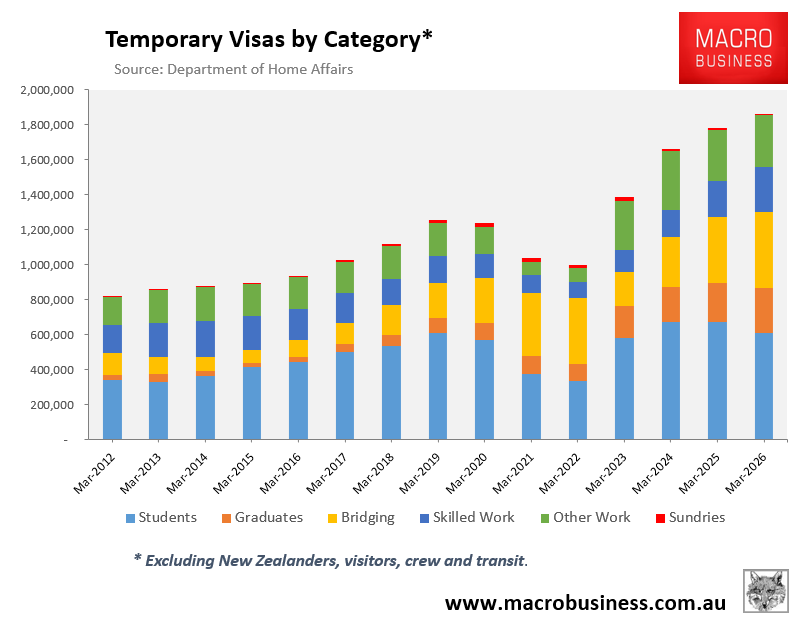
It’s more like 20% of the population in the relevant age groups. Very few temporary immigrants are children or elderly. They are in Australia as students (600,000), graduates (250,000), temporary workers (300,000), or working holidaymakers (250,000).
Or they are among the 432,000 who are here on “bridging” visas—in other words, their visas have expired, but they’ve applied for other visas, and they’ve been allowed to stay in the country on bridging visas (with work rights) while they wait.
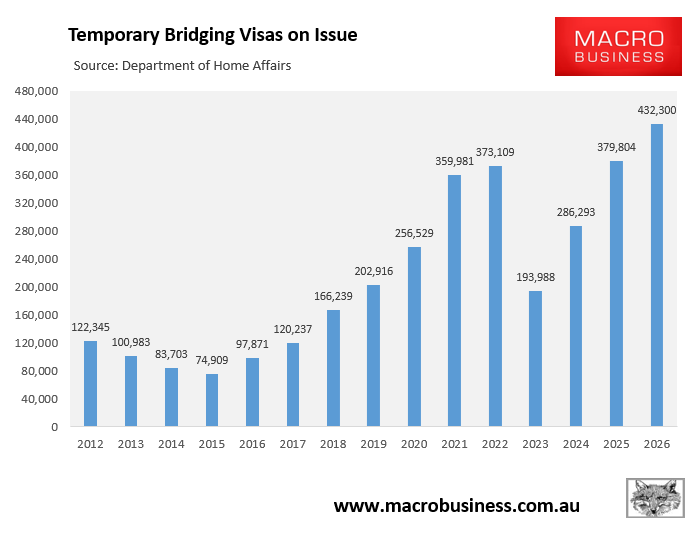
A decade ago there were rarely more than 100,000 people on bridging visas at any one time. The number started to blow out in 2018-2019 as international students came to realise that they could stay in the country indefinitely by paying for a succession of (mostly useless) qualifications and degrees.
The number boomed during COVID as travel was disrupted, but quickly fell back to pre-COVID levels when borders reopened in 2022. But since 2023, the number of people in Australia on bridging visas has more than doubled, as the system has come to be routinely abused by non-genuine international students.
International students can apply to take on additional studies (bridging visa), then if they are rejected, they can apply to have the decision reviewed by the Administrative Review Tribunal (bridging visa), then if their review is unsuccessful, they can apply for asylum (bridging visa), then if their asylum application is unsuccessful, they can apply for another administrative review (bridging visa).
You can find all the statistics in my Menzies Research Centre report on International Student Course-Hopping.
It’s a rort, but it’s a perfectly legal rort. That said, it’s ridiculous to leave the loophole open. An obvious reform is to require all student, graduate, and working holiday visa applications to be made from offshore. When international students and working holidaymakers finish their programs, they should go home.
They should only be let back in if they have legitimate reasons to return to Australia, and their applications should be judged on the same basis as for other offshore applicants.
In particular, post-study work visas should only be granted to graduates who have verified job offers in their actual areas of study. The stated purpose of the “temporary graduate” visa program is to give students “time to gain valuable work experience and demonstrate [their] skills to Australian employers.”
The purpose is not to ensure a steady supply of over-educated manual labourers and Uber Eats delivery drivers.
Making repeat visa applicants apply from offshore would prevent visa abuse, discourage non-genuine students, unclog the Administrative Review Tribunal, and establish a fairer system in which everyone wanting to come to Australia would be judged on the same basis.
Combined with a streamlined process for evaluating frivolous asylum applications lodged by people from safe countries, these reforms would rapidly reduce the number of temporary residents in Australia, without preventing any legitimate applicants from entering the country.
Making people apply from offshore is an easy fix that should be uncontroversial. It would not address all of the many problems of Australia’s immigration economy—in particular, it would do little to bring down international student numbers at Australian public universities—but it would buy time for the rest of the system to catch up.
The intuitive approach to excessive immigration is to reduce the intake. That could and should be done, but it requires politically difficult reforms. Accelerating the outflow of those who abuse the system should be a no-brainer. Even politicians should be able to understand the logic—and the electoral benefits.
