
Are we really seeing a student visa “crackdown”?
“Labor’s $1.4bn student visa crackdown revealed”! That was the online headline in the Australian over the weekend, with Universities Australia claiming that “the crackdown will cost institutions $1.4bn in fee revenue over the next three years” as “refusal rates have jumped from 6% to 26% over the past nine months.”
The newspaper reported that “the international student intake fell from a post-pandemic peak of 577,295 in 2022/23 to just 371,564 last financial year—a 35% cut. Numbers are on track to fall even further, with only 247,878 visas approved in the first nine months of this year.”
But wait—is that true? And why are the newspapers so interested now when the relevant data were actually released on April 30?
The answer to the first question is a lesson in how to lie with statistics. Of course, the numbers are correct; they come straight from Department of Home Affairs student visa program spreadsheets. Not that reporters are famous for navigating administrative data pivot tables.
And numbers did fall from 577,295 in 2022/23 to 376,731 in 2023-24 and 371,564 in 2024/25. That’s because in 2023/24 an extra 200,000 visas were granted to students who couldn’t travel during the COVID years.
But are numbers really “on track to fall even further”? A little bit. They’re actually “on track” to fall by 6.4% from last year’s levels. And the figure of “247,878 visas approved in the first nine months of this year” cited by the Australian is actually a convenient misprint; the real number was 257,878, or 10,000 higher.
Still, visa approvals this year are running 17,676 behind last year’s figures, and that is something, right? Well, not really. International student enrolments dipped slightly at the beginning of the pandemic but have consistently grown every year since 2021.
How is it possible that enrolments keep increasing even though the number of visa approvals have fallen in the last three years? This happens because, once in the country, students can stay to do second and even third degrees.
As international study in Australia has transitioned from an educational opportunity into a backdoor work visa, many students pull every lever to stay in the country, even if it means paying tuition for worthless degrees they will never use.
Nonetheless, the Australian quotes the head of the National Tertiary Education Union (NTEU) as saying that “it’s a potential nightmare for universities” that could trigger staff cuts.
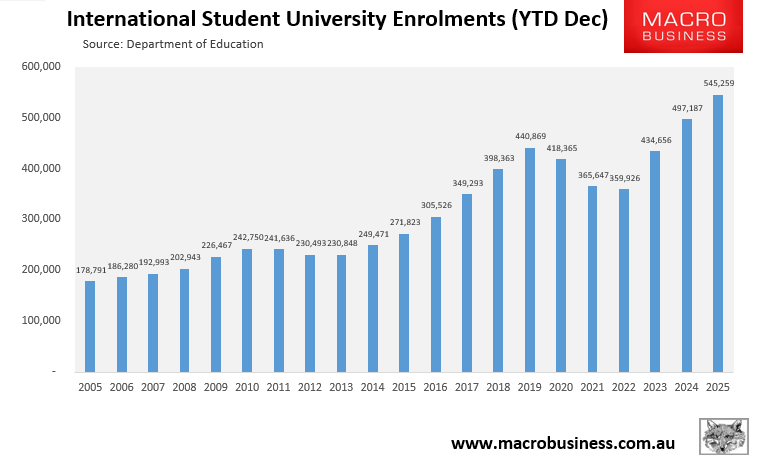
Staff cuts, because international student numbers are rising—but are not rising as fast as they might if universities faced no limits on the numbers of international students they enrol?
Well, anything is possible. But what about the real hot-button issue, housing?
The NTEU’s national president editorialised that in any case “fewer international students won’t fix the housing crisis” because “more often than not they’re living in accommodation like extra bedrooms, on campuses or other rooms that locals don’t want to or can’t live in.”
That’s right, Australia’s nearly 1 million international students are mostly living in the nooks and crannies that actual Australians would otherwise leave empty.
But housing does explain why the Australian is suddenly interested in visa approval data that was published more than two weeks ago. Of course, the leader of the opposition, Angus Taylor, last week telegraphed that he would tie international student visa approvals to housing availability.
Queue a defensive press release from Universities Australia, which seems to have been the basis for the report in the Australian.
A confluence of interests among universities, for-profit colleges, immigration agencies, the real estate industry, and (yes) the media has resulted in a series of catastrophic public policy decisions around international education.
Worse, it has corrupted the national discourse. Instead of questioning the statistics cited by self-interested organisations like Universities Australia, the National Tertiary Education Union, the International Education Association of Australia, and Property Council Australia, reporters amplify them.
The money flows that support all this are opaque, but there is no question that large amounts of money are being made. And as is so often the case with easy money, much of it comes from the privatisation of the public sphere.
It’s up to the public to exercise an appropriate scepticism—and persuade its elected leaders to do the same.
