
Man with economics degree (Albo) discovers economics
For many Australians, their first introduction to economics comes in high school, often in a Business Studies class, where they learn the basics of commerce, such as supply and demand.
Despite this being a rather basic law of economics and broader civilisation, with changing price conditions related to supply and demand being reflected in archaeological evidence as far back as ancient Sumeria (up to 5,000 years ago), in Australia, it is too often a forgotten science when it comes to the nation’s policymakers.
Much like the apple falling from a tree and hitting Isaac Newton on the head, Prime Minister Anthony Albanese recently had a brainwave and finally discovered the demand side of the supply-and-demand equation.
Amidst the rise in fuel demand driven by concerns regarding adequate supplies and news that Australia had only a little over a month’s worth of fuel stockpiled, the Prime Minister noted that the current shortage of fuel was a “demand issue, not a supply issue”.
This statement is rather a seismic shift in the Prime Minister’s commentary, considering that, when it comes to housing, demand is almost never mentioned; it is always characterised as a “supply issue”.
This blind spot for basic economics is not exclusive to the PM and his government; it has long been the stance on both sides of politics that housing is a “supply issue”.
It has also been a popular line for the Governor of the Reserve Bank, with former Governor Philip Lowe characterising the solution to Australia’s housing crisis in 2023 as “supply, supply, supply”.
Basic economics, along with objective reality, tells us that it’s about more than just supply.
It’s about the balance between supply and demand.
When it comes to housing, it’s clear that supply and demand should be carefully balanced wherever possible to ensure there are enough homes available as the population grows and household demographics evolve.
While it can theoretically be a deeply challenging task to manage domestically driven housing demand in a way that doesn’t stymie household formation, managing demand from external sources, such as overseas immigration, is actually very simple.
Despite the perception that Australia is an underperformer in terms of new home construction, the reality is quite a bit different.
In the past 35 years of data, Australia has outbuilt Canada and the United States in per capita terms every single time.
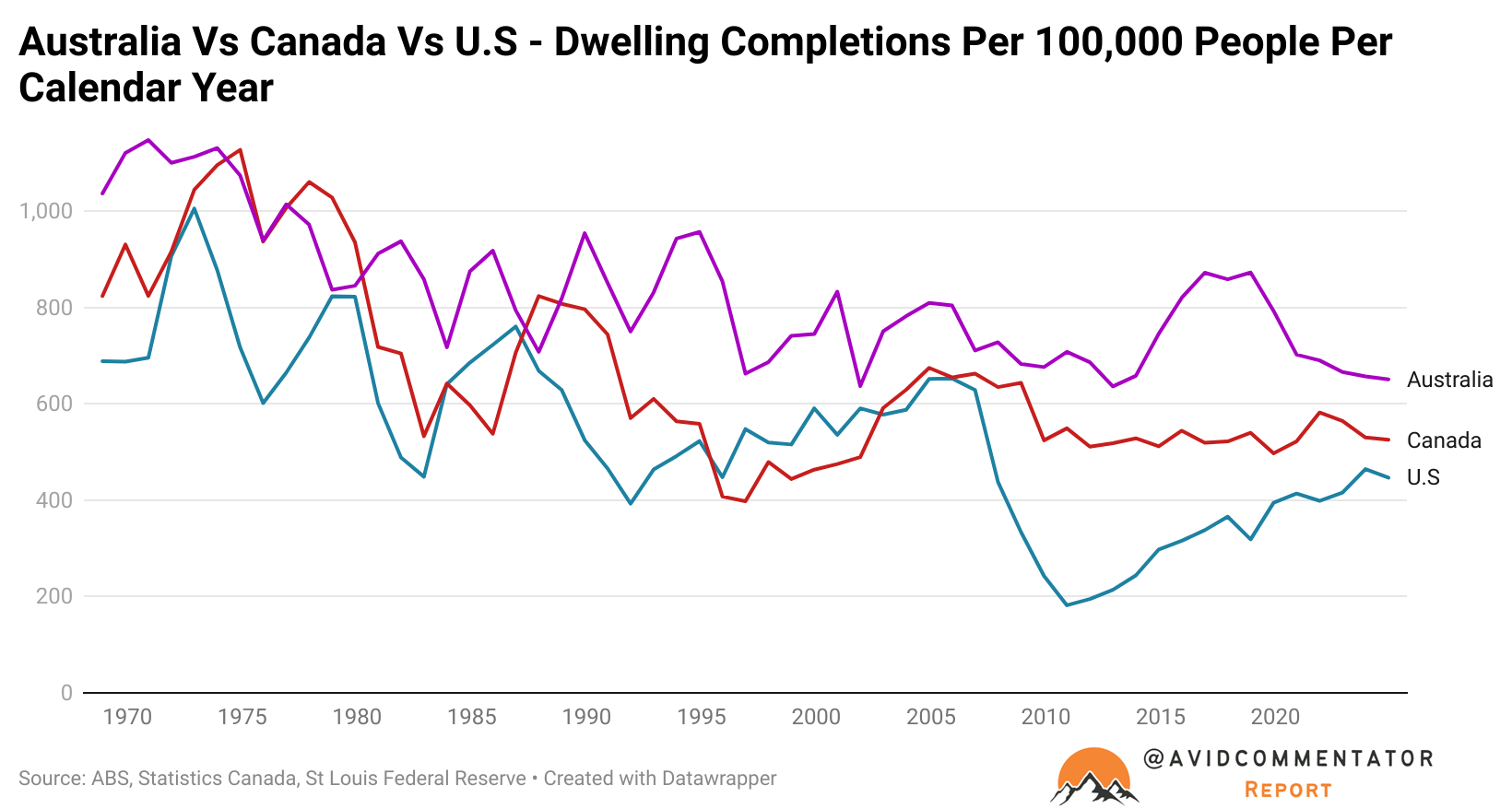
Despite the deterioration in completions per capita compared with earlier decades, which afflicted both the U.S. and Canada, Australia remains one of the developed world leaders for homebuilding.
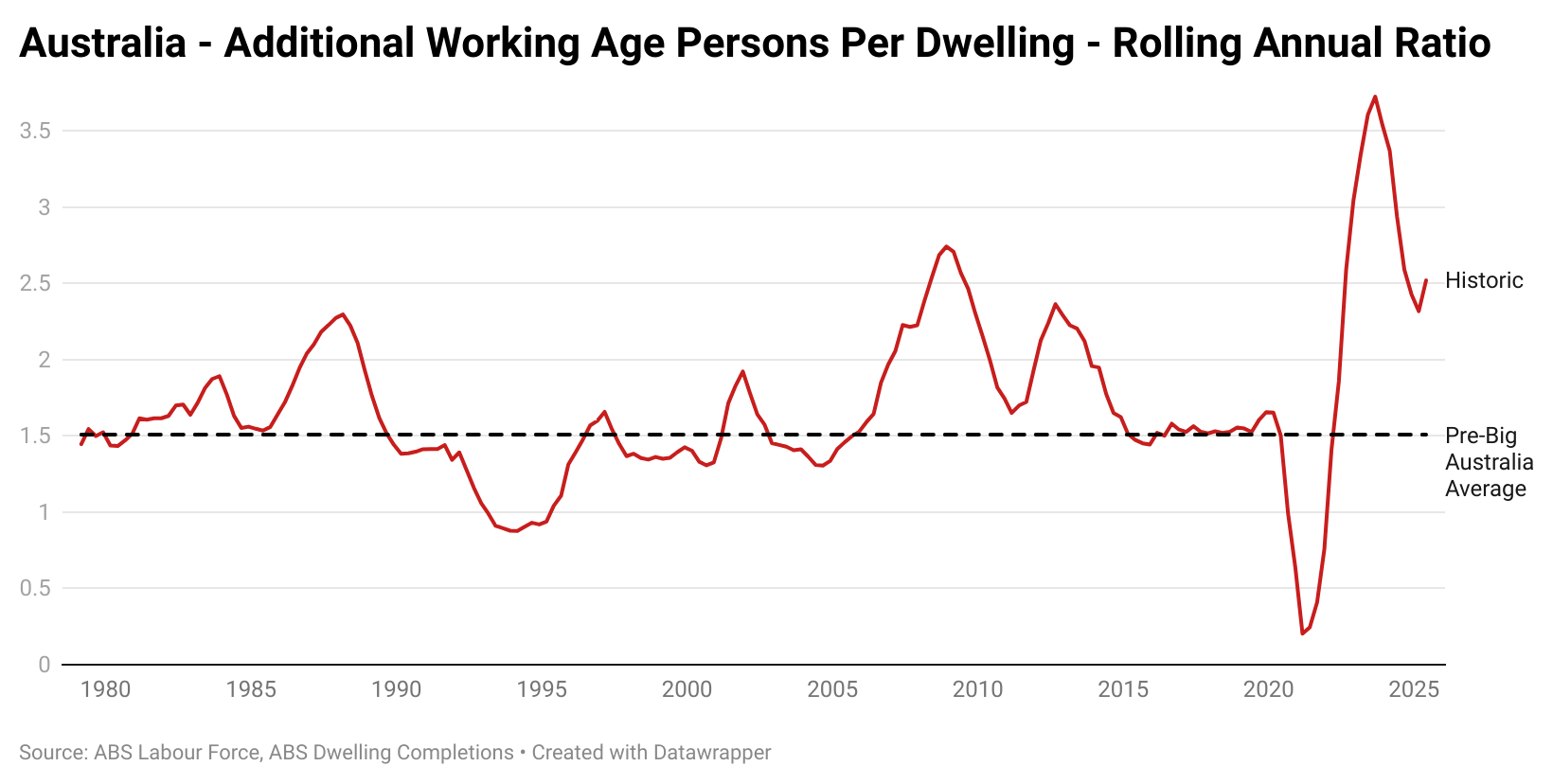
Where issues arise is the level of migration relative to homebuilding.
As the chart below illustrates, the average level of growth in the working-age population per dwelling completed averaged a little over 1.5 across the entire pre-Big Australia era from the late 1970s to 2004.
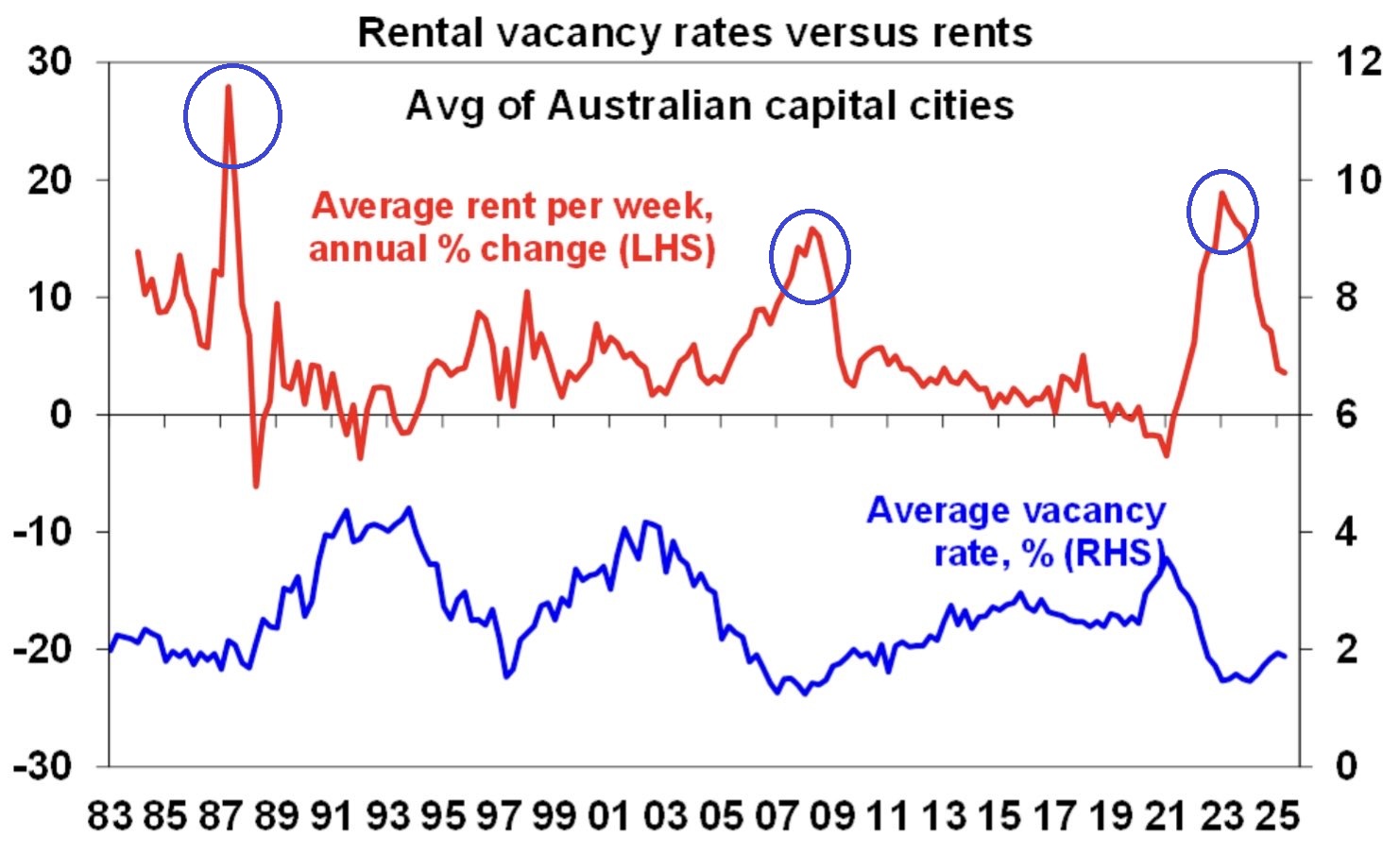
As you can see, there are three major surges in the level of working-age population growth relative to dwelling construction: the mid- to late 1980s, the late 2010s and from 2022 to 2024.
As the chart below from AMP Chief Economist Shane Oliver, along with a bit of rough drawing by me, illustrates, each of those surges in working-age population growth occurred alongside a dramatic surge in rental price growth.
The Takeaway
The relationship between working-age population growth, housing supply growth and rents is inescapable; it is built upon the most basic foundational element of economics, a timeless part of human civilisation.
Prime Minister Albanese clearly understands how the concept works regarding fuel, and one imagines he has forgotten his economics degree from the University of Sydney.
What we too often have in Australia is an unwillingness to admit that the laws of economics exist and by extension that migration naturally impacts the balance of housing supply and demand.
Ultimately, we can all agree that internal migration has a significant and at times dramatic effect on rents and home prices; we should collectively extend that to the impact of overseas migration, considering it is far larger.
