
The CapEx equation: Why inflation has tipped the scales from renovation to knockdown rebuild

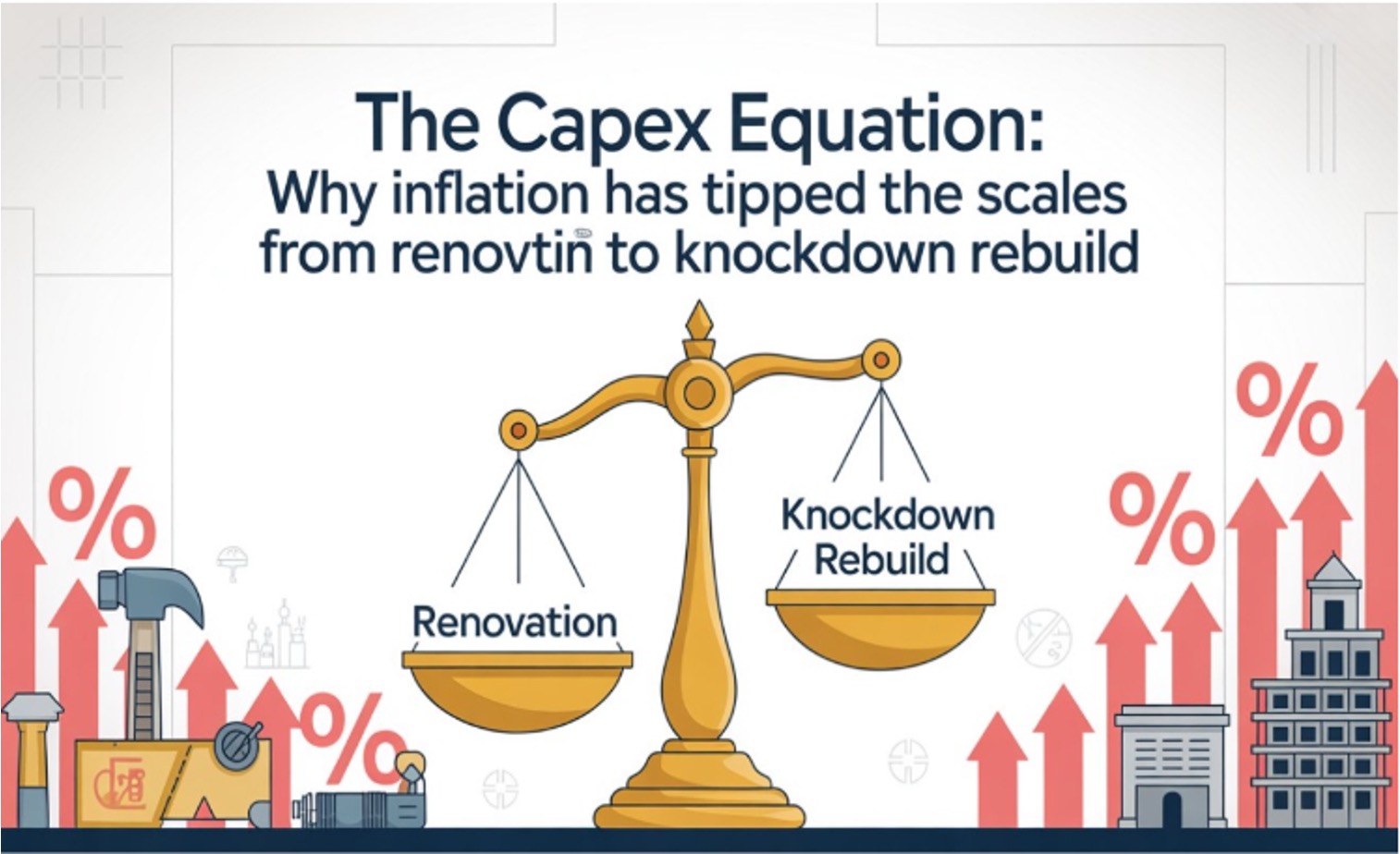
In Australia’s current economic climate, property investors and homeowners face a critical decision: invest in bespoke renovations or opt for a knockdown rebuild. With labour costs and material prices rising, and interest rates still exerting pressure on borrowing costs, the financial calculus has shifted decisively toward fixed-price rebuild solutions as a hedge against inflation and capex risk.
Renovations: A Risky Cost‑Plus Model
Custom renovations have long been a popular method to add value to existing properties. However, data from Victorian volume builder SJD Homes indicates that bespoke projects are highly vulnerable to cost-plus overruns, particularly in periods of construction cost inflation and ongoing supply chain disruption.
According to industry benchmarks like the ABS building construction price trends, prices received by building businesses have climbed sharply in recent years, driven by rising input costs such as materials and labour. These factors compound unpredictability, especially when developers and renovators attempt to budget based on historical costs rather than current market dynamics.
For investors focused on asset value preservation and ROI, this unpredictability translates into significant financial risk.
The Knockdown Rebuild Advantage
In contrast, standardised knockdown rebuild services offer a fixed-price contract model, insulating investors from market volatility. By replacing an existing dwelling entirely with a newly constructed home under a pre‑agreed price, homeowners and investors can achieve predictable capex outcomes without compromising on compliance or quality.
Investors looking to mitigate cost blowouts are increasingly turning to standardised knockdown rebuild services, which offer the fixed-price contracts that bespoke renovations cannot match, says market data from SJD Homes.
This fixed-price contract certainty is particularly valuable when the construction cost environment remains strained. ABS data confirms that building construction prices continue to trend upward, placing ongoing pressure on project budgets and making bespoke renovation budgeting more fraught than in previous cycles.
Economic Considerations: CPI and Construction Costs
The CPI and other inflation indicators reveal the true scale of the cost challenge. Rising labour and material costs, tracked in sources like the Broker News Construction Cost Index, continue to drive up expenses. Renovation projects without fixed pricing risk significant budget blowouts, whereas knockdown rebuilds offer predictable costs and reduced financial exposure.
Market Implications for Property Investors
The shift towards fixed‑price knockdown rebuilds has broader implications for the construction and property investment sectors. As ABS analysis illustrates, the growth in construction costs remains elevated, underpinning a long‑term trend that favors predictable, fixed-price solutions.
From a strategic perspective, opting for a knockdown rebuild allows investors to:
- Lock in fixed capital expenditure with clear contractual terms
- Minimise exposure to cost overruns caused by inflation or design changes
- Improve forecasted ROI through reduced uncertainty
- Protect asset value by delivering modern, compliant dwellings
Conclusion
In today’s economic environment — marked by rising labour and material costs, inflationary pressure, and ongoing supply chain uncertainty — the financial case for fixed-price knockdown rebuilds has strengthened relative to bespoke renovations. For investors and homeowners prioritising ROI, capex certainty, and risk mitigation, structured rebuild solutions represent a more financially defensible strategy.
By engaging with reputable providers for fixed-price knockdown rebuilds, stakeholders gain a market‑tested approach that mitigates financial risk while delivering compliance and modern construction outcomes — a crucial consideration for anyone navigating Australia’s current construction and property investment landscape.