

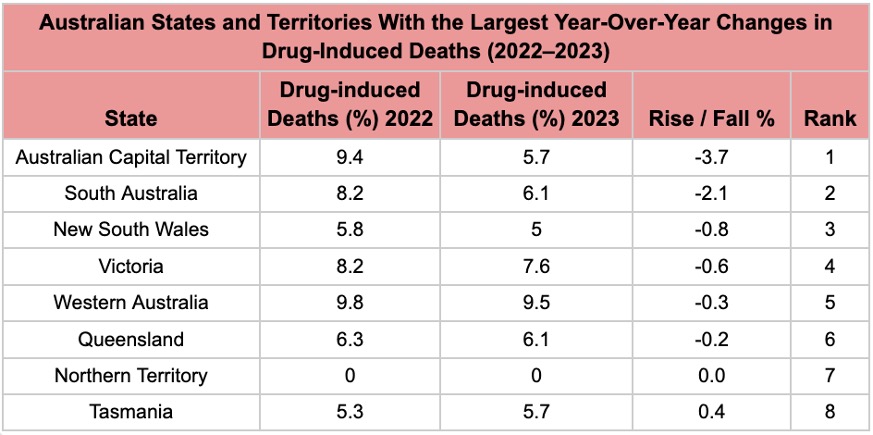
- The Australian Capital Territory has recorded the sharpest fall in drug-induced deaths nationwide, dropping 3.7% between 2022 and 2023.
- South Australia (2nd) and New South Wales (3rd) each recorded drops of 2.1% and 0.8%, respectively.
- While most states reported declines, Tasmania saw a small rise of 0.4 percentage points, and the Northern Territory recorded no change.
A new study reveals that the Australian Capital Territory has seen the largest drop in drug-induced deaths in Australia between 2022 and 2023.
The research by Australia’s top-ranked young university, University of Technology Sydney Online, analysed national drug-induced mortality data across Australian states and territories from 2022 to 2023. The year-over-year percentage changes were calculated to identify the regions showing the strongest signs of recovery and improved public health outcomes.
Australian Capital Territory ranks first with a 3.7% decrease in drug-induced deaths, falling from 9.4% in 2022 to 5.7% in 2023.
South Australia ranks second with a 2.1% decrease in drug-induced deaths, falling from 8.2% in 2022 to 6.1% in 2023.
New South Wales ranks third with a 0.8% decrease in drug-induced deaths, falling from 5.8% in 2022 to 5.0% in 2023.
Looking at the study, a spokesperson from the University of Technology Sydney Online commented:
“The data highlights how drug-induced deaths are declining across several parts of Australia, particularly in the Australian Capital Territory, South Australia, and New South Wales.
“These findings suggest that ongoing public health programs, community outreach, and substance recovery initiatives are beginning to make measurable progress. Continued investment in prevention, treatment accessibility, and education will be key to sustaining these positive trends and reducing the burden of drug-related harm nationwide.”
What Public Health Leaders and Communities Should Know About Drug-Related Recovery Trends
Experts recommend the following actions to help sustain and expand declines in drug-induced deaths:
- Continue funding harm-reduction and early-intervention programs in high-risk communities.
- Expand access to evidence-based treatment and recovery services across all regions.
- Strengthen education initiatives focused on overdose prevention and substance misuse risks.
- Improve data collection and monitoring to identify emerging risk patterns quickly.
- Support community-level outreach programs that connect individuals to long-term recovery resources.
Victoria ranks fourth with a 0.6% decrease in drug-induced deaths, falling from 8.2% in 2022 to 7.6% in 2023.
Western Australia ranks fifth with a 0.3% decrease in drug-induced deaths, falling from 9.8% in 2022 to 9.5% in 2023.
Queensland (6th) recorded a 0.2% decrease in drug-induced deaths, followed by Northern Territory (78th) with no change and Tasmania (8th) with a 0.4% increase between 2022 and 2023.
Table for Extended Results:
The study was conducted by the University of Technology Sydney Online, Australia’s top-ranked young university, and is recognised among the Top 100 universities globally*. Their fully online postgraduate courses provide a flexible, high-quality education designed to fit different career goals
Methodology:
The study analysed national drug-induced mortality data across Australian states and territories from 2022 to 2023. The year-over-year percentage changes were calculated to identify the regions showing the strongest signs of recovery and improved public health outcomes.
Data Sources
- Drug-Induced Death Data → https://www.unsw.edu.au/research/ndarc/resources/trends-drug-induced-deaths-australia-2004-2023
- Research Dataset → https://docs.google.com/spreadsheets/d/1XYOf94eNG_8-VzP9NA8zkS2b5hTXLL_bYhgdsFHf6q4/edit?gid=0#gid=0
- Study by → https://studyonline.uts.edu.au/