No ASX today but a nice post on the Aussie dollar to fill in, from Mr Weston.
The perfect storm for AUD appreciation
The conditions are firmly in place for further AUD appreciation and rather than prophesise where the AUD is likely heading in 2016, short-term traders are best off assessing these key considerations:
Technicals and price action
Volatility and sentiment
Positioning
Yield spreads and moves in key commodities
Technicals – Targets for AUD/USD
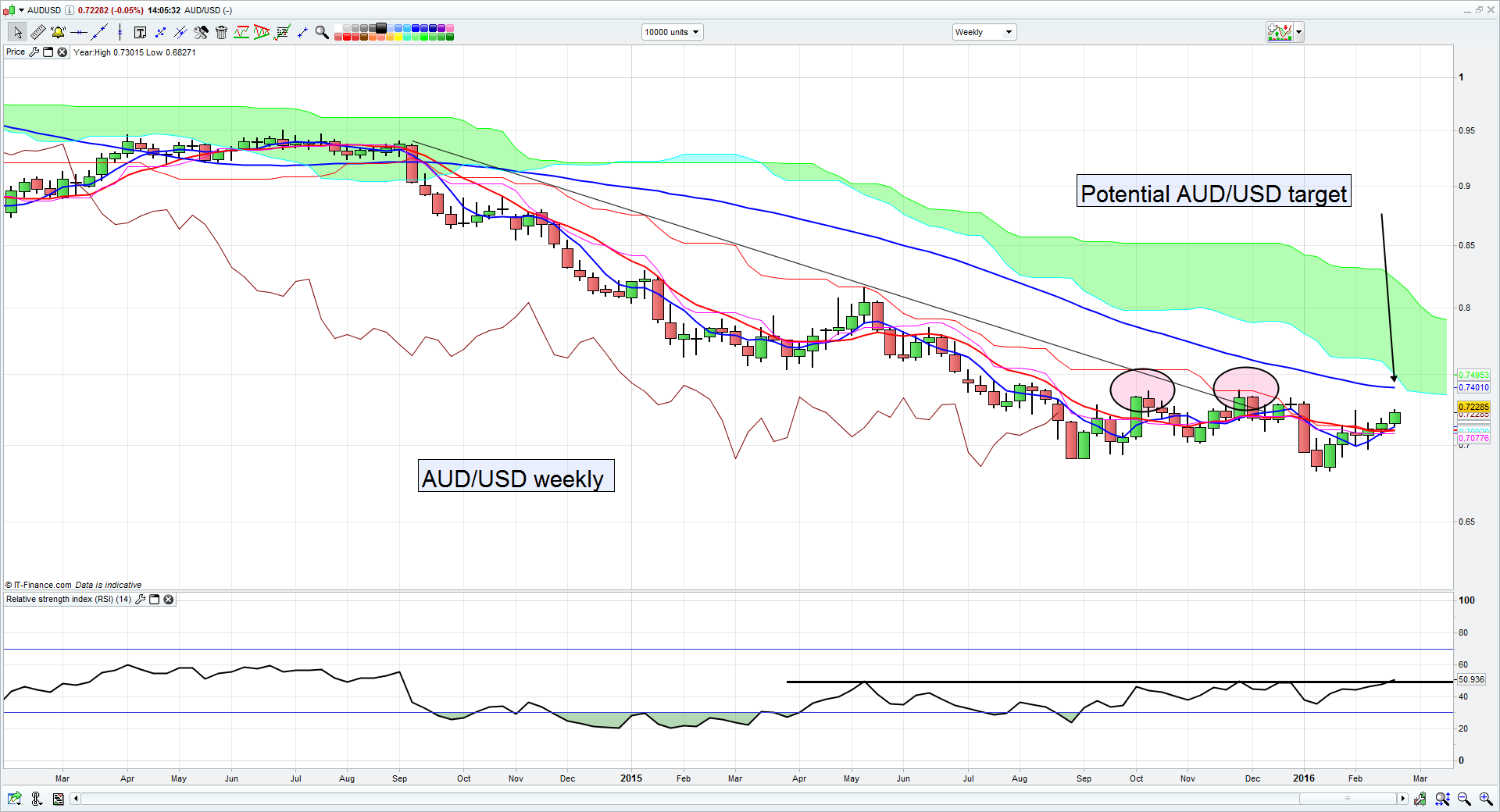
AUD/USD weekly chart
Technically, there is real scope for AUD/USD to trade as high as $0.7375 to $0.7400, which represents the base of the ichimoku cloud and the 55-week moving average. There is also a double top pattern in October and November– circled in red. Looking at the 14-week RSI, we can see this appears to breaking to the top end of the range and above the key 50 level.
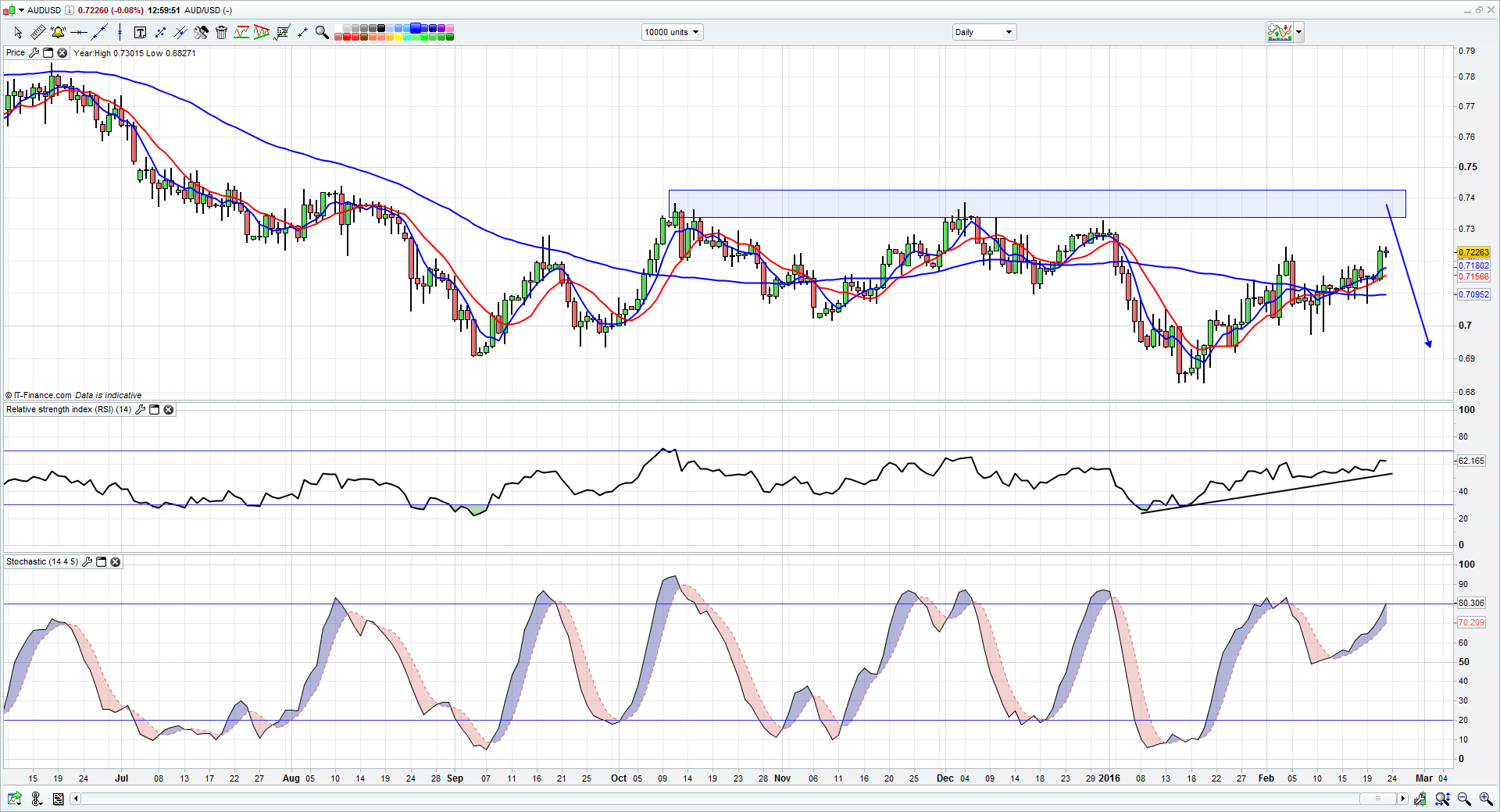
AUD/USD daily
Again, we can see momentum is to the upside (both moves highlighted in the oscillators), suggesting that while price won’t move in a straight line, a move into $07385 to $0.7400 is possible. Price does need to break the February high or there is a risk of a double top. Stops could be placed under the 19 February low of $0.7069.
Volatility
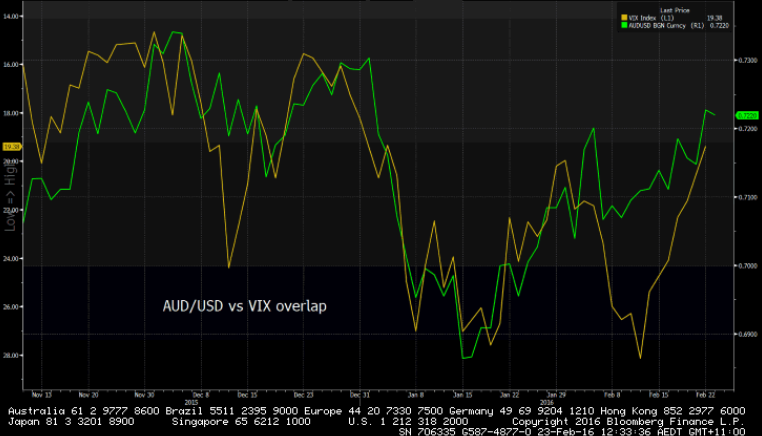
Overlapping AUD/USD to the VIX (the yellow line, I have inverted) we can see that there are periods where correlations are higher than others. The current rolling 30-day correlation is -0.39 (or 39%), which is the strongest inverse correlation seen since 2013. As long as the VIX (US volatilty index) stays low and traders sell volatilty, then AUD should appreciate as traders buy high yielding currencies – the carry trade.
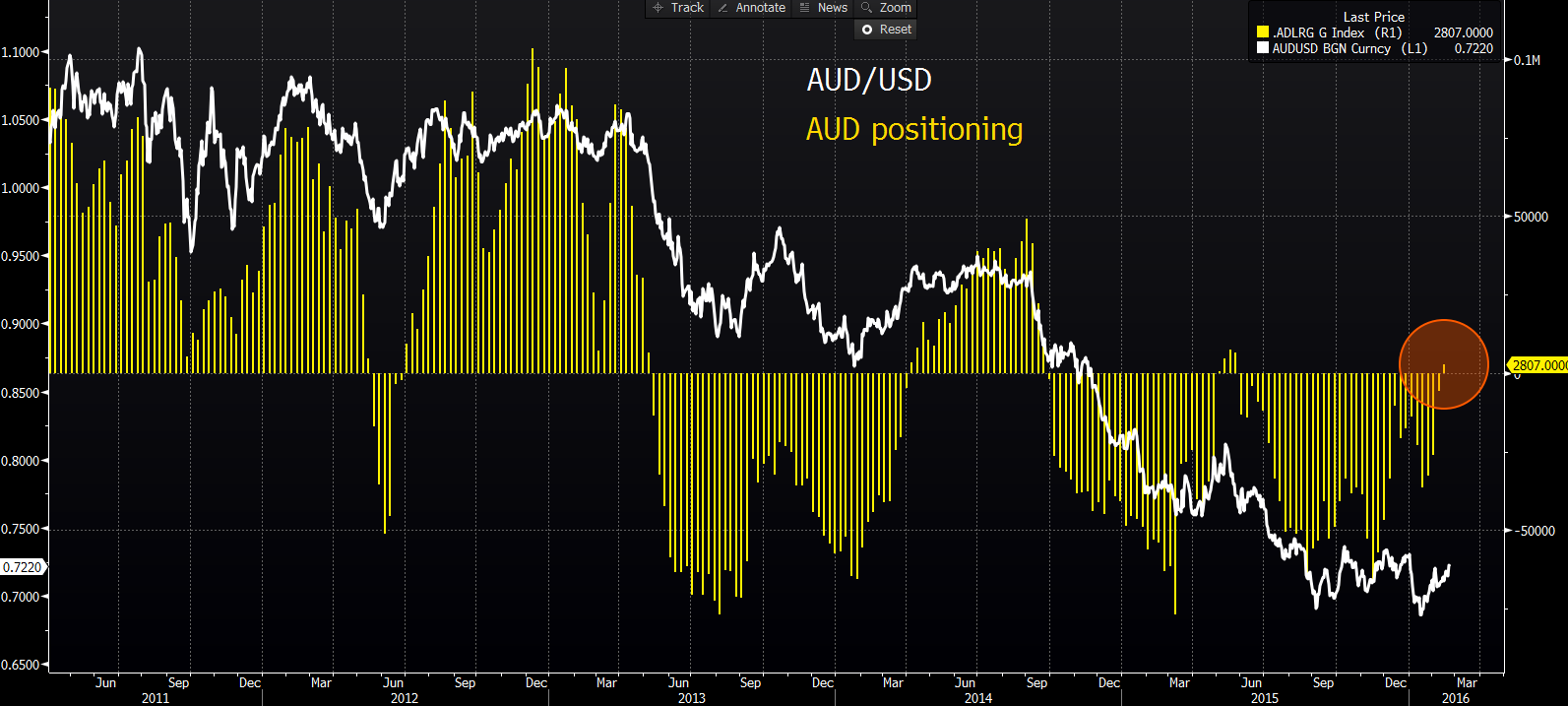
Positioning (weekly Commitment of Traders report)
For the first since June 2015, we have seen the speculative market run a net long AUD/USD position. This tells you quite a clear message on sentiment. It also tells me that positioning is very neutral and not thematic of a market likely to head towards $0.6000 anytime soon.
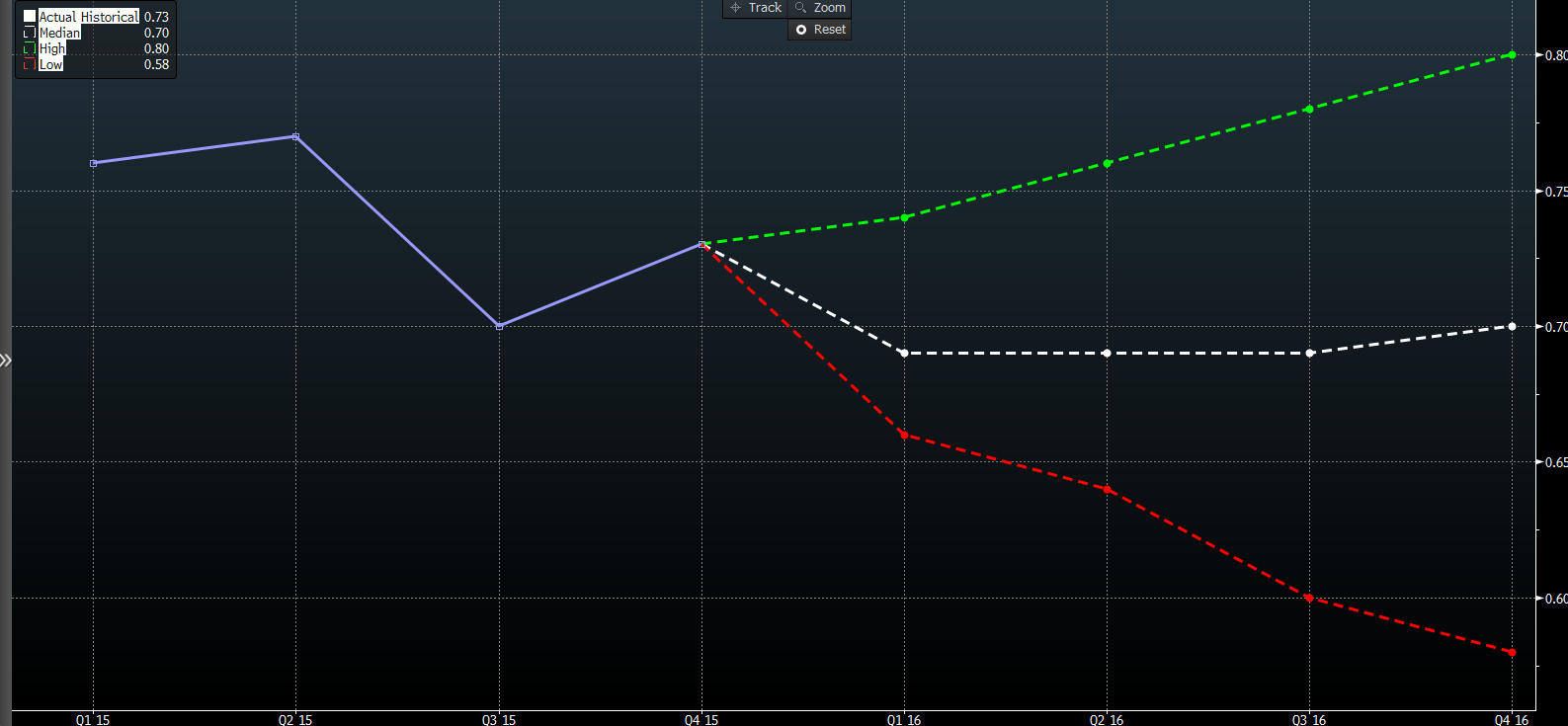
If we look at the FX analysts forecasts for AUD/USD, we can see consensus that the pair averages $0.7000 by Q4 (white line), with the most bearish analyst calling for $0.5800 and the most optimistic $0.8000.
Yield spreads and moves in commodities
Top pane – AUD/USD vs iron ore (red – LHS). The recent rally in iron ore is clearly assisting AUD upside, with spot having rallied 34% in USD terms since the December lows of $38. Seasonality (restocking), improved steel prices, and optimism of steel-end demand are clearly helping here.
Given the expected supply glut of around 45 million tons this year, it’s hard to see the iron ore price having significant further upside, something BHP boss Andrew Mackenzie talked about in today’s earnings report. Still, prices should be supportive of AUD/USD into $0.7400.
Bottom pane – AUS/US 10-year bond spread vs AUD/USD (red – RHS). The premium that the Australian 10-year treasury commands over the 10-year US treasury is oscillating around the 70bp area, but supportive of further AUD/USD upside.
I would also look at oil as a key consideration, especially as price moves into the January highs of $36.27 and the double bottom neckline. A break there could be very positive for oil related currencies. Short EUR/NOK would be a preferred trade.
Conclusion
Given the correlations seen in markets, as long as global equities push higher and volatility remains subdued, then AUD/USD should move higher. Short GBP/AUD and GBP/JPY remain a favourite way of expressing Brexit risk, but I would caution on selling sterling at current levels as price will be fully dictated by upcoming polls, many of which will be wildly inaccurate. As long as iron ore prices remain firm, then I expect AUD/USD to trade into the $0.7385 to $0.7400 area where I would look at longer-term short positions with more conviction.