Chris Weston, Chief Market Strategist at IG Markets
Looking around the Asian region today, the ASX 200 is 0.1% lower, the Nikkei is 0.1% higher and the China CSI is down 1.5%.
We were provided a fairly negative lead from Wall Street and price action as detailed yesterday is starting to look a little more vulnerable. Despite this lead, the two clear highlights in the Asian session have been reports that China has lowered its growth targets to ‘around 7%’, and narrative from Reserve Bank of Australia member Philip Lowe.
Reports are that China have lowered its GDP (to ‘around 7%), retail sales (13%), fixed asset investment (15% from 17.5%), foreign trade (6%), inflation (3%) and money supply targets (12%), although these figures have largely been expected from economists for a while. They should not surprise in any way. The fact mainland markets are lower is probably more a by-product of the heavy amount of retail flow involved in the markets, who perhaps get caught up in semantics more than professionals. The lack of reaction in the AUD/USD or Aussie resource stocks seem the better guide at the lack of surprise on the announcements stemming from the National People’s Congress (NPC).
The current consensus is that we see China growing at 7.2% in Q1, 7.1% in Q2 and 7.0% in Q3, although the risks to Q3 growth are firmly to the downside and 6.5% could be a reality. Expect another 50 basis point cut to banks reserve ratio requirements this quarter.
Australian retail sales grew as expected at 0.4%, however Mr Lowe’s comments were a greater driver pushing the local unit up 30 pips to $0.7843, although sellers have been coming back into the pair. Mr Lowe went out of his way to highlight the central bank are not targeting a weaker currency policy, which should fulfil Australia’s G20 commitments. However, his comments that the AUD is closer to ‘fair value’ has given the shorts some reason to cover positions. His comments that further easing may still be appropriate are a simple reiteration of the official RBA statement and shouldn’t shock but I stand by my call from yesterday to play a range of $0.7910 to $0.7723.
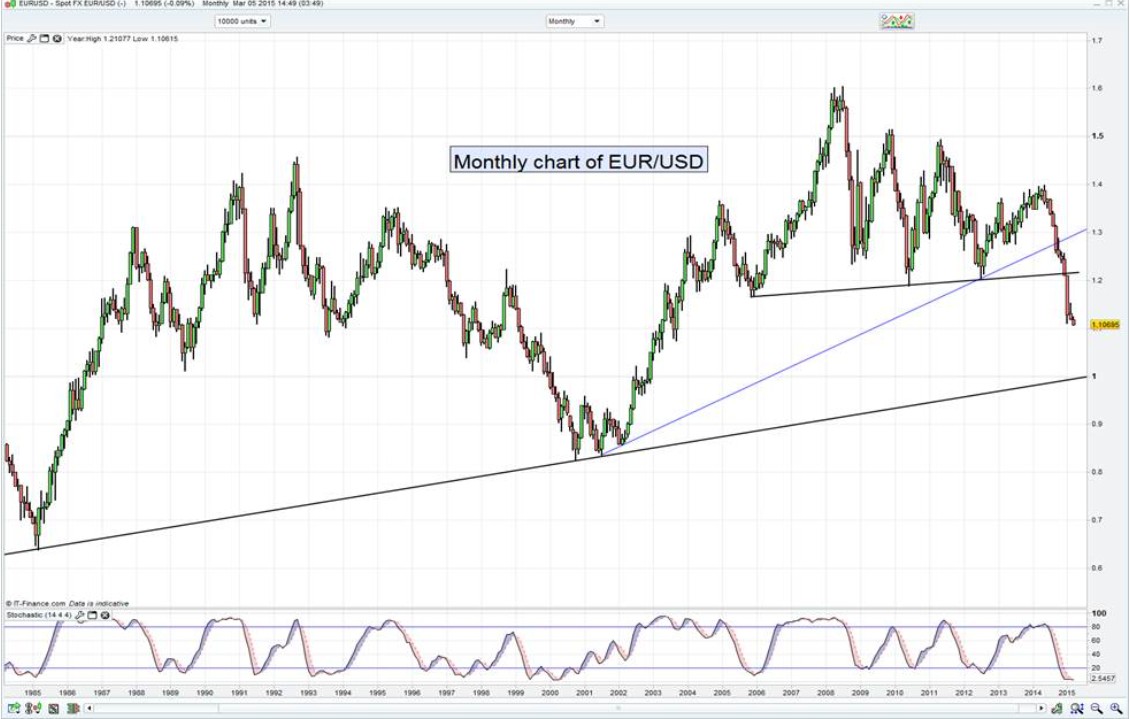
On the FX theme EUR/USD printed the lowest level since 2003 yesterday ($1.1061), taking out the January lows of $1.1097 in the process.
The economic data flow in Europe has been fairly upbeat of late, with Germany driving European retail sales to a 3.7% gain in January, while German manufacturing and unemployment have also been positive. M3 money supply is also increasing and banks seem to be lending more (as shown in the ECB’s lending survey) and this seems key if Europe is to grow.
The data seems to be providing some backbone to European equities and while the perception of central bank liquidity is helping sentiment, for the first time in years, we are actually seeing positive net EPS revisions. These issues are helping European markets to outperform and should continue to do so for the months to come in my opinion.
European inflation expectations have picked up somewhat of late with the five-year swaps market (the ECB’s preferred measure of inflation expectations) pushing from 1.48% to 1.72% since mid-January. This is probably a function of brent prices finding stability as well, but it highlights that traders could be warming to the idea that the deflationary threat is waning.
Yield spreads driving FX markets
Importantly though, the European bond markets haven’t really responded to the economic data points. This is best measured by looking at yield spreads and the difference between one bond market yield and another. If we are looking specifically at EUR/USD, the two-year US treasury commands an 88 basis point (or 0.88%) premium to the two-year German bund – I have looked at the two-year bond as it is more sensitive to interest rate expectations. As the US treasury premium increases, so the USD becomes more attractive to investors.
This thematic is unfolding in AUD/USD; with the pair finding buyers, as the premium the Australian two-year treasury holds over US treasuries has increased after the Reserve Bank of Australia meeting. Specifically, we have seen the spread in short-term yields increase to 125 basis points (or 1.25%), from 114bp. If the RBA wants the trade-weighted AUD to fall closer to ‘fair value’ then they really need to drive bond yields lower, as the European Central Bank is doing. What’s occurring here shouldn’t be seen as a currency war; to me this is an interest rate war. Lower bond yields result in a lower currency.
Corporates issuing debt extremely cheaply
In Europe, bond yields are not only negative in the secondary market (where traders freely buy and sell), but we have recently seen Germany and Austria actually issue debt with a negative yield (governments are effectively being paid to borrow money), something many thought they would never see. On the corporate side, French energy giant GDF issued 20-year debt at a coupon (and therefore a yield) of 1.5%, which is amazing in itself for a corporate, while Nestle recently saw its own bonds trade with a negative yield in the secondary market.
It’s not just European companies, but globally corporations have ramped up the levels of debt they have issued in EUR’s. This firmly puts the EUR as the markets preferred funding currency for carry trade structures.
The ECB meet tonight and while there will be upgrades to the bank’s GDP forecasts (economists are expecting 2015 GDP forecasts to increase 30bp to 1.3%), there will also be some punchy downgrades to their inflation forecasts too. Importantly though, the market is keen to understand the technicalities around its proposed bond buying program. How will they actually achieve the €60 billion a month in public and private bond purchases, in turn expanding its balance by over €1 trillion by September 2016? Will the buyers predominately come from domestic or foreign banks (like we saw when the Federal Reserve started buying its own asset purchase program)? Will they use traditional market markers, or use less conventional avenues, such as reverse auctions in the purchases?
Importantly, the ECB will be buying more European bonds than are being issued by sovereigns as part of their funding requirement, so in effect we are seeing negative net issuance. By its very nature, this will keep European bond yields low, so in turn we should see US bond yields blow out against European bond markets. The end result should be a weaker EUR.
The technical set-up is clearly bearish with EUR/USD breaking through the 2005 and even 2001 uptrends in Q4 2014 and is now eyeing the uptrend drawn from the 1985 low around the parity level. On the daily chart, both trend and momentum oscillators suggest selling rallies with lower levels expected on multiple time frames.