

US investors could overlook US data again today; although June CPI and industrial production are due, Q2 earnings from Goldman Sachs, Johnson and Johnson, Coca-Cola and Yahoo (after the closing bell) could see the S&P 500 close up for a ninth day. Interestingly, the small cap Russel 1000 is also up, and has been for the last eight days, which is one of the best runs in around six years. What’s more, only 3% of stocks have gained every day in-line with the index, thus rotation is naturally occurring, which is a positive sign in a market approaching all-time highs.
Any one of the aforementioned names could be responsible for pushing the S&P through the all-time intra-day high of 1687, although Goldman Sachs looks especially interesting, notably after beating on the bottom line (EPS) in six of the last eight quarters. A decent drop in revenue of around 21% is expected, with investment lending right at the heart of that decline.
Asia has been relatively subdued today with the Nikkei playing catch up after being closed for Marine Day yesterday. The index hit a high of 14,638, although tailed away after the first couple of hours; momentum-focused traders will want to see a daily close above 14,595 (the 61.8% retracement of the May to June sell-off) to encourage a more expansive move to 15,000.
USD/JPY looks heavy above 100.00 and although the Japanese Upper House elections on July 21 should provide the Abe government the necessary control of the DIET to smoothly push through structural reform over the medium term, the prospect of a dovish Ben Bernanke in the coming days is keeping the USD bulls in check. A number of downgrades to the US Q2 run rate to between 0.5% and 0.8% after yesterday’s June retail sales have also suppressed the USD and helped ease the ten-year bond to the 2.50% area.
It was interesting to see statistics from Financial Futures Association of Japan detailing activity by Japan retail traders increased 16.3% in May to $5.4 trillion (¥532 trillion). This is effectively the highest level since November 2008, and by all accounts the flows continue to be aimed at short JPY positions. While there is nothing to gain from this directly as a trade, it perhaps highlights the belief on the ground that Abenomics is working and could actually create inflation.
China has rallied 0.4% (CSI 300), although the index was lower for most of the day, not helped by a fall in real-estate developers. Housing is still a major issue in China, and tomorrow’s June property price will certainly be watched closely by the market. Yesterday’s data dump showed the property sector continued to grow with property construction gaining 14% in June and 8.8% year-on-year in Q2. There is every reason to believe that housing starts should continue to push higher at a subdued rate, despite clearly lower contributions from the shadow banking committee. From a direct equity perceptive, statistics from the China Securities Times suggested that of 1530 Chinese-listed companies, around 30% have shown a decline in net profit.
It is worthy of note as well that USD/CNY is trading a two-week high and clearly we have got to the point where the PBOC has a pro-growth measure again, although we don’t expect a major move higher (or lower in the RMB) anytime soon.
In Australia the local market has traded in a range of 4999 to 4973 and again seems to take intra-day support from China. Rio’s production numbers look fine, business as usual. If you’re short stay short, if you’re long stay long, the investment case hasn’t materially changed. The key talking point was initially the earlier implementation date of the ETS scheme, although this was later overshadowed by the RBA minutes which have taken the market by surprise. Seldom do the minutes move markets as it’s simply a stretched version of the original statement, however in a market searching at every turn for clues of an August cut, the minutes today have shown absolutely no rush to ease again. This is a market that is short AUD in a big way and positioned for an August cut; narrative that policy was appropriate for the time being, especially in light of the falls in the AUD suggests the bank is in no rush to ease again. Interestingly AUD/USD was at 0.9230 at the last meeting, thus the pair will probably struggle to get too much traction past this level, although one suspects that it will take its direction from the USD side of equation from here.
AUD/USD has rallied to a high of 0.9195 (from 0.9105 pre minutes), while the more interest-rate sensitive AUD/NZD pushed back above the 1.17 handle. The RBA has left the door ajar, but we’d expect the probability of a rate cut to decline further from its current stance of 52% (down from 68% at the start of the day); it’s not hard to think this could fall to a 30% chance, despite business confidence being poor and employment hardly inspiring. From a momentum perceptive we could look to sell on a daily close below 0.9080 and would potentially add on a further move through the recent low of 0.9037.
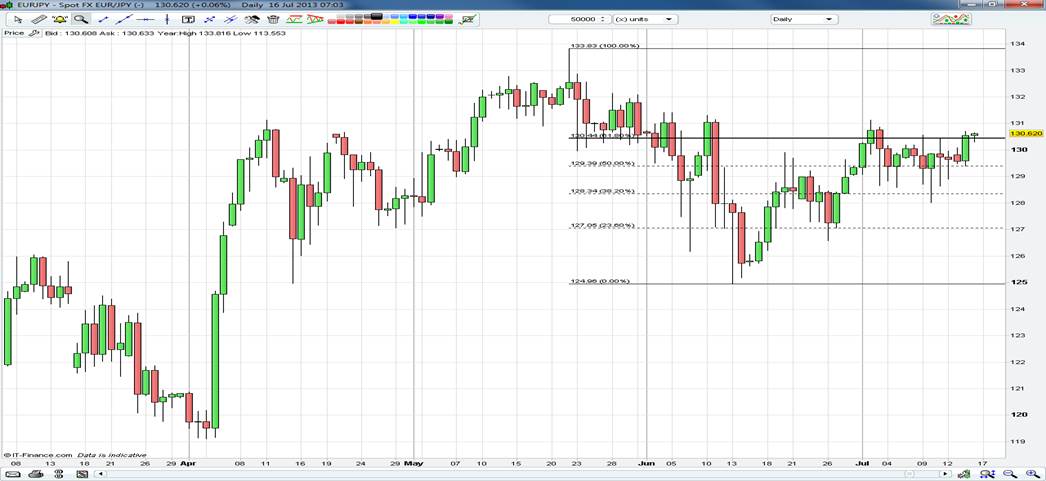
European markets look like they will see a lifeless start although momentum is to the upside and there are plenty of catalysts over the next twelve hours for both the bulls and bears. In the UK inflation should be seen running at an annual rate of 3%, so Mr Carney should already be in the midst of putting together his letter of explanation to George Osborne. Cable looks like a sell above 1.5200, while EUR/USD could re-claim the 1.31 level if today’s ZEW confidence print shows improvement as expected. EUR/JPY looks interesting having broken (but yet to close) above the 61.8% retracement of the May to June sell-off (133.81 to 124.96) at 130.48. A close above here could signal a more pronounced move to 135 and onto 137.