

In Asia, those left in the market that aren’t ‘feral hogs’ continue to be thrown by the ever-changing macro landscape, with a poor Chinese tape among a backdrop of Fed members showing genuine concern about the bond market’s reaction to the tapering debate.
The fact that bond yields across the world have seen such an aggressive sell-off hasn’t pleased the Fed, although its immediate concern is its own market; clearly 2.54% is not where it would like the benchmark borrowing rate to be. Comments from the likes of James Bullard, Narayana Kocherlakota, Bill Dudley and Richard Fisher seemed to be enough to push back at the one-way price action in the bond market, although it’s Dallas President Richard Fisher’s outspoken comments which have stolen the headlines. We always look for a change in stance from the Fed’s doves and hawks, and thus an uber-hawk sounding dovish will generally catch our attention, even if they are a current non-voter. It seems Mr Fisher’s comments were aimed directly at the bond market vigilantes who he believes have taken things way too far. He also backed it by saying he wasn’t in favour of going from ‘wild turkey to cold turkey overnight with regards to QE; two cracking headlines in one speech and clearly Richard Fisher gets the award as the most entertaining member of the FOMC.
With a number of Fed members pushing back on now elevated yields, we wouldn’t be surprised to see bond yields head lower. The ten-year bond is now 30% away from its 50-day moving average, which is the most stretched it has been in the last 50 years. Still, the trend higher is strong and we’d be waiting for signs of a reversal before buying; however it is worth pointing out that the primary downtrend drawn from the 2007 high comes in at 2.75%, and this could a good entry point for longs. Fundamentally we really can’t see why yields are this high. The $64 billion in five- and seven-year US treasury auctions over the next few days could highlight that the investment community sees value at current levels, or they may stay out and wait for even better levels. Improved demand (bid to cover) could be very interesting, especially for the USD which has been benefitting from a widening of yield spreads relative to other developed nations.
China has fallen away as the day has rolled on. This is another market where the bears are having an absolute field day, with futures markets in the CSI futures, A50 and H-shares finding one-way traffic as the day grows on. The seven-day repo has once again shown wild price action, trading between 16% and 6%, although it remains marginally higher on the day. We sit in the camp that the actions of the PBOC will ultimately be seen as positive given the long-term goals to reduce the instability in the financial sector; however the growing fear is that Chinese growth will miss the PBOC’s forecasts for the first time since the Asian crisis in 1998. There have already been at least five Chinese financial institutions pulling out of bond issuances in the last few days, and there has been increased stress on the mid-sized banks; many which source around a quarter of funding needs in the money markets. Many also use these funding lines to pay for maturing wealth management products (WMPs). Recall these are the high-yielding assets which Chinese nationals can invest in and subsequently it has been speculated that much of these funds have been lent out to SMEs (small to medium enterprises) at much higher rates, fuelling the much publicised credit boom. The issue now is that these medium sized banks’ margins may be at risk, although that’s exactly what the PBOC want to see to stop the expansion of credit. However, the consequence this could have on the SME space is real and could have negative implications.
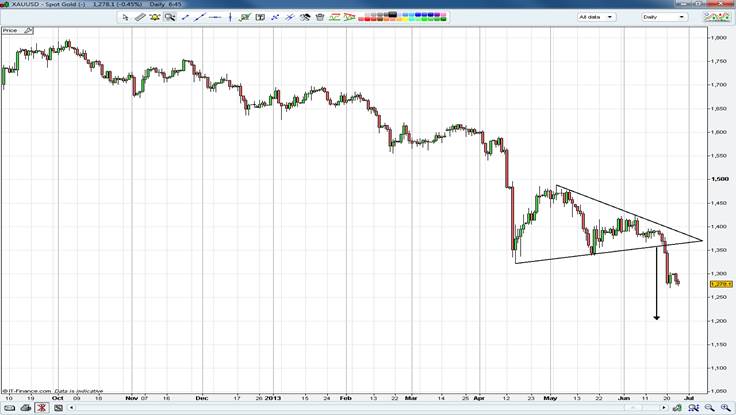
With the S&P 500 closing down 1.2%, it was initially positive to see both the Nikkei and ASX 200 in the green, however as China fell away so did these markets. It is interesting to see the pick-up in correlations between the ASX 200 and Chinese equity market, and as things stand at 0.44 (or 44%), it is the highest correlation since Q3 2012. It was positive to see the market rally off the low of 4632 (closing at 4656) having breezed through 4649 (2012 closing level) taking the ASX 200 now negative for the year; while this may be merely psychological, it is interesting to see the massive rise in banks CDS (credit-default swap) spreads, while BHP has been approaching the key buy-zone over the last few years around $30.00. One gets the feeling that the buyers won’t be so prevalent in the miner this time around. This is a trader’s market front and centre, and the lack of clarity should keep the investors away for now. This is an index that is in a firm downtrend and seems to be hit by both top-down macro themes and on a bottom-up perspective, with guidance downgrades seemingly by the day. Gold stocks have also been hit hard again and this is a sector we feel needs to be avoided at all costs, especially if we are starting to see positive real bond yields emerge in a number of developed nations.
AUD/USD has fallen as you’d expect, and despite short positioning at extreme levels a move through 0.9148 can’t be ruled out. Strength in US durable goods (consensus +3%) and a strong Case-Shiller housing print could see the USD bid and the pair’s lows tested. We’d expect the durable goods print to be positive given the potential for strong airplane orders.
European markets were looking positive, but the falls in the Nikkei, China and the ASX 200 have seen US futures pull back and traders selling our out-of-hours markets. Still, a flat open looks likely and one gets the feeling that won’t be the case for too long. US data will be in focus, while in Europe we get consumer confidence in Germany and business confidence in France. Retail sales are released in Italy, while Holland announces GDP figures.