Month-end flows have negatively impacted the USD, as money managers re-weighted holdings towards EUR, NZD, GBP, AUD and CHF. We wouldn’t be surprised to see this play out today, and it could potentially provide USD bulls better levels to buy.
Yesterday’s US Q1 real GDP print was revised to 2.4%, and clearly the weakness was down to inventories and government data. However, if you take these factors out of the equation, then GDP would be running closer to 3% in Q1 and you could also revise Q4 up to 3.3%. All-in-all, these are pretty healthy numbers and it will be interesting to see if this trend can hold up or if growth will gravitate towards this week’s OECD forecast of 1.9%, which also happens to be consensus among the economist community. Weekly claims also pushed up more than expected, and now the four-week average sits at 347,000, although some will point to a large 16,000 drop in claims in California. Certainly this data saw US bonds bid, and yields on the ten-year fell four basis points (bp). It will be interesting to see how bonds fair going forward, especially as UBS have suggested that its models indicate yields (on the ten-year) are 50bp above fair value. A move to its suggested target of 1.70% (now 2.11%) would probably be quite painful for USD and potentially equity longs.
US equities set up Asia positively, and today’s US session will be interesting given its month-end and the S&P is still up 3.6% for the month, which means it is the second best performing major market (in USD terms), behind the DAX (up 5.1%). We are keeping an eye on the Dow Transport index, which is sitting on key horizontal support. Data is in full force today, with personal income and spending expected to be flat on the month. Chicago PMI and University of Michigan confidence are released ten minutes of each other, and it will be interesting to see if these sentiment numbers mirror the increase seen in the Conference Board numbers earlier in the week. We will also be watching the core PCE numbers at 22:30 AEST, with consensus sitting at a meagre 1%. A number below 1% would be a kick in the guts for USD longs, as it would re-enforce the idea that the Fed will not taper in September.
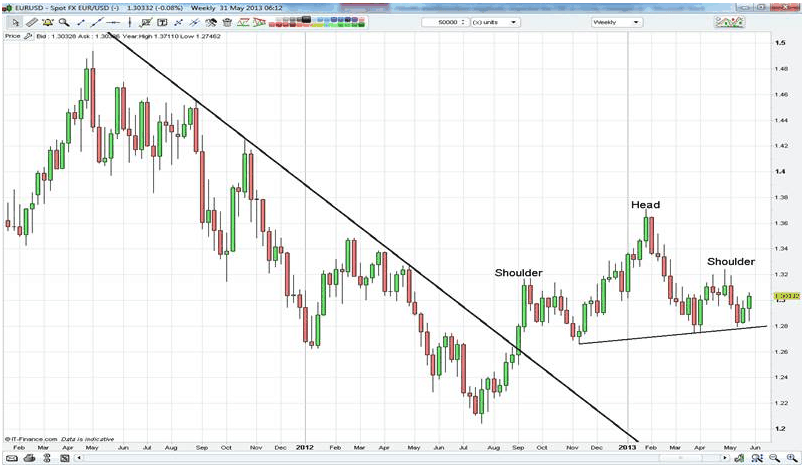
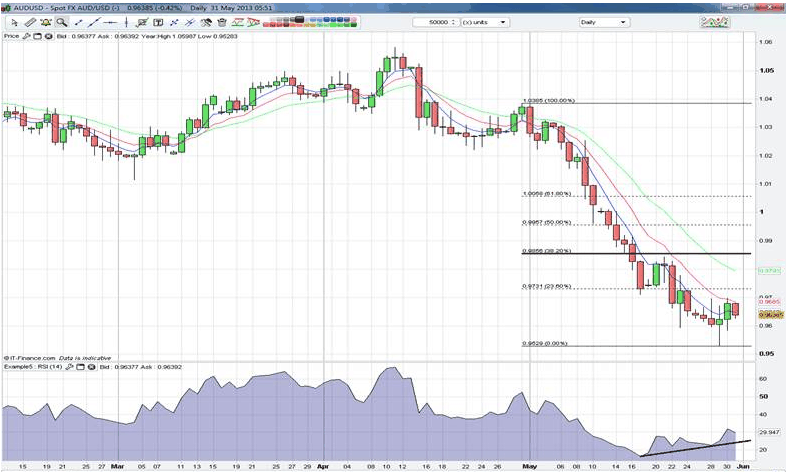
Price action in AUD/USD and EUR/USD will be of interest especially. On the daily chart, AUD/USD looks like it could see some consolidation, having seen positive divergence on the RSIs. Key resistance sits at 0.9855 (the 38.2% retracement of the 1.0384 to 0.9528 move) and we would look to sell into rallies at this level. EUR/USD has pronounced multi-month head and shoulders pattern (on the weekly chart) and a closing break of the neckline at 1.2792 is needed for a significant decline to materialise. It seems the market is happy to defend this level though, and a look on the daily chart shows the pair could squeeze up to resistance at 1.3070 (both the downtrend from the February 1 high and 61.8% retracement of the 1.3243 to 1.2797 move). The pair closed above the 200-day moving average yesterday, and clearly talk about increased LTRO (long term refinancing operations), payback from banks and improving credit demand is helping.
(Daily chart of the AUD/USD)
Back in equity land, it’s better days for Japan, with the Nikkei up 1.4% at 13,851, although futures fell heavily after the post-match auction. What is also helping is speculation that the Government Pension Investment Fund could look at a new approach to portfolio strategy that would create a higher allocation of stocks. The index is still down 0.2% for the month, which, if it closes at current levels, would end the run of nine positive months. Interestingly, after the index rallied to 15,942 earlier this month (up 15% on the month), it was only the second time since 1973 that the index has given up a 10% gain to close lower; such is the volatility. Data out of Japan was pretty much as expected today, and while industrial production (+1.7% in April) grew more than forecast in April, it was another month of deflationary forces, showing the mountain that the BoJ has to climb to get to 2%!
The ASX 200 has found modest buyers for most of the day, but closed lower after a big tick lower after the unwind of the post market auction. After one day of poor price action, Goldman Sachs call to sell banks and buy miners is back on in earnest. The materials space is up 1.2%, with utilities also putting on a good show, higher by 1.5%. The index closed down 5.1% this month, which looks to be the worst monthly performance since the 7.3% drop seen in May last year. Interestingly, if you price the index in USD terms, the market is down a massive 11.4%. In fact, it is the worst performing market of any global index in any G10 currency. When the banking sector makes up such a high contribution to the overall index, you can see the impact an 8.3% fall can have.
With Asian leads holding up and US markets pushing higher, it’s interesting to see a mixed open across the European markets. Traders and other money managers will continue to manage portfolios into month-end, while keeping an eye on the upcoming economic data. On the docket we get reads on unemployment and CPI reads for the eurozone and Italy, while retail sales numbers from Germany and France will be in focus. The UK will also produce net lending figures, however it’s worth highlighting that China releases PMI data on Saturday, so we could see AUD/USD gap on Monday if the read misses consensus of 50.0.
(Weekly chart of EUR/USD)