


The USD is once again in vogue across the G10 complex, and this time it’s not just ‘tapering’ that is causing the USD buying, but genuine selling in the bond market which have caused the USD inflows.
Yesterday’s monster sixteen basis-point (bp) move to the upside in the ten-year treasury has been widely talked about on the floor, with the yield not just printing a new yearly high, but now honing in on the 2011 high of 2.41%. We are now looking at a ‘mere’ 125bp advantage that Aussie government bonds holds over the ten-year US treasury, compared to 171bp in March, and you can see why AUD/USD is in such a strong downtrend.
The 10.9% yearly jump in US house prices (the biggest since April 2006), seems to be a key catalyst behind the strong rise in consumer confidence (the highest reading since February 2008), however a poor two-year auction also pushed up yields. Perhaps this low demand is a function of expectations of future ‘tapering’, or even strong equity markets, especially after twenty weeks of equity inflows, however it puts today’s $35 billion five-year auction firmly in play. Traders will be keen to look at the bid-to-cover ratio, with the last auction seeing this ratio at 2.86 times. With a lack of US data and Fed speakers today, this auction could get quite a bit of attention.
Thursday’s core PCE will now be the key upcoming release, especially as consensus is a lowly 1%, which should keep the Fed printing at its current rate through to December in our view. We also feel the market is stating it feels next week’s all-important payrolls report will be strong as well. We will await this event in earnest and are keen to see exactly what happens to risk assets like equities if the number prints significantly above expectations of 163,000 jobs. We feel this could highlight a lot about current sentiment. We just don’t see the market being ready for the Fed to ease back on QE at this stage, however we feel there will be a time when the market accepts the Fed’s actions, but this is months away.
Japan has taken a back seat for once, although the intra-day 269 point range is still high by historical standards and the market seems quite perplexed as the late day crash in the market. Yesterday’s poor 20-year JGB bond auction is still leaving a bitter taste in the domestic bond market, and yields have continued to push up again and now sit at 92bp. BoJ Head Haruhiko Kuroda meets key market players at 17:00 AEST and hopefully he will be able to fully dictate what the bank is actually trying to achieve with regards to yields, as well as any future actions it may have in instilling confidence. Of course these may include heightened transparency around bond-buying (Rinban) operations, increasing the frequency of JGB intervention among others factors.
Perhaps the focal point of Asia though is further negative sentiment towards Australia, with the market taking it out on the local unit. Firstly PIMCO suggested Australia needs easier monetary policy, saying the sovereign is facing an economic hole as mining is set to decline and will struggle as China’s GDP trends towards 7%. This view was then complemented with a 2% decline in Q1 construction work (consensus +1%). Historically, the market has tended not to put too much emphasis on this reading, although we highlight that it feeds nicely into future GDP reads through dwelling investment, which itself accounts for 5% of GDP and non-residential construction at 9% of GDP. What’s more, the warm weather of late had a few thinking we could have had an upside surprise, given warm weather can be positive for construction. Interestingly, the ASX 200 is up 0.1%, helped largely by stocks with foreign earnings and a strong rotation into materials names from the banks following a recommendation by Goldman Sachs to do so.
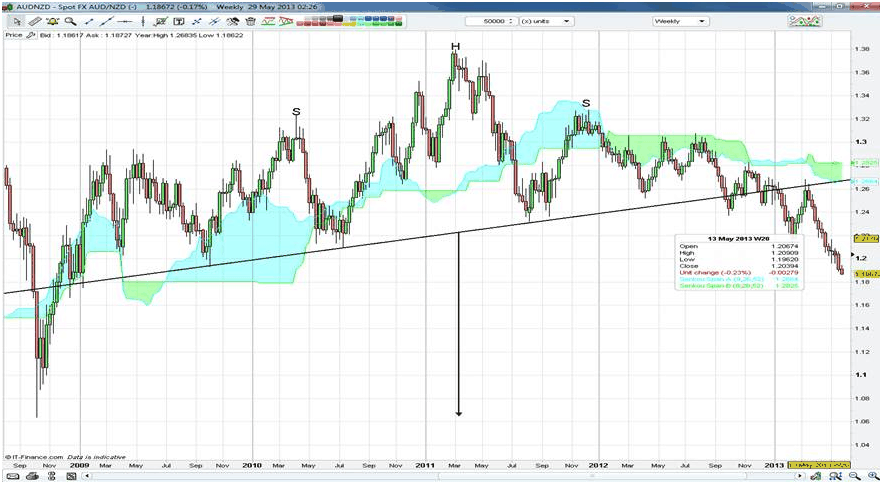
AUD/USD has hit a low 0.9527, which is the lowest level since October 2011. The key now is whether the pair can maintain this momentum and close below the June 2012 pivot of 0.9582. A daily close could see the pair go on to target the October 2011 low of 0.9387. AUD/NZD still looks good to the downside and could target 1.06 over the longer term given the break of the neckline of the head and shoulders pattern.
Europe looks set to undo much of yesterday’s hard work, with a weak open expected across the board. Germany looks set to get the lion’s share of attention given German data is in full focus tonight, with German CPI (expected to print +1.3% year-on-year), unemployment (anticipated at 6.9%) and the employment change. EUR/USD continues to trade in its 1.28 to 1.30 range, and as we said yesterday, we prefer long EUR/GBP at present. The fact that Brussels is moving away from austerity is positive, and from a currency perceptive so is the clear rejection (as things stand right now) of negative deposit rates.
From a currency perceptive, USD/CAD will be in focus with the pair continuing to push above 1.0400 ahead of today’s Bank of Canada meeting, with traders eyeing the June 2012 high of 1.0447. This is Mark Carney’s last address as the head of the Bank of Canada before he starts his post at the BoE in July. We aren’t expecting too much from this central bank meeting and wouldn’t anticipate the bank to alter its interest rate or inflation guidance. If anything, the BoC will take heart from the rise in bond yields, as this will naturally drive mortgage costs up, which will lower the chance of rate hikes driven by the ‘overpriced’ housing market.