

The USD has been modestly offered in Asia, although it doesn’t feel like we are going to see significant downside anytime soon. We have long held a longer-term bullish view on the USD and continue to do so, but against select G10 currencies we feel expectations have become a touch optimistic and we could see modest downside in the short-term.
US bond yields remain the key though for both the equity and currency markets, and a break of the year high of 2.09% (on the ten-year) could bring the 2011 high of 2.41% into play. The USD will continue to find buyers in an environment of rising yields, especially as inflation expectations are falling and threat of positive real yields will send investors out of stocks and back into the bond market. We are not seeing the great rotation trade emerging, and unless inflation expectations can increase in-line with yields, then we would not be surprised to see the S&P 500 find sellers at the top of the rising channel.
Our view though is that the USD is a touch overbought at current levels, and despite some big technical breaks against other G10 pairs, it could be bought at more compelling levels in the short term. We still don’t believe the Fed is going to change policy in its mid-year meeting and will look forward to Ben Bernanke’s testimony on May 22, in which he may look to put the market back in step after comments from well-known hawks and non-voting members Charles Plosser and Richard Fisher. Of course we have had two strong weekly jobless claims and a solid non-farm payrolls report as well, which now has employment tracking above Chicago Fed president Charles Evans’ target, however we still have the full sequester period to play out. Thus expectations in the market have got a touch too bullish for our liking right now.
Gold is also a good indicator of expectations around the Fed, and the fact the metal has put on $10 today shows some of the expectations of near-term asset purchase slowing are being priced out.
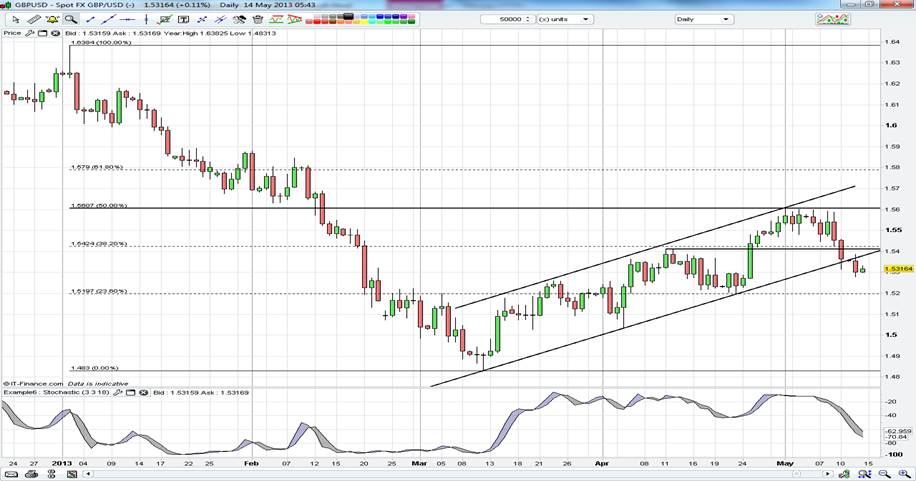
Cable looks interesting after the channel break, and we would look to sell up the former uptrend of 1.5370, with a potential stop at 1.5430 (above the 38.2% retracement of the 2013 high to low and April 11 high). We would look to target 1.5200 and below in the medium term.
USD/JPY has traded in a range of 101.86 to 101.35, although our bias is to buy dips and we feel having a nibble at 100.40 (just above the 50% retracement of the recent 99.15 to 102.15) could be good entry point; stops could be placed just under the big figure at 99.85. This fits in with our view that the USD could find sellers in the short term. The JGB (Japanese government bond) market has once again seen heavy selling with the ten-year bond hitting 86.4 basis points (bp),the highest level since August 2012 (86.7bp). According to finance minister Taro Aso, this is a function of investors buying stocks and shunning bonds, which in theory is good, although stops short of the ‘Abenomics’ plan to get investors to buy foreign assets. The Nikkei is currently down 0.2%.
The Australian market has closed up 0.2% with further buying of companies with high levels of offshore earnings. The budget which is announced at 19:30 (AEST) doesn’t seem to be hurting too many of the healthcare bodies, but clearly some of the wealth managers are beneficiaries of pre-positioning, with names like IFL, PPT, MQG, MFG and CGF doing nicely. You could throw CBA into the mix given its recent acquisition of Count Financial and see why that bank is the best performer. From a forex perceptive, we would be surprised to see a huge reaction in AUD/USD, unless we see a big surprise in spending or spending cuts, which alters the perception of central bank action to offset fiscal policy.
US futures are up a touch, which is testament to the lacklustre flows seen in Asia on an index level. European markets should see gains on the open though, helped by the fact that S&P futures are 0.2% higher than the European equity close. Data watchers will focus on German CPI and the ZEW survey, which is expected to improve. This metric hasn’t created too much volatility of late and some economists would suggest it generally overstates the direction of the economic data and market trends. Italy releases its March finances, and given how it showed deterioration (year-on-year) in February, this is a metric we will closely be watching, and any further signs of stress could send the ten-year BTP back above 4%. There are a number of companies reporting, such as Deutsche Post and Vivendi, although nothing that should show any major trends to move the market.