

It seems the trade is ‘buy the US market on a Tuesday and you can’t go wrong’, or at least that has been the trend with seventeen straight higher closes on that day. Still, equities are in a sweet spot and we continue to see no reason why global markets can’t go higher from here in the medium term, especially as the deepest pullback in the S&P 500 since the November lows has been 3.8%.
The global monetary easing is in full flight, and this will continue to push money managers into the most compelling asset out there – equities. Bond yields are still very low; clearly a function of soft inflation forces, albeit with the assistance of various central banks to drive down lending costs. This is all occurring at a time when pretty much every central bank in the G10 is aggressively easing, cutting interest rates, threatening to impose negative deposit rates or talking down their exchange rate.
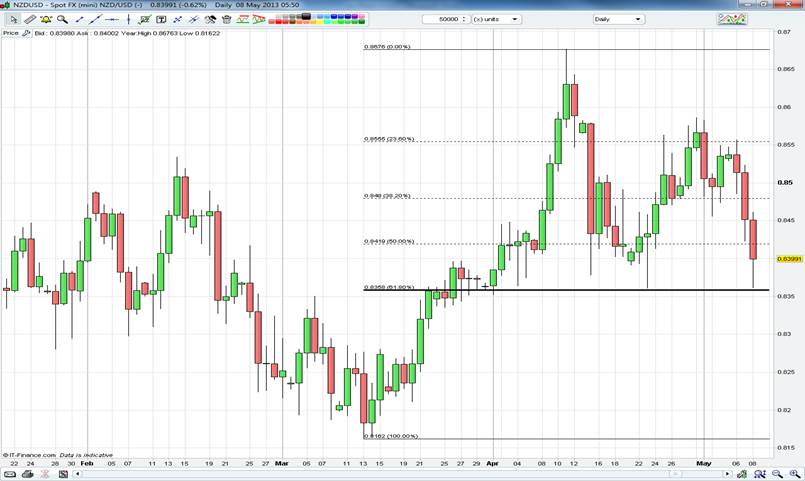
This was evident yesterday with the RBA cutting to a historic low, and according to Macquarie and now Westpac, this won’t be the end, with 2% likely to be the trough. Today was the turn of the RBNZ, with Graeme Wheeler not only suggesting the NZD was ‘significantly overvalued’, he also detailed the bank has sold NZDs in the market. This action clearly took the market off guard, with NZD/USD falling to 0.8360 (from 0.8425), and once again testing key support at the 61.8% retracement of the March to April rally and April 23 low. On reflection though, the bank has sold very little currency this quarter, although we probably won’t fully know the details until data is released in the coming weeks. Most traders would say that if a full-blown intervention had occurred, then the RBNZ would have prepared the banking world beforehand. To us this was an exercise to weaken the exchange rate, and is clearly the most it can do with actually lowering the cash rate.
South Korea has also been out, not to be outdone talking about closely monitoring exchange rates.
China has become a positive for the region and put a further bid in resource plays, which were already doing nicely on the open anyhow. China’s trade balance figures are always hard to interpret given recent seasonal factors, but the April numbers were clearly positive for risk. The surplus of $18.16 billion was not only higher than expected, but made even more positive by strong gains in both exports (+14.7%) and imports (+16.8%). The Chinese equity market didn’t initially rally on the news, but found buyers through the day, with the Shanghai Composite currently up 0.8%, while CME copper only managed a small move up to $3.32 per pound; Japanese and Australian investors certainly took heart from the numbers. The Nikkei printing a new high, despite USD/JPY struggling to break ¥99.00. Queue the cynics questioning the accuracy of the data.
The ASX 200 closed up 1.1%, and although it printed a new yearly high, couldn’t quite hold it in the post market auction . The great rotation trade that has been talked about (out of banks/defensive plays and into resource names) hasn’t fully taken fold today, and although and while materials were on fire and defensives were sold, no one was willing to sell out of banks ahead of the NAB result and the upcoming dividend season. NAB is due to release earnings tomorrow and the market is expecting cash earnings of $2.881 billion (+1.8% on the pcp), while one suspects its dividend will be under the most scrutiny given what we have seen from ANZ, WBC and MQG. ANZ will take 8.2 points out of the market when it pays its 73 cent dividend.
Positioning a portfolio or strategy around an environment of 2% rates is something else we need to focus on given Westpac’s and Macquarie’s calls. One suspects that inflation will be supported given the rates cuts, but low enough in the first place to give the RBA scope to ease. While on the other side of that, one suspects both deposit rates and the ten-year bond yield will be much lower than current levels. Could we see negative real interest rates, where inflation is actually killing any returns made from savings? This is a situation savers know only too well in many developed economies. The other question is will the lower rate support the yield plays, despite their expensive valuations, or on the other hand cause worry to investors as the cuts would be in response to a faltering economy and thus earnings could be under pressure?
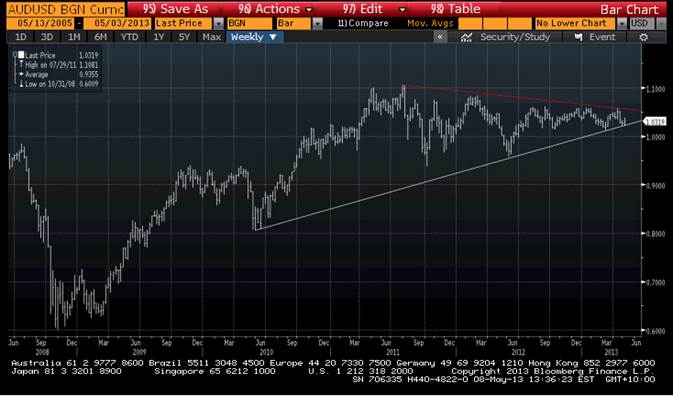
Given many (including ourselves) feel the Fed will look to lower the pace of asset purchases in Q1, it will be interesting to see where AUD/USD would be. A look at the weekly chart suggests it could be much lower. AUD looks quite poor right now against most currencies, especially in the G10. While we like AUD/NZD and AUD/CAD over the coming months, AUD/MXN looks set for stronger downside, notably if the ratings agencies are going to first increase the Mexican outlook and subsequently the rating.
Europe should see a flat open, although we go into the open with a positive bias. On the economic docket we get industrial production in German, Holland and Norway, while Canadian housing starts will also be in play. The Norwegian central bank meets, and while this is one for the forex market, it could be the next central bank to take action against its strong exchange rate. With the NOK (on a trade-weighted basis) falling around 2% from the prior meeting, the Norges Bank may take heart from this and leave rates on hold (our base case). However, given the recent trend in central bank surprises, we would not be shocked to see a cut.