

Whether the ADP private payrolls predict downside risks to Friday’s non-farms report we shall see. However, as things stand, both the miss to the April report and sharp downward revisions to the March numbers haven’t seen too much of a reaction from the analyst community, and consensus is still calling for 145,000 jobs on Friday.
The world is falling apart. Well perhaps that’s a bit of an overreaction, but it seems that data globally is dangerously close to contraction in many of the manufacturing surveys, while the services prints aren’t too flash either. Still, Ben Bernanke and the Fed have announced the ‘Bernanke put on steroids’ and thus falls in asset markets should be limited. Certainly there would have been a few in the market hoping the board would have acknowledged the weakness seen in the March data series. However, the fact that the Committee has now made it public that the Fed will officially look to increase its purchases programme (which probably now seems the most likely given current trends) should limit any major downside, notably in equities. Still, when the Fed is already expanding its balance sheet by $1 trillion a year, and liquidity from other key central banks is still making its way into markets, one questions how effective more QE will actually be longer term.
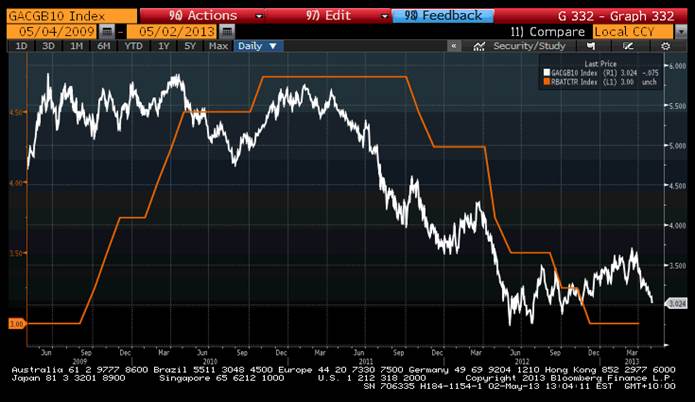
The bond market is speaking volumes, as it has for some time, with the US ten-year treasury at 1.62% and testing the November low of 1.55%, while five-year break-evens (the bond market’s way of measuring inflation expectations, and the yield differential between US five-year bonds and TIPS) are just above the key 2% level . Australian yields are now testing 3%, and considering that they were trading at 3.68% in March shows they have reacted aggressively to the domestic and global slowdown. Interestingly, the 10-year yield has been above the official cash rate since November and it looks very much like it may drop below here soon, similar to what we saw from 2010 to 2012. The swaps market has ramped up the prospect of a cut by the RBA and now prices the probability of a May cut at 58%, although this is at odds with the analysts community, with only 21% expecting a cut. Market versus analyst – you decide?
Data in Asia hasn’t been overly brilliant either with the revision to the flash HSBC PMI print coming in at 50.4. The new orders component printed 48.4, which is never a good sign. The Chinese equity market came back online today and is down 0.4%, and it was interesting to see the China Securities Journal post an article on China’s non-performing loan rate being underestimated by a ‘large measure’ because of ‘hidden’ bad loans. Again, further fodder for the China bears.
AUD/USD fell to a low 1.0241, and while today’s building approvals fell 5.5% on the month, it also coincided with a massive 126 pips fix lower in USD/CNY to 6.2082, which has resulted in the pair trading to a new nineteen-year low. Inflation is still a concern for authorities in China, but more so is credit, and clearly the PBOC is using the RMB as way of controlling capital inflows. The AUD has benefited from an ‘undervalued’ yuan for so long, however with USD/CNY trading at 6.1537 (at the lower-end of the trading band around the ‘fix’), it has become apparent that further strength in the yuan will become an increasingly growing headwind for the AUD, as China uses the exchange rate for restrictive issues, rather than pro-growth.
In the Australian market, again it was the cyclical sectors that naturally reacted to the raft of negative data points. Talk of ‘bubbles’ in the banking space has made its way around the floors, courtesy of a note from UBS (titled ‘Welcome to the great bank bubble of 2013’). The bank did suggest there was about 10% potential upside if the market ‘bid dividend yields to 4.5%’, and this would take them significantly above the all-time PE multiple. Citigroup responded later in the day refuting this, saying it did not see a bubble in Australian banks. Still, traders haven’t been too swayed by the report and shares have only fallen modestly.
So, Europe looks set to open on a weaker footing, although today is ECB day and given the raft of different outcomes, trading around this meeting is fraught with uncertainties. It seems logical that a cut is more or less priced in, although the real downside comes if the bank cuts by 50bp, or takes the world by surprise and imposes negative deposit rates – a fate that carries a very low possibility. The announcement of certain non-standard measures, including altering the dynamics around collateral for SMEs or perhaps looking at a UK-styled funding-for-lending scheme has been talked about, which in theory could be EUR positive. Sometimes reacting can be more profitable than prophesising, and we have heard compelling arguments from the EUR bulls talking about buying a post-cut dip, while the bears still see the risks in Europe and would look for any bounces as selling opportunities. Clearly if you take a step back and look at what the Fed and ECB are left to work with, you could make a more compelling EUR positive argument, as until the ECB becomes lender of last resort, its actions are limited.
PMI data out of Europe will also be closely watched, although it is a revision of the ‘flash’ estimates. On the corporate side, earnings from BskyB, Siemens and Royal Dutch Shell will be in focus. Shell has a 5% weight on the FTSE, so will probably command the greater attention from an index perspective, and according to statistics from Bloomberg, shares have risen every Q1 earnings day since 2003.