

It’s all about central bank action again, and while the Fed will never be out of trader’s minds, today traders have been positioning and reacting to potential ECB, RBA and RBNZ moves.
The RBNZ meeting came out early in Asian trade, and the rapid inflows into the Kiwi suggested that many had positioned for a central bank that would ramp up the negative rhetoric towards the local unit, especially given it had rallied over 3% on a trade-weighted basis from the previous meeting. The bank did acknowledge the NZD was overvalued; however, as said this was fairly limited, and predominantly mostly driven by the actions of the BoJ. The bank is stuck behind a rock and a hard place, with the tight housing market amid an ‘over-valued’ currency, and thus we feel rates will stay on hold for the remainder of the year, although our bias is for them to raise in 2014.
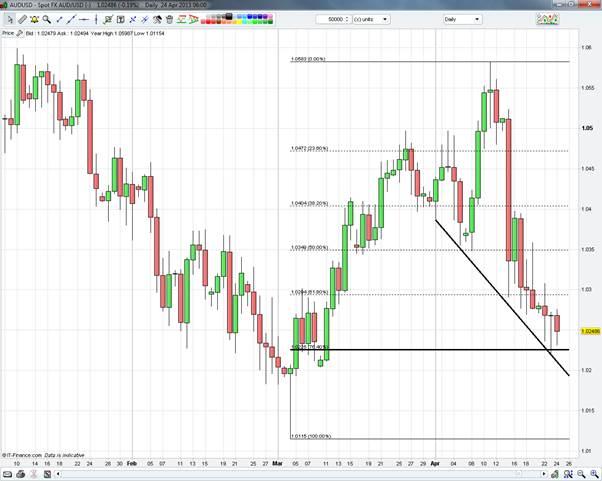
The RBA on the other hand has just been handed a partial green light to cut in May, although it’s still our base-case that the bank will sit on its hands and continue to wait to see the effects the 175 (basis points) bp of cuts has had on the economy. The six-month annualised core CPI figure is running below its target band, so you can understand why the credit market has priced in a meaningful probability of a May cut, with the OIS market now suggesting a 43% chance. Looking further out and the market is expecting two cuts over twelve months. The May meeting is shaping up to be a cracker and the AUD should see increased volatility as the participants go into the meeting split as to the outcome. AUD/USD fell to a low of 1.0232 and looks supported ahead of yesterday’s low of 1.0221, and downtrend support drawn on April 1.
Of course the market’s increased perception of more easing from the RBA has reinforced the yield trade on the ASX 200 which has been the clear favourite domestically for some time. The short growth, long yield trade rolls on, and while there have been a number of false signs to unwind these trades, time and time again the contrarians have been proved wrong. New highs have been seen in WBC and CBA, while the market’s new yield ‘darling’ Woodside (WPL) has added another 1.8% to its price. The key question now for WPL holders is whether the spike in the share price will encourage Shell to sell all or part of its 23% stake. On a side note, this will be the first four days since January for the ASX 200.
The other key issue is whether or not the ECB will cut in May. Clearly a 25bp cut to its refinancing rate is not going to change or alter the growth projections of the eurozone; however it would help the banks. Recent figures have suggested the eurozone banks are still sitting on excess liquidity of just over €300 billion, with most of these funds achieved from the ECB’s LTRO (longer-term refinancing operation) 1 and 2 programmes. In 2012 these banks (mostly Spanish and Italian) had around €800 billion in excess liquidity, and after making some tidy profits by buying peripheral debt in 2012, many have been looking to pay some of these funds back to limit the cost of borrowing. When banks re-pay these funds it represents a contraction of the ECB’s balance sheet, thus is a form of tightening. A cut to the refinancing rate will lower the incentive for the banks to repay the funds, thus keeping monetary policy loose. A cut therefore is a EUR negative, equity positive, however we feel a token 25bp cut will have limit affect.
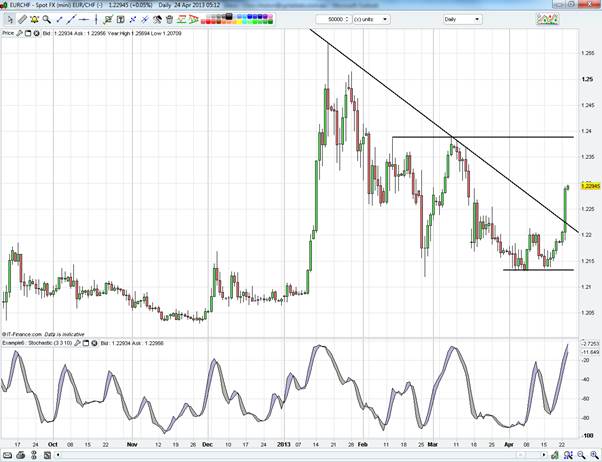
A rate cut aside, it is remarkable to see the inflows into the European peripheral bond market and while we are long-term EUR bears, when you see Italian, Spanish and Portuguese yields at the lowest level since 2010, it’s hard to make a case that EUR/USD is going down sub-1.28 anytime soon. EUR/CHF is a good barometer of sentiment here, and the pair has broken the year’s downtrend and has completed a move to the double-bottom target of 1.2286. The pair now targets the February and March highs of 1.2387 to 1.2391. Again, any further flows into Italian/Spanish bonds should help this trade.
Our European calls looks relatively constructive at this stage and traders and investors should feed off the optimism in Asia (Japan also up 1.75%). US futures are up a touch and Apple will control the focus of the market, with its German listing the best guide for US investors. Price action is not assured, and while the buy-back and dividend increases are clearly positive, it is countered by a poor Q3 outlook. Boeing and Procter and Gamble will also be in focus, while in Europe traders will be watching numbers from Daimler and Iberdrola.
On the data side, German IFO is expected to decline, while US durable goods could fall 3%, although this is a highlight volatile metric to predict. Of course with regards to data, less is more and with a number of central banks poised to do more equities, they should find buyers on data disappointment.