It’s business as usual with the Dow hitting a new high, the S&P 500 grinding into the key 1576 level, USD/JPY firmer, cable lower and AUD/USD remaining range-bound. Just another standard day in the capital markets.
The fact that the VIX closed at 11.56 (effectively the first time it has been below twelve since April 2007) shows just how much confidence the markets are displaying, and traders will focus on whether the so called ‘fear index’ can crack the psychological 10 mark in the near-term. Perhaps these low levels represent a red flag to the contrarians. However, on the other side of the coin, perhaps this is a green light for those looking to pick up a carry in the forex market, which is one of the key factors keeping AUD/USD supported in the face of poor weekend Chinese data.
The market has certainly given the AUD the benefit of the doubt given the seasonal distortions, and has pushed the AUD to the highest level since 2008 against the JPY, the highest against sterling since 1985 and multi-month highs against the CAD. The momentum behind AUD/JPY move is extremely powerful and a shift above ¥100 beckons.
Again, Asia has focused on Japan and we continue to be Nikkei bulls and JPY bears into the Japanese fiscal New Year on April 1, and the BoJ meeting on April 3 and 4. We find it interesting that Japanese investors have cut back on their overseas exposure and have re-allocated funds domestically, creating a net $38 billion inflow into the JPY in February – effectively the largest inflow since records began in 2005. One questions how much weaker the JPY would have been if Japanese investors hadn’t repatriated these funds. However, like we have seen with global investors and the subsequent outperformance of US assets during the numerous Fed asset purchase exercises, getting set in a position ahead of central bank buying seems to work out quite nicely.
On another note, despite the big moves in the JPY against all G10 currencies, there are still many players, namely Japanese real money accounts yet to sell. If the need to unwind currency hedges continues, especially into the new fiscal year when we may see life insurance firms and the Government Pension Fund re-allocate holdings, then this could bring a fresh wave of selling, thus pushing USD/JPY and the crosses higher. The moves in USD/JPY and Nikkei today though were premised on reports that Haruhiko Kuroda may actually announce steps to ease policy prior to the BoJ meeting on the April 3. This would be highly positive for USD/JPY and the Nikkei, as it would send a strong message that the bank is tackling deflation head-on. Traders have priced in a move by the BoJ to increase its asset-purchase programme in April, but the question is how much will it announce. There is a chance given the idea floated by both board members Ryuzo Miyao and Sayuri Shirai that we will see the BoJ combine both of the banks’ two easing programmes (the asset purchase programme and the Rinban operation), while there has also been talk of extending the duration of its JGB holding as well. Interestingly, Morgan Stanley noted that seasonality certainly supports holding long positions in USD/JPY into the central bank meeting, and since 2005 USD/JPY has always appreciated between March 20 and the beginning of April by an average of 3.95%.
Elsewhere it seems the early positive moves seen in Japan didn’t have huge ramifications and the ASX 200 continues to consolidate, closing down 29 points, with CBA pushing higher, while ANZ and WBC are lower. Taking out the points are TLS, RIO and WOW.
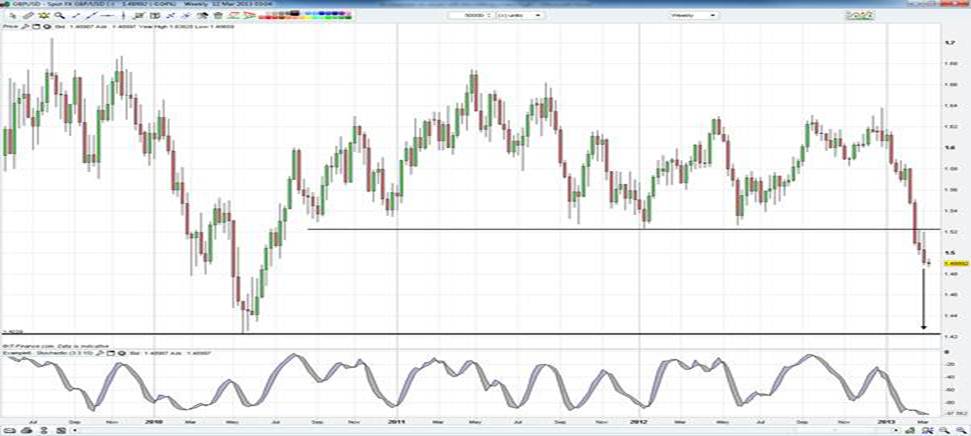
Our European calls are flat and it seems that equities at least are going to have a pretty uneventful open. Even data is thin on the ground with trade balance figures seen in the UK, while we get CPI reads in Germany, Sweden and Portugal. The focus will remain in the UK as we also get industrial production and UK GDP estimates. Our view on cable remains one of further weakness and we feel the downside risks to sterling are real, despite the fact it has been sold off heavily in recent months. With momentum and trending indicators suggesting further weakness, traders could look to sell on rallies and a move to the May 2010 low of 1.4230 can’t be ruled out this year.