


I haven’t posted about Queensland for a few months now, although if you have been following the MB twitter feed you would have been seeing the near-daily news flow from Queensland of surreal political stories. Ministers falling on their own swords or being perpetually unwell or unavailable to answer allegations, claims of nepotism and dodgy lobbying, a mining billionaire accusing the government of wanting to send him to jail while supposedly financially backing defecting government members and a smear campaign against the Premier.
It really does hark back to the weird old days of Joh Bjelke-Petersen and as a Queensland citizen I wake ever day wondering what bizarreness will be reported next. This weekend brought news that many members of the LNP consider water fluoridation a ‘brain altering poison’ even though some cities in Queensland have been running a fluoridation programs for nearly 50 years.
But I digress ….. this is an economics blog after all.
I stated back in September that my major concern with the new Newman government wasn’t that they were pushing a program of fiscal consolidation but more that I was concerned about a possible ideologically misguided implementation on top of their inability to communicate policy.
As I said then:
I am also concerned that these cuts are, in part, the result of ideology and I have detected from previous statements from the Newman government that there is some belief that the government budget is somehow disconnected from the broader economy and therefore fiscal tightening, even of the scale of billions of dollars, should have limited, if not a positive, economic effect.
As we’ve seen with Europe, this sort of thinking is quite dangerous and I as a Queensland resident I am more than a little concerned that an overzealous attempt to “fix the problem” has the potential to do the opposite.
…..
On top of a government program aimed at saving $4 billion dollars over the next 3 years, coal is under pressure , the housing market remains in the doldrums and private sector credit growth is at 35 year lows. Under these circumstances it is very difficult to see exactly where growth of that magnitude is going to come from over the next FY and that is a considerable concern. Part of the issue with the budget as it stands was the highly optimistic revenue expectations of the previous Bligh government under the belief that the housing market would continue to expand ad infinitum. If the state government is now forecasting 5% GDP growth, even in the face of its own program of fiscal consolidation, I fear we’ve just replaced one form of delusion with another.
As I noted in that piece the Liberal government were setting itself economic targets that I considered exceptionally optimistic and on top of that possibly being driven more by an ideology than an accurate understanding of the likely outcome of their policies.
Late last week the Qld treasury produced a wrap of the national account data for Queensland and it certainly supports my initial concerns.
Queensland’s seasonally adjusted (sa) state final demand (SFD) fell 1.6% in the quarter , after rising by 3.4% in the June quarter . SFD rose by 2.7% through the year, its lowest annual rate since March quarter 2010.
The decline in SFD in the September quarter was driven by broad based falls in dwelling investment and public final demand. While business investment also fell a modest 1.3%, this followed a strong gain of 9.9% in the previous quarter. Meanwhile, household consumption growth slowed from the fast pace seen earlier in the year.
What you’ll also notice from the chart below is that both state and federal government investment and expenditure were also a drag on final demand along with a large fall in private investment.
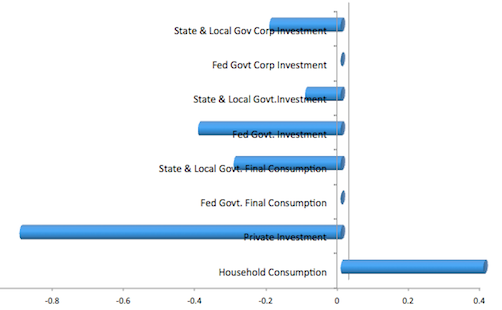
So household consumption growth is slowing, and private investment is contracting even though the RBA has provided a 1.25% cut in rates over the last 12 months. The reason ?
… weak labour market outcomes and lacklustre consumer sentiment likely weighed on growth. Lower household spending on food (down 0.8%), transport services (down 3.1%) and clothing and footwear (down 1.9%) detracted from growth in the quarter. Dwelling investment fell 15.5% in September quarter 2012.
And here is the chart of trend unemployment comparing Queensland to Australia, the grey arrow points to the March 24th election:
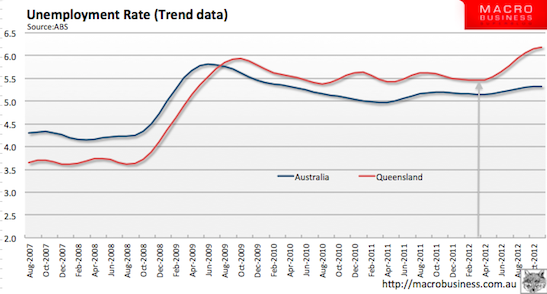
So the program of fiscal tightening at both the state and federal level appears to be having an overall negative effect on employment and consumer confidence which in turn is leading to falling rates of consumption and investment. No real surprise.
The trouble I see, which is why I alluded to it at the start of the post, is that strong political leadership is an important factor in providing support to the economy through during time of economic stress. This certainly isn’t something I am currently seeing from the Newman government, and thus far all of the statistics are displaying the exact outcome I feared.
Obviously we’ll have to wait for a few more quarters to see if this is a minor correction caused by the front-loading of government cuts or something more sustained, but I do have to wonder with the mining boom coming of the boil, commodity prices remaining under pressure, all levels of government still promising surpluses and the Queensland consumers appearing none-to-happy about the current situation, exactly where is this growth going to come from? Although SFD isn’t exactly equivalent to GDP it does look as though we are into the negatives rather than that promised 5%.
Queensland Treasury brief below: