The underperformance of the two mining giants – BHP Billiton (BHP) and Rio Tinto (RIO) – is a big factor in the weak performance of the Australian market overall. Deutsche Bank has a buy on RIO, and a price target of $101, which would take it back to the levels before the company’s self inflicted debt crisis.

Net debt to equity is down to a much more manageable 24%, so the lesson has obviously been learned.
Deutsche has reduced calendar 2102 earnings by 4% but thinks the stock has potential:
“This was a tough quarter across the board but particularly in iron ore as cyclones in Australia impacted sales more than expected (-17% QoQ). Coal production (-18% QoQ) and mined copper (-13%) rounded off one tough quarter, and we have trimmed our CY12 earnings by 4%. However production will rebound in 2Q and we view Rio’s CY12 production guidance (iron ore 250Mt) as conservative, as such our forecasts remain slightly above guidance.
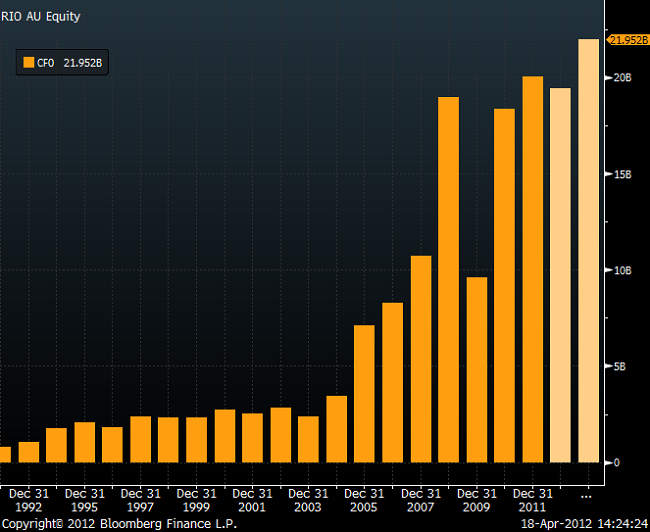
Despite the downgrades, iron ore fundamentals and cash flow is strong and in our view the market is not paying for growth, particularly beyond 230Mtpa in the Pilbara. Buy retained on valuation.”
RIO is on a current and future earnings multiple (P/E) below 10 times, which ordinarily should mean it has good prospects for capital gain. It does suggest an underlying pessimism about commodity prices. Return on equity (ROE) is a healthy 22%. Sales and profit forecasts look pretty static, which may be cause for pessimism.
These are the risks Deutsche sees:
“Key risks to our view include movements in iron ore, copper, coal and aluminium prices away from those that we currently forecast and a significantly different A$ than we currently assume. With earnings for the group strongly biased to iron ore and copper (~90% combined of operating earnings) production levels, prices for those commodities are an important consideration: a 10% change in iron ore price could lead to ~13% change in earnings for Rio Tinto specifically, on our estimates.
Liquidity is no longer an issue for the company in our view with balance sheet gearing firmly below the typical 20% range.
Specifically, for the aluminium division risks include reduced Chinese demand for bauxite, alumina and aluminium, delays to expansion
projects and continued weakness in prices.”
UPDATE: reader Ben requested some financial charts – here is RIO’s cash from operations and P/E ratio for the last 10 years