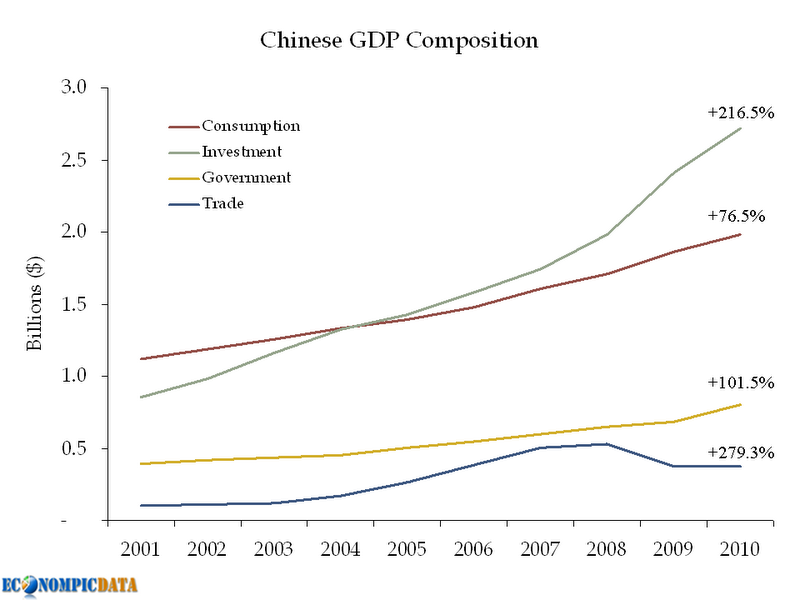
As we know, China is aiming to rebalance its economy toward internal demand. Truth be told, exports are less of a growth driver now than they were in 2008 (but do note than nothing can stop it from having negative contribution to GDP growth). But, for the past 3 years or so, investment has become the main game. The goal that the Chinese economy rebalance toward domestic consumption is as distant as ever.
That hasn’t stopped eminent commentators like ex-Morgan Stanley Stephen Roach from thinking that China will not follow in Japan’s footsteps. According to Roach: China has “strategy”, whatever that means:
Strategy. Since 1953, China has framed its macro objectives in the context of five-year plans, with clearly defined targets and policy initiatives designed to hit those targets. The recently enacted 12th Five-Year Plan could well be a strategic turning point – ushering in a shift from the highly successful producer model of the past 30 years to a flourishing consumer society.
Recently, he repeated it:
China has no choice but to move quickly to implement the pro-consumption initiatives of its recently enacted 12th Five-Year Plan. Strategic transition is what modern China is all about. That’s what happened 30 years ago, when economic reform began. And it needs to happen again today. For China, a soft landing will provide a window of opportunity to press ahead with the formidable task of increasingly urgent economic rebalancing.
I don’t question question the Chinese’ desire to rebalance growth towards consumption and away from investment. But the reality is that policy makers started talking about doing so not in the 12th Five-Year Plan, but the previous one. Unfortunately, they have had absolutely no success as the share of consumption continued to shrink. In fact, the financial crisis of 2008 forced China into a even more investment-driven economy as exports collapsed:
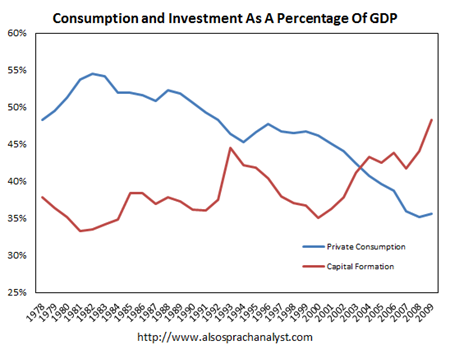
In his newsletter, Michael Pettis estimated the kind of growth in consumption China needs to get back to the old days when consumption as a percentage of GDP was in the low 50 per cent range (which is still low):
If you think China will grow at 6% a year for the next ten years, and you think Chinese household consumption will grow to 50% of GDP in ten years, then implicitly you are projecting annual household consumption growth of 10.2%. If you think China will only rebalance to 46% of DP in ten years, then you are implicitly projecting a 9.3% annual growth in consumption.
The reason this is so interesting is that it implies that consumption growth will be a very tough and substantial upper limit to GDP growth. If China grows by 6% a year, and if we expect a minimal rebalancing to 46-50% of GDP, we would need consumption growth to surge to around 10%, a number never achieved before.
Is that achievable? I don’t have the answer, nor does Michael Pettis. It is certainly possible, but I remain sceptical.
The key reason is that China is facing a very sizeable bubble (along with other things like the debt mess and over-investment in infrastructure), the handling of which I fear will cause a dramatic slowing in the economy. In that scenario, my worry is that policy makers will be tempted to do what they did in 2008-09 again, namely, to throw money into the economy and build even more bridges to nowhere to keep GDP growing at a 7-8% rate. That would once again increase the investment share of GDP. Alternatively, if policy makers decided not to act this time, we might be seeing GDP growing at low single-digit rate, or even a outright contraction. That would be negative for household consumption as income can’t grow.
P.S. Here another chart derived from Michael Pettis’ calculations from Econompic: