

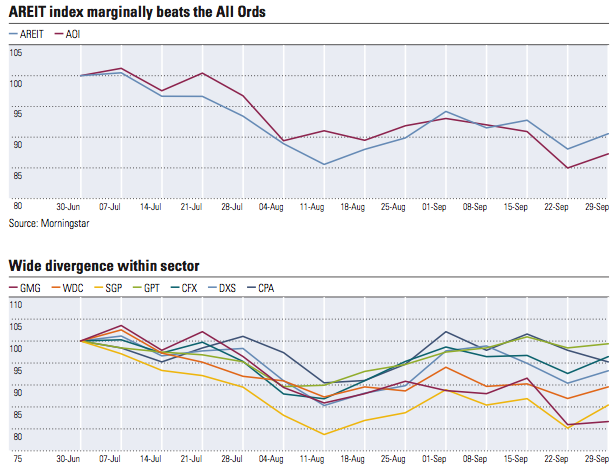
With Europe teetering, it is hard to see how one would make a case for property investment of any sort. But some brave, probably scarred souls, are still looking at retail property trusts (AREITS). A Morningstar report notes that the AREIT sector fell “only” by minus 9.5% in the September quarter, which was not as bad as the wider market. This after having gone sideways for most of 2010-2011. Morningstar considered it a matter of “particular concern” that the index fell in August when the American and European crises worsened. A concern, yes. A surprise, no:
This hit the residential developers particularly hard with Australand (ALZ), Stockland (SGP) and Mirvac (MGR) all falling heavily, then not recovering nearly as well as other AREITs before the end of the quarter. AREITs with international exposure and higher gearing were also hit hard. With confidence in the AREIT sector fragile, bad news from around the world is capable of driving further falls in the index providing buying opportunities.
AREITS are nowhere near as dodgy as residential property, having already taken a massive hit. The absurd gearing games have also met their ultimate end. A lot of the rubbish has been washed away. Gearing levels are generally down to a much more manageable 20-30%. But property of any type is still subject to rapid asset deflation, just as we saw a series of asset bubbles. The international situation will continue to have a deep impact on the local market.
Morningstar likes the office sector:
The office sector stands out as the growth sector for AREIT revenue, with improving occupancy rates and moderating incentives driving effective rental growth. The most recent Property Council of Australia data shows vacancy rates are below the equilibrium 10% level in all cities except Canberra, where the Federal Government’s policy shift to preferring green buildings for occupancy may mean that some non-green buildings remain vacant, even with discounted rents, for considerable time. As a result of the GFC and the difficulty in raising debt funding, speculative office development has been rare across Australian capital cities over the last few years, leading to modest current supply levels which are now resulting in relatively strong office market fundamentals.
Morningstar notes concern brewing about executive remuneration, which is fair enough. What exactly is so challenging about holding property and farming out rental yields that requires stratospheric remuneration to attract “talented” enough executives? Such greed is a very bad sign for investors, not just because of the wage cost, but because of the kind of people who look for such rewards. Still. Morningstar does think there is some value:
Retail property trusts look cheap and could rally if cyclical factors currently depressing spending improve but the long term outlook is relatively unfavourable with ongoing household de-leveraging and migration to online shopping.
Meanwhile, Deutsche Bank has a hold on Westfield Retail Trust, saying that it has outperformed and it is time to lock that in. It has a buy on Stockland Trust Group, arguing there will be buybacks:
SGP indicated today that it is targeting $600m of non-core (predominantly Office and Industrial) asset sales in FY12. Our forecasts currently allow for $611m of FY12 disposals (previously announced sales + 52 Martin Pl & 452 Flinders St at BV), however we estimate that, were SGP to dispose of all assets currently being marketed for sale at book value, this would take total FY12 sales proceeds to $850m, in our view potentially facilitating an expansion of the current buyback from 5% of issued capital to 10%.