

IMF tackles asset bubbles

By Leith van Onselen

Earlier this month, the International Monetary Fund (IMF) published a working paper, Asset Price Bubbles: A Selective Survey, which provides an overview of recent literature on asset price bubbles and examines some of the behavioural drivers behind those bubbles.

The IMF uses a very straightforward definition of an asset price bubbles, namely that “a bubble is a deviation of the market price from the asset’s fundamental value”. Or, put another way, a bubble occurs “when an asset’s trading price exceeds the discounted value of expected future cash flows”.

In its literature review, the IMF provides the below summary of famous asset price bubbles, many of which will sound familiar to readers:

1) Dutch tulip bubble:

Perhaps the earliest known example is the tulip bubble in Holland that started in 1634 and burst in February 1637. Amid the general fascination with rare species of tulips among the Dutch, prices on rare tulip bulbs rose, attracting the attention of speculators. Since the supply of rare bulbs was severely limited in the short run, and demand sky-rocketed due to the influx of speculators, prices rose rapidly amid heavy trading. At the bubble’s peak, a single tulip bulb sold for an equivalent of $60,000 today.

2) South Sea bubble:

The South Sea bubble involved the market price of an English firm called the South Sea Company. This firm had no assets but told investors that it had come up with a strategy to earn enormous profits in the South Seas. During the first half of 1720 the company’s stock price rose by over 700 percent, then fell during the second half of 1720 to about 50 percent above what it had been at the start of the year.

3) Mississippi bubble:

Refers to the rapid rise and fall in the share price of a company popularly known as the Mississippi Company. In effect, the company controlled all trade between France and the rest of the world outside of Europe. Later, the company also purchased the right to mint new coins in France and the right to collect most French taxes. By January 1720, it had become Europe’s most successful conglomerate and European investors, who knew little about the remote colony of Mississippi at the time, were excited about the possibility of finding gold and silver there. The company’s expansion was financed by issuing shares, the price of which rose dramatically as the company’s reach expanded. Share price rose from around 500 livres tournois in January 1719 to 10,000 livres in December 1719. The market became so active that even low-income individuals started buying the company’s shares. The trend reversed and stock prices began to fall in January 1720 as investors started selling shares in order to turn capital gains into gold coins. Instead of paying off in gold coins, the company tried to get investors to accept paper money, agreeing to assume that the share price was 10,000 livres. The exchange of shares for paper money caused a runaway inflation that reached a monthly rate of 23 percent. Finally, Law devalued shares in the company in several stages during 1720; by September 1721, the price had dropped to its prebubble price of 500 livres.

4) 1929 US stock market and real estate crash:

The crash involved the collapse of both stock and real estate prices. By the end of 1932 real estate prices in Manhattan had fallen by 67 percent from the third quarter of 1929 and stayed down for the remainder of the decade. Mortgage lenders suffered large losses, limiting future lending. Moreover, the collapse of the housing sector greatly depleted households’ wealth, contributing to the severity of the Great Depression.

5) 1989/90 Japanese stock market and real estate crash:

In the 1980s, Japan experienced a rapid run-up in equity and real estate prices. From 1980 to the peak in 1989, the Japanese stock market rose 373 percent in real terms but fell by 50 percent in the next three years. Land prices followed a similar pattern. They almost tripled in the second half of the 1980s, and at its peak in 1990, the market value of all the land in Japan was four times the land value in the United States. By the end of 1993, Japanese land prices had dropped by almost 50 percent. Some argue that the collapse of the bubble had a lasting effect, slowing down the rate of economic growth up until the present.

6) Dot Com bubble:

Started around 1995. From that time until March 2000, when the bubble started to deflate, there was a rapid growth in the internet sector and related fields, fuelled by the supply of new internet IPOs. The mysterious nature of the new technology added to its allure. The internet-heavy NASDAQ Composite rose from 775.20 in January 1995 to 2,505.89 in January 1999 and more than doubled from this point to its peak of 5,048.62 on March 10, 2000, after which it started declining, reaching a low of 1,314.85 in August 2002. During the bubble period, investment banks responded to the high demand for internet shares by loosening their standards for the types of firms they typically took public. A large fraction of the new internet IPOs never generated any profit; the general thinking was that these firms would initially offer their services for free in order to capture market share and would start generating revenue later. Many of the new companies had the same business model and competed in the same market, ensuring that a large fraction of them would eventually fail.

The IMF also points out that many bubbles are instigated by cheap credit and notes that bubbles can burst or deflate gradually.

A plausible story underpins most bubbles:

According to the IMF, most bubbles historically “have had a compelling and sensible story behind them. For example, the dot-com bubble fed on the argument that the new technology would bring great improvements in productivity; similar lines of reasoning were offered during the past railroad and electricity booms. Land-price bubbles were often justified by the logic that an ever-growing population combined with a limited supply of land is sure to make land scarce. During the recent U.S. real estate bubble, the frequently heard argument was that real estate prices would permanently increase because securitization would allow to diversify the idiosyncratic risk of real estate.”

Why bubbles burst?

The IMF also provides a number of potential reasons why asset price bubbles burst, including:

  1. When the supply of new capital is exhausted. In order to keep growing, a bubble needs an inflow of new investment capital. As the inflow of new capital slows down, prices begin to flatten out and, as a result, the initially optimistic sentiment eventually reverses, causing the bubble to deflate.
  2. Bubbles caused by a sudden expansion of credit will deflate when credit tightens, which happened in Japan in 1990, precipitating the collapse in the Japanese equity and real estate markets.
  3. Bubbles will deflate when a sufficient supply of the bubble asset is added to the market (via new housing construction, IPOs, SEO, etc.). For that reason, Glaeser, Gyourko, and Saiz (2008) argue that real estate bubbles will be shorter-lived in areas with more elastic new housing supply.

Trading volumes:

The IMF also argues that “bubbles are frequently accompanied by abnormally high trading volume. In the early stage of a bubble that precedes the speculative frenzy, trading volume is relatively low. It drastically increases during the middle stage of a bubble’s life cycle, as the past price increases begin to be noticed by a wide cross-section of investors who then engage in speculative or feedback trading. The demand for the asset at this time is very high. In order to meet this demand, additional supply is often provided by means of IPOs, secondary equity offerings (SEOs), new start-ups, and, in the case of real estate bubbles, by construction of new housing. As the rate of inflow of new capital starts to drop, the speed of the bubble’s growth decreases, potentially leading to a decrease in trading volume. In the later stages of a bubble, fraud is more frequent as investors try to get rid of the overvalued asset by preserving an illusion of rising prices.”

The sub-prime mortgage bubble:

The IMF paper then finishes up by attempting to explain both the origin and causes of the US sub-prime mortgage bubble. According to the IMF:

The origins of the recent real estate bubble can be traced to the low-interest-rate environment that followed the collapse of the dot-com bubble and a number of financial innovations and policies that made housing investment seem more attractive than an investment in stocks and bonds…

These developments are some of the reasons behind the initial rise in house prices that was subsequently amplified by further capital inflows into the housing market, consistent with feedback trading models.

As in the limited liability models, the securitization process had the unfortunate side effect of creating a moral hazard problem for lending institutions, since they no longer held the loans on their books.28 The institutions’ primary objective became to increase the number of loans made, which was done at the expense of loan quality. The competition among lenders for new loans led to a proliferation of the types of loans designed to attract subprime borrowers with few assets and low income. These loans (the most widespread being adjustable-rate mortgages) required little or no money down and low initial payments that were scheduled to increase to prevailing market rates in a few years. The would-be feedback traders who could not previously obtain a mortgage loan now could. Those who were especially optimistic about the prospects of the housing market frequently owned several properties, hoping to resell them…

Just like securities analysts during the dot-com crisis, bond rating agencies failed to sound the alarm. This could have been the result of both incentive problems and a series of faulty assumptions in their risk models… Investors, blindly trusting these ratings, did not demand a high enough rate of return to be properly compensated for their risk exposure…

In this environment, highly risky loans were made at low mortgage rates, which led to even further price increases. Speculation in the housing market was abundant and the investment strategy of “flipping” properties was promoted by the success stories reported in news media. As in previous bubble periods, the market was dominated by the optimistic investors…

As during the Roaring Twenties, the rise in housing prices was accompanied by a construction boom. Many new houses were built to supply the market with additional units of the overvalued asset, especially in the areas that experienced significant price increases. When the prices eventually began to fall, the unsold inventory of new housing was supplemented by the staggering number of foreclosures, exacerbating the fall in house prices. If the Great Depression is any indication, house prices are likely to remain low for a long time, until the housing demand finally catches up with the existing housing supply…

While I don’t disagree with the IMF’s assessment, it falls short by not properly examining the supply-side of the US housing market, and the role played by restrictive planning processes and urban consolidation policies in accenuating the boom/bust price cycle initiated by the factors described above.

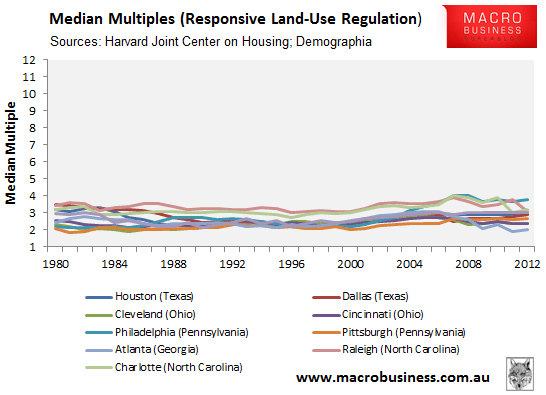
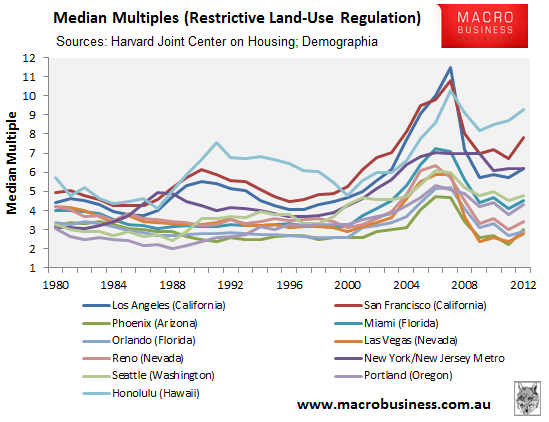
As explained in last week’s presentation, Housing supply & price volatility, the markets where land supply was most restricted through regulation or physical barriers to development experienced far bigger price booms and then busts than markets where such barriers were not present, and land/housing  supply was more easily able to adjust to changes in demand.

In fact, taking the IMF’s definition of a bubble as “a deviation of the market price from the asset’s fundamental value”, it is questionable whether the supply responsive states experienced a bubble at all, given house prices never appreciated beyond four times household incomes and remained affordable throughout the sub prime crisis, as opposed to the supply-restricted states where prices relative to incomes rose sharply and then plummeted (see below charts).
The full IMF paper is provided below.

unconventionaleconomist@hotmail.com

www.twitter.com/leithvo

IMF – Asset Price Bubbles – A Selective Survey (Feb 2013)


81 Responses to “ “IMF tackles asset bubbles”

  1. PhilBest says:

    I hope someone somewhere draws Leith’s commentary to the attention of the IMF people.

    One of the things that is a step in the right direction by the IMF, is the identification of the role of urban land values in the Great Depression.

    I argue that this was far more important than the booming and busting share market, and that it is only mainstream economics’ appalling lack of grasp of urban land economics that has allowed flawed mythology to prevail for so long.

    Bubbles in the “value” of urban land (and I think the IMF definition of a bubble is excellent) have always been far more destructive to an economy, than a bubble in the share market. I recall several share market crashes in my lifetime that had the commentariat crying doom and gloom, and life on main street was not affected by much, or for long.

    It was LAND that did it, in the 1930′s; it was LAND that did it to Japan in the 1990′s, it was LAND that did it to California, Spain and Ireland.

    The IMF is also slightly wrong about the inevitability of “oversupply” of construction in these land price bubbles. I would agree that Ireland and Spain had oversupply exactly according to the mechanism outlined by the IMF. I would also accept that this was the case in the 1920′s. But in that case it is worth noting that “oversupply” is a highly subjective concept. There were plenty of people still needing a proper home, it is just that the PRICES of what was getting “supplied” were well beyond their reach. The same phenomenon exists in China today. When you have 300 million households earning less than $1,000 per annum still needing housing, this does NOT justify a construction boom in endlessly “flipped” properties priced at $300,000 plus.

    But I have come to realise that the notion that there was “oversupply” during the US housing bubble of the 2000′s, is seriously flawed. The subjectivity of this assessment is less obvious than in China, but it is still there. The problem is entirely in the PRICE OF the “supply”.

    The difference between China and the US, is the magnitude of the mismatch between the overpriced supply and the numbers of people representing potential “demand” at a more sensible land price.

    • Pfh007 says:

      + a lot

    • dumb_non_economist says:

      Philbest, what’s your take on Australia?

      • PhilBest says:

        I have been long been expecting a meltdown to come eventually. I do not see it possible to delay it forever. Inflated urban land prices are themselves the means of destruction of the system in which they are embedded. Sure they are someone’s gain, but they are a cost to someone else, and the “gainers” are NOT “producers”, while those upon whom COSTS are imposed, ARE.

        It is noticeable in every nation with an urban land price bubble, that the “tradables” sector of the economy shrinks and productivity falls, at least relative to the historical norm. It takes a long time to rebuild these losses and get REAL growth in the economy resuming.

        The UK has survived for so long in the face of policies that relentlessly increase urban land prices, only because of all the wealth “transfer” that flows into London’s finance sector. It also has some other high-income, low-land-requirement sectors like international media. Even so the UK is a dead economy walking now. I expect an economy like Australia’s, that does NOT have a “London”, to be less able to sustain the inflated urban land prices.

      • dumb_non_economist says:

        Thanks

  2. raveswei says:

    “it falls short by not properly examining the supply-side of the US housing market, and the role played by restrictive planning processes and urban consolidation policies in accenuating the boom/bust price cycle initiated by the factors described above.”

    because supply side “limitations” had only minor effect on the bubble. That bubble was credit boom child.

    Places with the largest bubble (NV, AZ, FL) recorded largest construction boom in history in many instances even before prices started sky-rocketing.
    In almost all cases construction activity crashed a year or more before prices started falling.

    There is no evidence whatsoever that short supply had any major effect on house prices during 2000s but that doesn’t stop people arguing about this.

    • Ah, no. Land supply in both Arizona and Nevada were highly restricted by government control of nearly all of the developable land. The government drip fed land onto market (i.e. did not respond to demand), which sent fringe land prices skyrocketting. Read here, here, here and here.

      You have clearly learnt nothing. Watch land prices, since they are the key driver of escalating house prices.

      If credit was the sole driver, then how come did around half the markets in the US (with virtually identical access to credit) experience NO BUBBLE?

      • raveswei says:

        Construction in Arizona boomed much before land prices prices did. Construction also cashed a year before house prices.

        You have clearly learnt nothing. Land prices boomed because speculators with pockets full of easy credit money started speculating despite land supply and construction boom going on even before prices did.

        If land restrictions were the sole driver, then how come did cities with no population growth experience BUBBLE in 2000s or Texas cities experience BUBBLE in 80s?

      • Excuse me. When have I ever claimed that “land restrictions were the sole driver”? Unlike you, I have always looked at both sides of the housing equation – demand and supply. Whereas you have only ever looked at credit. Also, increasing demand can come in many forms – credit, population growth, rising incomes, falling household sizes, falling unemployment, etc.

        As usual, your tunnel vision comments are about as useful as trying to eat chinese with only one chop-stick.

      • Mav says:

        When have I ever claimed that “land restrictions were the sole driver”?

        Ravs is mistaken. PhilBest, wasn’t it you who made that claim?

      • raveswei says:

        Where I said that credit was the sole driver?

        I repeated so many times that easy credit is major not the only cause of these housing bubbles. And I showed so many times that supply was never short of providing more than enough housing for all people (every single place with a housing bubble recorded significantly higher supply than needed (more homes were constructed than needed by growing population).

        The only reason why house prices spiked is additional speculative demand created by easy credit and stimulated speculation.

        Sure, we can deal with speculative demand by wasting money, land and resources to build even more unneeded empty homes just to meet speculative demand (all in the name of free market that doesn’t work – does not allocate capital efficiently) or we can just prevent speculative demand and use all that money and resources to improve quality of life for everybody.

        Without speculative demand existing land restricted supply will be more than enough and more than enough responsive to provide housing to everybody at low price.

        So tell me, why we need to waste money, resources and agricultural land to built empty ugly cities just to achieve the very same result (low cost housing) that can be done by few simple regulatory rules that cost nothing?

      • Do you honestly think if the UK or Australia dropped maximum LVRs down to 50% that suddenly housing would become affordable for almost everybody? Sure prices would tank, but the tightened credit would mean that a large number of FHBs could not buy, meaning they would still miss out.

      • raveswei says:

        when and where I said that we should drop maximum LVRs down to 50%?

        We need to prevent easy credit and speculation, not prevent people from buying a home.

        LVR on PPOR can be at 80% as it was for decades without negative effect on FHBs ability to buy home.

        But LVR is not so important as the maximum credit amount is. We should limit how much banks can lend (as multiple of income not in repayment terms at current IR) and put strict rules how income should be calculated and what documentation should be available. We have to make interest only loans illegal – these loans are only used for speculation.

        Credit on investment properties should be treated differently. It should be very restricted especially for existing properties and more importantly tax policy on investment properties should change. We have to create speculative tax on all investments, especially basic needs like housing. We should also introduce land banking taxes that will impose extreme tax on undeveloped land zoned for development.

        None of these rules will prevent FHBs from buying home while it will make speculation very hard. It will also stimulate investments in new construction. People with extra money will be forced to invest in some other more productive things. That exactly what we want

      • The Claw says:

        Raveswei, you are clearly an expert on the Arizona housing problem.
        What impact did this bubble have on a young family trying to buy a house to live in in Arizona?
        Did any areas remain affordable? Could they get affordable housing if they increased their commute?
        Lets say they could only afford the pre-bubble price. How high and long did prices go? What rent did the young family have to pay while they waited for the bubble to pop?

      • raveswei says:

        rents were flat during bubble period with average 3bdr unit rent around $1000 pm in Phoenix metro. House rents were just slightly higher at around $1150 pm.

        So bubble had no negative effect on family who needed nice place to live. Bubble did have negative effect on families who wanted to buy a house not because there was no enough homes but because speculators were pushing prices up.

      • The Claw says:

        Thanks. I sure wish I could get away with paying $1200 per month while I wait for prices in Sydney to fall.
        It sounds like there were no innocent victims in the Phoenix “bubble”.

      • raveswei says:

        I guess you can pay $1000 more per month than people in Phoenix (median house rent in Sydney is $2200) because you can earn more than $2000 more a month on average then residents of Phoenix.

      • PhilBest says:

        Raveswei, are you incapable of seeing the effect of ANY MAGNITUDE of rationing of urban land, on housing prices?

        How about a “zero growth” regulatory boundary? No new horizontal growth permitted, only “upwards”. Would that make economic land rent rise?

        How about a “tightened” boundary? Everything outside it to be demolished and everybody accommodated by new building “upwards” within it? Would that make economic land rent rise?

        According to you, the price of land in UK cities would be exactly the same regardless of whether they had their green belts and growth constraint planning processes. Also according to you, if cities like Houston and Austin and Charlotte and Atlanta and Raleigh imposed the same policies as the UK, they would continue to have exactly the same housing market outcomes – large lots at affordable prices, and rapid growth in population and employment.

        Your position is ABSURD. And you are not the only one. Total blindness to the effect of simple quota schemes in land.

        I have explained what happened in Phoenix and Las Vegas. They initially WERE like Houston and other elastic-supply cities; they built good numbers of affordable houses to match in-migration; then at some point their developers requirements for land ran up against government land holdings.

        Exactly the same COULD happen to Houston IF its growth ever approaches government land holdings or some other “bound” that had not been approached in the past. I do not have time to examine all US cities to predict which ones might yet experience this problem, all I can do is look at cities with land markets that behave unusually, and find an explanation for that.

      • raveswei says:

        “How about a “zero growth” regulatory boundary? No new horizontal growth permitted, only “upwards”. Would that make economic land rent rise?”

        In absence of speculative demand, housing prices would not change much even if “zero growth” regulation is imposed because new land is not required for new housing to be constructed.

        In that case, price of LAND would go up but that doesn’t mean HOME prices have to go up. In a typical “5x lot size development” price of land as percentage of the total cost gets down to relatively minor number. If a free-standing house on a 1000sqm block costs $2m, price of land should not add more than 20-30k to price of a 100sqm unit in a typical “5x block size development”.

        I don’t know why you think house on a half a acre block is the “the only housing”. Housing is much more than that, in many places units close to city centre are much more desirable housing option.

        The reason why unit prices are so high in Australia is easy credit funded speculative behaviour not price of existing urban land. Without speculative demand even with current land prices units could be significantly less expensive.

        If similar restrictions were imposed in Houston, for example, “house on large block” prices would initially increase but in absence of speculative easy credit environment would adjust back because lower opportunity cost would make pressure on house prices.

        I don’t see a reason why would we all strive to provide “house on a large block” in large city for everybody. That urban sprawl growth option is very expensive in infrastructure, environmental, resource, health and general quality of life terms.

        I can understand your (and some other people’s) desire to live in a big house on a large block in a large city but that should not be an option for everyone. Living in big city creates many benefits but also makes some housing options unavailable for some people. It’s important to provide relatively cheap and decent housing for everyone but not “small town” housing options in the middle of big city.

      • “In absence of speculative demand, housing prices would not change much even if “zero growth” regulation is imposed because new land is not required for new housing to be constructed.

        In that case, price of LAND would go up but that doesn’t mean HOME prices have to go up. In a typical “5x lot size development” price of land as percentage of the total cost gets down to relatively minor number. If a free-standing house on a 1000sqm block costs $2m, price of land should not add more than 20-30k to price of a 100sqm unit in a typical “5x block size development”.

        Ridiculous comment. Despite the land cost per square metre skyrocketting, according to you housing would remain affordable because we would all be living in rabbit hutches.

        “I don’t know why you think house on a half a acre block is the “the only housing”. Housing is much more than that, in many places units close to city centre are much more desirable housing option.”

        No shit sherlock. But why not allow the market to function properly and let people live where they want to live instead of forced consolidation?

        “The reason why unit prices are so high in Australia is easy credit funded speculative behaviour not price of existing urban land. Without speculative demand even with current land prices units could be significantly less expensive.”

        Only if they shrank to the size of rabbit hutches.


        “If similar restrictions were imposed in Houston, for example, “house on large block” prices would initially increase but in absence of speculative easy credit environment would adjust back because lower opportunity cost would make pressure on house prices.”

        This comment makes absolutely no sense.

        “I don’t see a reason why would we all strive to provide “house on a large block” in large city for everybody.”

        When have we argued that? You have reached for yet another straw man argument. What we are seeking is an end to artificial growth constraints that force-up the cost of all types of housing.

        “That urban sprawl growth option is very expensive in infrastructure, environmental, resource, health and general quality of life terms.”

        Where’s your evidence? Growth constrained cities in the US tend to have longer average commute times than non growth constrained cities. Local pollution is also likely to be dicipated across a larger area in cities without growth constraints, which is healthier for inhabitants than bunching. Also, more spread-out cities tend to have greater green space than tightly packed cities (e.g. Germany vs the UK). You have also failed to consider that growth boundaries often lead to exurban leapfrog development, which increases sprawl. Finally, infrastructure costs are unlikely to be more expensive in cities without growth constraints because land prices (a key cost input) are much lower.

        I can understand your (and some other people’s) desire to live in a big house on a large block in a large city but that should not be an option for everyone. Living in big city creates many benefits but also makes some housing options unavailable for some people. It’s important to provide relatively cheap and decent housing for everyone but not “small town” housing options in the middle of big city.

        Again, you have (deliberately?) misinterpreted my analysis and resorted to yet another straw man argument. What I am seeking is an end to artificial growth constraints, lower land prices, and freedom for people to live where they want (whether in houses or apartments).

      • Why are you looking at building permits, which can lag construction by years (especially in heavily planned states)? You should be looking at actual construction.

        For example, this chart shows that you are wrong about Phoenix. Your claim that construction led prices is crap.

      • raveswei says:

        Construction permits actually prove you are wrong, because boom in permits means there was no “land restrictions issues”. Construction lagged not because land development was restricted (they already had permits) but because somebody was speculating on prices.

        So, stop speculation and there will be no supply nor demand issues.
        This actually proves my point not yours.

      • You are clearly delusional. You claim that credit is the only driver of bubbles, yet in the many US markets with permissive planning and liberal land supply, prices NEVER BUBBLED. How can this be when these markets had virtually identical access to cheap and plentiful credit as the supply restricted states?

        Face facts Rave, there are two sides to the housing equation – demand and supply. Cheap credit explains only part of the problem.

      • raveswei says:

        “yet in the many US markets with permissive planning and liberal land supply, prices NEVER BUBBLED.”

        Like Houston, Texas?

        where house prices dropped almost 40% in real terms following bubble peak in early 80s – that is higher price drop than in many “land restricted ” cities after 2006 crash.

      • Nice straw man argument. Houston’s median multiple never went above 3 times household incomes, so it is hard to call it a bubble. Besides, what’s worse a 40% drop from 3 times incomes or a 35%-50% drop from 5 to 12 times incomes (as occured in the supply-restricted states)?

        I comprehesively debunked your Texas bubble myth here. What is amazing is that Houston’s house prices never exploded in the early-1980s after experiencing a massive oil price boom, surging immigration, and ridiculously easy credit (the S&L debacle). It’s a testiment to its liberal land supply.

      • raveswei says:

        ha ha

        What difference does median multiple makes in regard whether you call it bubble or not?

        In just few years prices increased and than fell by 40% – clear bubble – almost the same as California in 2000s.

        I’m not saying that Texas bubble had worse effect than some other once – I just claim that Texas did experience a typical credit driven housing bubble although had no land restrictions.

        about Texas bubble causes:
        http://www.chron.com/business/article/Burns-Housing-bubble-a-flashback-to-80s-Texas-1809020.php

        Some of the reasons why Texas house prices didn’t bubble this time around are memory of the bubble from 80s (prices didn’t recover 14 years after) and more importantly, Texans saw few other bubbles in meanwhile: Enron bubble, oil bubble of 2000s, defence industry bubble, …

        You should look somewhere else for the reasons why house prices in Houston are not 5 or 10 times the income (maybe the fact that city has no urban planing has something to do with reasons why Houston is not very desirable among the people who have options to chose where they want to live)

      • raveswei says:

        I found Houston house price data:

        http://nomoneynoworries.files.wordpress.com/2010/07/avg-house-prices-houston.jpg

        Average house price in Houston in 1983 was $105k (in 1983 dollars). Median US household income (I could not find historical data for Houston) in 1983 was $19,453. Today’s national median is just slightly below Houston median so I will assume that same was the case in 1983.

        Median multiple in 1983 was 5 and it dropped to 2.8 in 1995.

        Still not a bubble?

      • Wrong again. The Harvard Joint Centre for Housing calculates median multiples for all the major metro areas in the USA back to 1980. Houston’s peaked at an affordable 3.3 times incomes in 1982 and 1983. Stop telling lies.

      • raveswei says:

        You are calling me a liar because your fancy Harvard source is somehow better than all the other sources?

        One of the best sources for properties in Texas is Texas A&M University Real Estate Center. They have very extensive data for Texas since 1979. Office of Federal Housing Enterprise Oversight provides very similar data for Texas.

        Even if your claim about 3.3 times multiple in 1983 is right, it wouldn’t disagree with the fact that it fell by almost 50% in following decade. Still bubble by any measure.

        In fact, Houston recorded the largest real house price decline of all large cities until 2006. So, if that wasn’t a bubble than there was no bubbles at all in US before 2000s.

        You had no problem calling late 1970s UK price cycle a bubble although it was significantly lower by size and consequences than Texas early 80s bubble. Why? Because UK has land restrictions so every price volatility “must be” a bubble to fit your theory. At the same time huge price bubbles in places with no restrictions are not bubbles just “noise” or something.

      • Are you seriously trying to say that the Harvard Joint Centre for Housing is not a reputable source? And yes, you are a liar if you claim that Houston’s median multiple was five in the 1980s – it wasn’t, as Harvard clearly showed. Besides, in your earlier example you compared AVERAGE house prices against MEDIAN incomes – a rookie error if ever I saw one.

        As for your claim that an affordable market is a bubble, then we obviously subscribe to different definitions – mine being a significant shift away from fundamentals (e.g. incomes).

        Your comment on the UK is yet another straw man. My point about the UK is that it has experienced four booms & busts since the 1970s – in reference to its extreme price volatility caused in part by its highly restrictive urban planning system – not that all four episodes necessarily represented bubbles (i.e. a significant departure from fundamentals).

        Take your blinkers off and try to see that house prices are not only determined by credit but rather the interplay between credit and supply. If you can’t do that, then yes you are delusional.

      • raveswei says:

        median house price for Houston is not available for period before 1989 so I used average. Even if used estimate for median house price based on data from later years, median multiple would be above 4.

        Your comment about UK is not sincere. You claim that volatility in UK market was caused by land restrictions has no ground in any data. I showed you that although land restrictions were introduced in 1950s house prices didn’t move until banking deregulation was passed into law two decades later. In fact, I pointed out that some of land regulations were actually lifted just before bubbles in 70s and 80s.

        As I said before land supply regulation might have effect on house price behaviour but it’s not major factor that contributes bubble creation. There was no single case where newly imposed land restrictions caused housing bubbles while there are many examples where banking deregulation and relaxations of credit rules created housing bubbles without any changes in land development rules. Texas is example how housing bubbles form even in places with no land restrictions.

      • “Your comment about UK is not sincere.”

        No, you are not sincere. For ideological reasons, you fail to see what is directly in front of you. There are copious studies from all manner of reputable sources (e.g.London School of Economics) that recognise categorically that the UK planning system has helped make land/housing less affordable and added to volatility (in combination with credit).

        “There was no single case where newly imposed land restrictions caused housing bubbles”

        Rubbish. The markets that experienced the biggest booms and busts had land-use or physical constraints. Those without experiences far less volatility.

        “while there are many examples where banking deregulation and relaxations of credit rules created housing bubbles without any changes in land development rules.”

        You don’t need changes in land development rules, just for the the constraint to already be in place when credit is relaxed. There are also many cases where markets with liberal land supply experienced NO BUBBLE despite ridiculously easy access to credit (e.g. around half the markets in the USA between 2000 and 2008).

      • barry says:

        What about Ireland? There was nothing restrictive about land release there as evidenced by the massive supply overhang. Didnt stop prices going to the troposphere.

      • The Patrician says:

        Leith,
        What is the most accurate/useful unit of measure of constricted/relaxed land supply?

      • Land prices, particularly prices at the fringe.

      • The Patrician says:

        I thought you might say that. ;)

        Is there any other way to objectively measure the responsiveness of land supply?

      • raveswei says:

        “Land prices, particularly prices at the fringe.”

        How do you establish causation in case where housing prices and land prices go up together?

        Why did land prices, particularly prices at the fringe, rise in Texas in late 70s and early 80s?

      • Yet more staw man. Of course land prices can rise with increased demand – no supply curve is perfectly elastic (horizontal). But such rises are likely to be modest compared to supply constrained cities.

        Stop wasting mine and everyone elses time. You are as bad as any troll.

      • The Claw says:

        How do you establish causation in case where housing prices and land prices go up together?

        I like to use the lumplike thing that sits on the end of my neck. I recommend you start doing the same.

      • barry says:

        300,000 empty houses according to 2006 census.

        In 2006/7 Ireland built more houses than the UK.

        Almost 20% of the workforce was employed in the construction industry directly or indirectly, hence the massive rise in unemployment once the bubble burst.

        More here:http://www.finfacts.ie/irishfinancenews/article_1015142.shtml

        I find these facts hard to reconcile with the contention that “supply was constrained”

      • Barry. Did you actually read my link? It explained the situation very clearly. Sure, supply increased, but only after prices had already bolted (much like Melbourne currently). Hence, supply was unresponsive.

        I highly recommend that you read this paper on Ireland from the UK’s Policy Exchange.

      • The Patrician says:

        Leith,
        How do you define the responsivness of land supply?

      • When buyers of land (e.g. developers) are free to acquire land from sellers and develop this land with minimal interference (with some obvious exceptions on environmental/social amenity grounds, such as nature reserves). Growth boundaries, restrictive zoning, upfront infrastructure charging (as opposed to long-term bond financing), slow development approval times, etc violate this condition. This condition can also be violated where there are physical barriers to development and genuine land shortages exist (e.g. Hong Kong, where land supply is basically exhausted).

        I explained the key elements here.

      • barry says:

        But supply was responding massively from 2002, and yet prices kept going up.

        I take your point, but you need to take mine: the builders built and built but the bubble kept inflating; for at least 4-5 years before it popped.

        Supply was not unresponsive in the way you suggest. If that were the case Ireland would not have been left with a massive supply overhang, an overhang that was years, not months in the making.

      • Barry. It is the short-run elasticity of supply that matters – a point that I have made from day one. It doesn’t make a pinch of shit difference if the supply responds years into the bubble as it is already too late and the horse has bolted. You must also realise that the planners in Ireland belatedly approved a bunch of new housing of a form and in places where there was little demand. That is, the new construction was often small, poorly built, and in the wrong location. This would not have happened if supply was determined by market preference, not planners. The UK Policy Exchange paper explains the Ireland situation very well. It is wrong to suggest that the Ireland land/housing market was “responsive”. Same goes for Spain.

      • The Patrician says:

        ok, so wouldn’t a more appropriate measure of the “responsiveness of land supply” be a function of the rate at which the government release residential land to developers(i.e. lots per month/year)and the number of vacant lots held by developers?

        So to take it to the extreme, if the government is not releasing any new lots and the developers have sold their land banks the responsiveness of supply is extremely low.

        Alternatively if the Government releases and the lots held by developers are growing above the rate of pop growth/household formation, responsiveness of supply could be said to be moderate or better.

      • Way too complex. The government should not be “releasing lots to developers”. This should be a market-based transaction between an unimpeded buyer and an unimpeded seller, not based on approvals/sales by central planners and government officials.

        Using your logic, you would claim that Melbourne has “responsive supply” since the expansion of the urban growth boundary (UGB) in 2009 (far too late mind you) has led to the growth of vacant lots above the rate of household formation. Yet, there is still loads of low quality land to the west and north that should be developable, if only it was allowed by the planners. The lack of competition (via the UGB, etc) still means that developers are able to corner the market, which is not possible in unrestricted markets (since there is simply too much potential land available for development).

        It can also take many years to move from the land acquisition phase to final approval phase, which inevitably slows down the pipeline and supply responsiveness.

        If you want to see what a competitive land market looks like, read my Texas post (linked in my previous comment).

      • The Patrician says:

        I understand and agree with your points re Texas. Houston is a shining light of affordability but ….
        My point is that by simply using price as a measure of supply responsiveness you are not measuring supply but ….price responsivness.

      • PhilBest says:

        I would say that the test is as simple as:

        Can anyone buy farmland at farmland prices and build houses on it? Yes/No?

        If they can’t, then constraints on supply will definitely be causing housing to be unaffordable and volatile in price.

        It does not matter if the planners say there is “20 years supply” of land within their growth boundary, if no-one can simply buy any of the land within it at true rural values rather than at some “speculative commodity market” price. Anyone COULD buy at those prices OUTSIDE the boundary – but they are not allowed to build houses there – a denial of the principle of individual property rights.

        Ironically, when there is NO boundary, many people CAN buy land that WOULD have fallen INSIDE such a boundary, AT true rural prices…!

        “20 years supply” of land beyond an urban fringe is only ever a couple of minutes drive in a car to cross it all into the “true rural” zone anyway. This true rural land would perfectly logically be part of the “supply” able to be brought into the urban economy if it was not for the zoning and “planning”. And the quantities of true rural land involved, within economic striking distance of the urban economy by the automobile using household, is so vast that for economic analysis, it might as well be infinite. No land banker can capture it all, nor would it be economic to do so. (If the government owns it all, that is a different story – as in Arizona and Nevada).

  3. The Claw says:

    I wonder how Sydney housing compares to all those other bubbles?

    Dutch Tulips Bubble 1634-1637 (4 years)
    South Sea Bubble 1720 (1 year)
    Mississippi bubble 1719-1721 (3 years)
    1929 US stock market 1924-1932 (9 years)
    1989/90 Japanese stock and RE 1980-1993 (14 years) to be 50% down from peak
    Dot Com bubble 1995-2002 (8 years)

    Sydney Housing 1988-2013 (26 years) 10% down from peak. Sydney-wide median price has reached a 10-year permanently high plateau.

    • Mav says:

      Sydney Housing 1988-2013 (26 years) 10% down from peak. Sydney-wide median price has reached a 10-year permanently high plateau.

      Nothing original or different about that. There were people who proclaimed all those other bubbles have also reached a “permanently high plateau”.

      “Stock prices have reached what looks like a permanently high plateau. I do not feel there will be soon if ever a 50 or 60 point break from present levels, such as they have predicted. I expect to see the stock market a good deal higher within a few months.” – Dr. Irving Fisher, Professor of Economics at Yale University, one of the most important US economists of his day, speaking on October 17, 1929, a few weeks before the Great Crash.

      I know we have a few local volunteers who would like to join that list, like RBA governor Glenn Stevens and financial “economist” Chris Joye.

      • The Claw says:

        I can’t find a 10-year flat period in any of those other bubbles.
        Was there a 10-year flat period in Spain? Was there a 10-year flat period in Ireland? Was there a 10-year flat period in Nevada?

        How can I be sure that Sydney prices won’t rise for another 26 or 36 years to a more typical-shaped bubble peak and then crash from there?

        Want a bet that Steve Keen will pay my rent for 36 years while we wait for the inevitable?

      • Mav says:

        Where is the 10-year flat period in Sydney house prices?

        In any case, nobody is stopping you from buying a house now, The Craw. Go right ahead.

      • The Claw says:

        What I can and do buy is hardly relevant.
        What is revelant is the ridiculous claims made by posters like you that there is no difference between Sydney house prices and any other bubble in history. There is obviously a tremendous difference in time and shape of price.

        Can anyone reasonably say that Sydney price are a bubble?

      • Mav says:

        Still waiting for that 10 year period where Sydney house prices were “flat”.

      • The Claw says:

        Between 2003 and 2013 Sydney prices were essentially flat.
        Some suburbs like the inner west had huge price rises, but many suburbs remain at 2003 prices and some suburbs have even fallen.

      • Alex Heyworth says:

        “Can anyone reasonably say that Sydney price are a bubble?”

        Yes. See the definition in the article.

        Compare discounted value of future rents to current price. QED

      • Mav says:

        Some suburbs like the inner west had huge price rises, but many suburbs remain at 2003 prices and some suburbs have even fallen.

        Examples please.

      • The Claw says:

        Chippendale up big
        Hornsby up small
        Roseville flat
        Galston down

      • Mav says:

        While not a plateau, I’ll give you that the levels have gone back to what they were in 2003.

        But what makes you think it’ll be a permanently high plateau and not revert to pre-2003 levels?

        Besides, if it is going to remain a “plateau” going forward, what are the incentives for an investor or a home owner to buy now?

      • reusachtige says:

        Good point Claw

    • raveswei says:

      “Sydney Housing 1988-2013 (26 years)”

      you are hilarious
      http://www.newapartmentssydney.com.au/wp-content/uploads/2011/10/Real-House-Prices.jpg

      how about:
      house prices everywhere (5000 BC to 2013 AD)

      • The Claw says:

        That graph shows just what I mean. The rise started in 1987 on that graph and it is flat from 2003-2011.

        That is exactly what I mean. What is hilarious? You obviously are not saving up to buy a house in Sydney.

      • raveswei says:

        You seem to see only lines that go up

        how about falls in meanwhile or 20% down you do not consider a fall

  4. GSM says:

    I need to get this off the bookshelf and read it again. Great foreward by Baruch. ;

    http://compare.ebay.com.au/like/300846539385?ltyp=AllFixedPriceItemTypes

  5. Alex Heyworth says:

    If a house is only worth the discounted cashflow you can get out of it, there are destined to be a lot of very disappointed “investors” in the not too distant future …

    PF should be along shortly to do the sums.

    • The Claw says:

      If rents continue to rise as they have done the last few decades, and interest rates remain low, then there will be many happy smug “investors”.

      • Alex Heyworth says:

        That’s a couple of pretty big “ifs”, TC.

      • reusachtige says:

        Just as likely as the reverse, sadly.

      • Alex Heyworth says:

        Not over the lifetime of a housing investment (say 40 years).

      • Mav says:

        The Claw, is your rent rising?

      • The Claw says:

        The Claw, is your rent rising?

        Yes. My rent has risen faster than CPI and wage increases.

        The actual amount is also quite stunning. I pay more than $600pw. That’s about 2 pensions.

        Hopefully it won’t rise much in the next few years and hopefully house prices will crash soon. Is that what is going to happen? Will the shortage lessen?

      • Janet says:

        Rents rose, and continued to, in the UK when the crash of the early 90′s happened. Property remained depressed for 5 years or more, before slowly releasing those trapped by negative equity. Now, sure, ‘property always rises”, but 10 years of no growth in property to those who expected it, is a long time in an adult life-cycle. Property can collapse and rents can rise, and the two can break their correlation.
        And as I’ve posted before: Shortage is a function of affordability (ability to pay). If there ar 1000 Ferraris in Sydney at $5m and 100,000 people want one, is there a shortage? Or just desire that is unfulfilled….

      • Mav says:

        Yes. My rent has risen faster than CPI and wage increases.

        I am afraid I cannot share in your misery. Maybe you should move and look for something cheaper?

      • The Claw says:

        Mav, first you want me to buy, now you want me to move.

        How about you just admit that Sydney housing is not a typical bubble and there is a shortage causing high rents and sustaining high prices?

      • Mav says:

        You are extrapolating a single data point to the whole universe to suggest that rents will keep rising above CPI & wage increases… At that rate, in 10 years, we’ll be asking our employer to send all over wages straight to the rental REA.

        How about I stick to my opinion and you stick to yours, deal?

      • The Claw says:

        How about I stick to my opinion and you stick to yours, deal?

        How about you acknowledge a valid point instead of bringing in all kinds of irrelevant matters and making comment on my personal situation?

      • Mav says:

        I HAVE acknowledged some of it.

        http://www.macrobusiness.com.au/2013/02/imf-tackles-asset-bubbles/#comment-218849

        But as Alex has pointed out, you do not have a valid point.

  6. The Claw says:

    Shortage is a function of affordability (ability to pay). If there ar 1000 Ferraris in Sydney at $5m and 100,000 people want one, is there a shortage?

    If the 100,000 people have parents who easily bought a Ferrari AND the 100,000 people need a Ferrari to provide them with an essential of life then YES THERE IS A VERY SERIOUS SHORTAGE of Ferraris.