

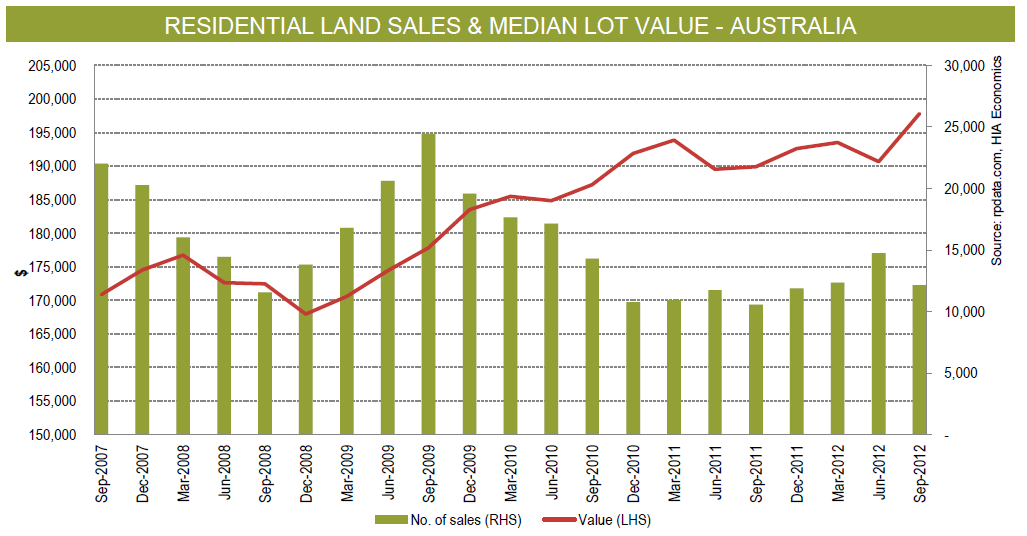
The Housing Industry Association (HIA) has just released its land sales report for the September quarter of 2012, which revealed a widening divergence between vacant land prices, which continue to climb higher, and the number of land sales, which dipped in the latest quarter and have barely moved since June 2011 (see next chart).
According to the HIA release:
The latest residential land update signals a long road ahead before new home building activity returns to healthy levels.
The HIA-RP Data Residential Land Report… highlights a significant decline in residential land sales in the September 2012 quarter.
“Residential land sales fell by 17.8 per cent in the September 2012 quarter, although the volume was still 14.9 per cent higher than the record low set a year earlier,” said HIA Chief Economist, Harley Dale.
“It is encouraging that land sales in a majority of markets have lifted off the depths plunged in 2011. However, this latest update highlights the uncertainty around whether the new home building sector can mount a recovery that is both sustainable and of the magnitude Australia’s population and economy require,” Harley Dale said.
“Overall, residential land sales, a key leading indicator of housing starts, signal a rocky road for any new home building recovery in 2013.”
“One catalyst for the emergence of a strong new home building recovery would be the reduction in the cost of new housing, including serviceable land, which is brought about by disproportionately high and inefficient levels of taxation,” added Harley Dale. “This requires bold and decisive policy reform across all levels of government, action which consistently fails to occur to the detriment of a more productive and efficient economy.”
According to RP Data’s research director Tim Lawless, the September results highlight the recovery in the vacant land market remains a fragile one. “After consistent increases in the number of vacant land sales over the past three quarters, the lower September result is a stark reminder that consumers remain very price sensitive and cautious about their household finances.”
“Land developers and builders are facing the challenge of providing affordable house and land packages at a time when land costs, as well as construction costs, continue to rise. The median price of a vacant block of land rose 3.8% over the September quarter last year despite the fall away in volume.”
“The broader housing market remains on a recovery trajectory, and I would be surprised if the vacant land market continued the slippage in transaction numbers we saw in September. Low interest rates and a subtle improvement in consumer confidence, together with Government incentives now more focussed on new housing, are likely to be the driver behind a gradually improving market.”
In the September 2012 quarter the weighted median residential land value in Australia increased by 3.8 per cent to $197,807. This value was 4.2 per cent higher when compared to the same period in 2011. The median value for capital cities increased by 5.1 per cent in the September 2012 quarter to $225,795, 6.0 per cent higher than in the September 2011 quarter. The median value for Regional Australia was $155,214 in the September 2012 quarter. This represents a quarterly rise of 0.8 per cent and a 0.2 per cent increase compared with the same period in 2011.
The divergence between land prices and sales is understandable given the extraordinary incentives being offered by Australia’s housing developers, such as offering buyers of new house and land packages free cars, landscaping, large cash-backs, or paying a buyer’s energy bills.
As explained previously (here and here), these types of back-door price reductions have been effective in maintaining the face value of land, but might also be precluding the new home market from functioning properly and could actually be stifling land sales:
A buyer of land that comes with an incentive, such as a new car, pays stamp duty on the higher contract price, resulting in more stamp duty being payable than if the price had been lowered by the amount of the incentive. Moreover, when the buyer seeks finance, the bank is more likely to value the property at a lower level than the contracted price, thereby reducing the amount that the bank will lend and effectively increasing the borrower’s required deposit.
Indeed, earlier this year it was reported that bank valuations on new house and land packages were coming in -15% below developers’ sale price valuations, meaning that new home buyers were being forced to contribute 15% more funds (on top of any housing deposit) in order to cover the valuation shortfall, or forfeit the sale.
However, while straight-out price reductions are superior to back-door reductions via incentives, Australia’s developers appear unable to cut prices directly:
Australia’s property development industry appears to be caught in a pincer. If they don’t abandon incentives in favour of transparent land price deductions, financing of new house and land packages will remain problematic and sales will likely continue to struggle. At the same time, reducing the listed price by the same value as the bonuses and incentives being offered could lower their collateral value, potentially triggering the banks to call in more equity from bank-financed developers to bring their loans back to agreed conditions and/or loan terms. Straight price cuts are also more likely to aggrieve recent purchasers that paid higher prices.
As noted previously, the core problem with the new house and land market in Australia is that prices remain above what many buyers can afford or are willing to pay. And until prices deflate, the rate of home sales and construction activity is unlikely to rebound materially, leaving Australia’s property developers holding large land banks that they cannot offload.
While I agree with the HIA that the level of tax levied on new developments and housing-related infrastructure is too high, and adds to the cost of new house and land packages, policy makers seeking to stimulate land sales and construction activity should also look at forcing greater competition and contestability on land-banking developers and land owners by removing artificial constraints on the quantity of land available for development (e.g. by removing restrictive zoning and urban growth boundaries). Policy makers should also consider reforming the tax system, namely implementing of a broad-based land tax in place of inefficient transaction taxes, in order to raise the holding costs of vacant land and increase the speed at which englobo land is brought to market.
unconventionaleconomist@hotmail.com
HIA Land Sales Report (Sept Qtr 2012) by leithvanonselen


Seriously, this just does not make economic sense. It’s so screwed up. Sales aren’t happening so prices rise in expectation of sales. HUH?
Yup.
Houses and Holes tends to push the agenda that it is government control, red tape, and artificial boundaries which are causing the price in-elasticity in land prices but almost never, ever brings land banking into the same argument – always separate.
Land banking is without doubt, in my PERSONAL VIEW, one of the greatest economic impediments to our successful economic prosperity.
.
I think his overarching point is that land banking is the reasonable, rational and expected result of “government control, red tape, and artificial boundaries”.
Make land easy for anyone to utilise (and concurrently expensive *not* to utilise), and the motive to land bank evaporates.
land banking can’t occur (in australia anyway) unless there is a quota on land being released.
A place like Darwin, Alice Springs, Port Hedland or Canberra is surrounded by enormous amounts of land.
No one entity can capture it all, there just isn’t enough money.
if an entity attempted to land bank, they would just be circumvented by other land on offer.
That circumvention, the free-market response, can not take place due to government control and red-tape.
Land banking occurs as a rational response to the above distortions, and prevents property developement behaving as what it really is… non-tradable manufacturing.
Beautifully explained. All of Australia’s cities, except maybe Sydney (due to geographical constraints), have plenty of land that could be made available for development if only the planning system allowed.
There’s tonnes of empty land in the NW and SW of Sydney.
I’ve also seen some developed blocks in Rouse Hill sit idly for sale for over 6 years. The prices are ridiculous, $350K for 385m2. I don’t get how developers can get away with this.
because no one can get away with offering 385m2 for $185.
Red tape prevents this.
Remember, you have to look at this as non-tradable manufacturing.
The block of land is inventory.
Because of red tape, holding cost for an inventory item is around 6 years. because of zoning interference, competition is suppressed.
6 years of borrowing costs for starters are built into the price.
Developers also gamed the system. it makes sense for them to acquire all the releases, if releases are so small thus affordable. A monopoly instinct.
So to optimises their own costs, and move away from bringing efficient product to market by quality or efficiency, to begin with the release inventory by drip-feeds, but then the rational response is to alert government to a source of extraordinary gains, then they get their cut of it by diverting infrastructure expenditure into those gains.
Heaven forbid they attempt to fix things up to bring a consumer item to market cheaper.
So here we are now, what should be an inventory item of a path of dirt, with a value added manufacture, to offer an consumer item with the utlity of shelter.
instead, it is a completely gamed system that offer extraordinary gains to … what in effect are child abusers.
And yet we still have a considerably large portion of the population willing to defend it.
Nice explanation RP. Re this:
“And yet we still have a considerably large portion of the population willing to defend it.”
Is that any wonder? We have far too many budding land monopolists/wanna be land (slum) lords in this country who also want the easy road to riches off the back of passive, unearned economic rent.
1.1 million of them last time I counted.
The land values line seems to reflect the main house price indices. A small brief “correction” during 2011 and 1H 2012, followed by prices rising since mid 2012. Looks like land sales are at an all time new record high, while house prices are still a few % away from all time peak, though not for long if house prices keep tracking up they way they have been in recent months.
Prices are tracking DOWN according to the only believeable index and that’s ABS. All the other indexes are propaganda pieces by vested interests.
That is correct. ABS, RPData APM and Residex indices are ALL pointing to rising house prices. The big 40% crash has been averted, once again (as expected).
The more astro-turfer’s there are on this site the better I feel about not buying into this bubble!
.
Significant savings growing all the time and 2 o/s trips a year! Would hate to have a mortgage right now, the carnage cometh!!!
They’re coming out in force now aren’t they? The volume of property bulls on this site is definitely increasing faster than the volume of property bears!… or house prices… or rents… or mortgage lodgements… or FTBs…
We really need a ‘known spruiker’ icon to start popping up next to names on comments. New people to the site might actually take these guys seriously.
Get in quick Arch
Yes, that is quite common market behavior and a bearish signal – ask your share market investor mates.
The only buyers are price-insensitive (or stoopid, you choose). Sale prices are further clouded by widespread sales incentives and growing block size.
Don’t Buy Now!
Prices rising is a bearish signal?
David, you said house prices would fall 20% in 2012, but they are actually UP 2% year-on-year according to the latest RData stats!
http://www.rpdata.com/research/daily_indices.html
It is if volumes are falling, which the data kinda infers here. It indicates that a growing percentage think now is a bad time to buy, leaving a shrinking percentage who are ‘price-insensitive or stoopid’.
Archie, your choice of statistic is masterful. What matters is real prices, you know, after inflation. See: http://www.prosper.org.au/1md
are loans inflation adjusted too David, or do you continually ignore the other side of the equation because it makes you advice look second rate?
Spot on David, even if nominal prices rise a few percent, a buyer who waits will pay LESS DOLLARS IN REAL TERMS, and that’s what the bulls don’t get!
Ahh, PF. Wages in aggregate track inflation (we all hope to slightly better it). My advice is contrary to your financial interest but warmly welcomed by the excluded.
Most are thrilled to find standing aside and saving a bigger deposit is delivering major life-long benefits.
Don’t Buy Now!
Well said, if house prices are barely tracking inflation the only sensible move is to sell and buy back later. Even if nominal prices are higher later, the real price will be lower.
Ok David – now I understand – your argument is complete hogwash because it is rooted in bias, and because you cannot justify it you give silly flippant answers to appeal to the peanut gallery.
I guess it’s the best you’ve got.
LOL PF – you have become agressive of late!
Your prediction was still wrong Mr Collyer. You said down 15-20% in 2012 (you didn’t mention that was in real terms). But prices rose in 2012 according to ABS and RPData.
Not trying to be a pedant, but prices fell marginally in 2012 according to RP Data. The ABS results for 2012 have not been released yet and could go either way (probably show bugger all movement).
PF can’t win with logic. So he’s decided to play the man not the ball.
His method is funny.
One one hand, he has descrbed himself as not relying (knowing) economi ctheory and places greater weight to his anecdotal observations.
He is quite clearly, and tacitly self-described, as less knowledgable.
You call him out for being less knowledgable, and he throws his toys out of the cot.
Then he often frames himself as being intellectually superior, only to resort to patronising quips such ‘well if you really don’t have an anwer, just say so’.
Well they are up 1.7% on current yr on yr figures, so there must be a very rapid recovery underway.
PF, I answered your Q: Wages in aggregate track inflation (we all hope to slightly better it).
While we have a private moment, can I just express my concern on a personal matter. I had a quick look at Aust Property Forum recently -don’t worry, I washed my hands straight away – and see you have been commenting there at 3.45 am. Get some rest, Peter!
May I express my concern at your words David.
Oh, and you didn’t answer my question.
Every accountant knows that ignoring one side of the ledger leads to very wrong findings.
If you allow for the effect of inflation on property prices, you must also allow for it in measuring the real debt.
Is there something in that simple statement that I need to explain?
That’s why people tend to do their calculations in nominal amounts, it’s easier.
However there is nothing wrong in using prices expressed in real terms, as long as you consistently apply it to both sides of the ledger.
Did you understand that? If not I’m happy to go through it over and over until you have it.
PF said “your argument is complete hogwash because it is rooted in bias”
.
.
Since when has any of your commentary been unbiased Peter?
yes David’s stubbornness at being wrong is very entertaining, I m sure next year he will predict a 50% crash
quite fun, sad for those who take him seriously of course, they are wasting precious years they cannot buy back but what to do, they only hear what they want to hear, so convenient, life is unfair blahblah blah…
I used to listen to this bear stuff but fortunately i have reassessed in time.Only Idiot do not change of opinion.
Dont Buy Now
Attack of the bulls!
frankly that was gentle, i would be a bear i would be starting to be upset by prosper’s predictions ( but I fully support their land tax campaign)
+1 dam, how long will this guy keep giving dangerous advice not to buy? Don’t buy when interest rates are low – crazy advice. Don’t buy when prices were falling like in 2012? Don’t buy now when prices are rising again? Will he keep saying don’t buy forever? When should people buy then, never?
When should people buy then, never?
Nah. Not never. Lets take 1 year at a time. Check back in another year’s time, will ya? It could be a better time .. or not.
Maybe never. Who knows? It all depends on each individual’s situation at a given point in time.
There’s no rule saying “you have to buy a house”!
Martin Place your missing the point! If enough young people can be persuaded not to buy a home then prices should eventually crash back to sensible levels. Keep up the good work David.
DON’T BUY NOW!!!
@overflow
house are bough and sold, it doesnt have to be FTB !
at this moment all the good deals (thanks to the lack of FTB) are taken by investors, everyone need a roof, no matter what
@Mav
in one year you will be one year older
and as rates are not going to shoot up anytime soon, your interest repayments will drop year after year but your rent just increase at par or above inflation rate.for PPOR, volatility in capital gain does not matter too much.
Renting worth it if you move every 2-3 years (to avoid stampduty/realestate costs) and if you rent premium properties ( which are really crazy good value to rent and really bad investments, I pay $900pw for a jewel)
@Dam, Bro, you reckon I should go out and buy a house, like, right now?
Seriously, you need to improve your scare-mongering soft skills, because:
1. In the scheme of things, Interest rates going up or down in 1 year makes very little difference in a 10-30 year long mortgage repayment cycle.
Yours is a Penny wise, pound foolish risk mitigation strategy.
2. My rent isn’t going up for another year. Anyway, didn’t you say you rent?
This “rent’s going up” thing is such a furphy.
A 4% annual increase on my rent (being generous) at a 4% yield takes the yield on the property up to a handsome 4.16% and hardly even touches the renter. On the other hand, if you’re paying, say, 5% (at emergency rates) for finance, it’s far from unimaginable that this price of renting money will go up to 5.5% in a given year – a 10% increase in cost. And we renters are supposed to be the ones worried?!
You work hard Arch
buy two. you deserve it
There were a couple of really useful posts yesterday on the article about NZ property buy someone calling themselves LandDeveloper – Patrician and UE exchanged a few threads with him
Inter alia He made the point that the developers consider the freebies they can give away (cars, credit cards etc) Costs of Goods Sold (so you can see these in company balance sheets each quarter) whereas any agreement to reduce prices would be a decision about Revenues (which would need to be made at a higher level in the developing company).
So that would explain a fair amnount of the freebies instead of reduced prices situation we see.
Given that it is reporting season for a lot of these companies I would be looking at the 2H 2012 statements (which I would guess will be coming out in the coming weeks) – particularly the COGS lines in the statements.
really top tip Gunnamatta!
I reckon CoGS increase should also be visible in the upcoming half yearly reports and will be checking.
I will also be checking reported net profit with net cashflow.
Archie you’re not gullible enough to believe the RP Data index are you. Bullshit prices are up 2 percent, more like down 15-20% in most places, and crashing hard as we speak. Don’t buy now!
“In the September 2012 quarter the weighted median residential land value in Australia increased by 3.8 per cent to $197,807.”
In September, Qld started paying $15K to people buying new homes. In October, NSW started doing the same thing. Both states also dropped the old $7K FHOG entirely, pushing more buyers towards new properties.
Thanks for this one Leith.
So vacant res land pricing continues to defy the laws of gravity.
The sales data indicates that land will continue to be drip fed onto the market at inflated prices until the someone blinks. The next quarters data will be interesting to see whether the “gifts and rebates” shenanigans will increase sales.
It would be interesting to overlay the stock of unsold lots held by the top 7 listed developers (currently running at ~250k)over this data.
I read that at ~6 yrs worth of total national vacant land supply (at current sales levels) sitting in the landbanks of 7 developers.
The above is yet more confirmation that the market is not suffering unresponsive supply but rather unresponsive pricing (ie price-fixing and collusion)
+1 to price fixing and collusion. The vested interests are trying their best to prevent the collapse but they can’t fight gravity forever.
You betcha, But the COGs line given to us yesterday – which I certainly think adds up from an individual company level – means that the Banks who back these developers are significant factors.
The banks (who are getting large the money to back the developers circa 30-40% from OS) need to provide collateral for their borrowings. Bank loan books are 65% mortgages, which presumably means that circa the same amount of collateral they are using for their OS borrowings is mortgages.
If they allow the value of the mortgages to slide then they need to come up with more collateral. If they allow cheaper land to come onto the market then they are undermining the value of their mortgages.
So the banks sure wont want to see cheap land coming out, and will presumably be happy with the freebies approach rather than the price reductions approach.
And the government standing behind the banks sure wouldnt want to have prices suddenly deteriorate either.
The price rigidity issue sits somewhere out here around this nexus and the various levels of player in the chain, Government – Banks – Developers – Customers, may not have the actual mechanism to communicate to each other the whole of the picture, just their little bit parts which look dysfunctional in isolation.
But without addressing the whole chain we sort of find ourselves in an economic cul de sac
+1 Gunna
What happens when the COG budget runs out?
A lot of the big developers – we need a list – would be reporting H2 2102 results within coming weeks.
Share prices and analysts may (in part) provide an inkling of how the market sees their costs.
There may appear to be a COGS budget for these guys but it would easily be fudged by any decent CFO with a contingency stash.
Australand
Sunland
PEET
Mirvac
FKP
Lend Lease
Stockland
Maybe DC will be following results?
Australand – February 7
Sunland – February 20
PEET – February
Mirvac – February 14 Market briefing
FKP – no mention (2012 was February 23)
Lend Lease – February 18
Stockland – February 13
All the big listed developers have multiple activities. They landbank, build houses, develop and rent commercial, trade farmland, subdivisions and developed lots, finance builders, etc.
Their accounts are quite opaque. There is no way you can tease out the COGS of residential land sales.
As I have pointed out earlier, the GFC snapped them around. After many painful moves, they are now lowly geared at ~25%. They are backed by shareholders’ equity. So they aren’t going bust. Instead, shareholders will have to endure very poor returns for years, if not decades.
On the issue of abuse toward me from the trolls, I quote Gandhi:
“First they ignore you, then they ridicule you, then they fight you, and then you win.”
Where are we up to?
Don’t Buy Now!
DC, If their accounts are so opaque, how can you be sure their gearing is so low?
I just had a look at some of last years statements. DC is 100% on the money. Nobody is going to be identifying too much out of them.
They sort of rank right up there with Russian levels of accounting transparency.
Would have been good to get a breakdown by state.
UE – Are the most/least expensive markets tables showing actual sales or current sale prices ?
Good question. I’m not sure.
The chart shows prices and sales volumes both up since Dec 2010.
You seem pretty confident on Australian house prices (which puts you in the minority of people who post here). Was wondering if your enthusiasm extends to Melbourne and Tasmania?
The land bankers appear to be able to stave off insolvency long enough to allow the market a period of irrationality (perhaps Alfred E Neuman could publish an explanation)… I wonder how many of their financial backers are sweating heavily at night?
I sleep well at night knowing that they dont!
If land prices are up doesn’t that mean council rates will just go up, so this isn’t particularly good news for homeowners.
Declining sales volume & rising price is evidence that debt leveraged developers (& their banks) require a higher inventory (asset) valuation to justify the rolling over of compounding interest on outstanding loan debt.
Good luck