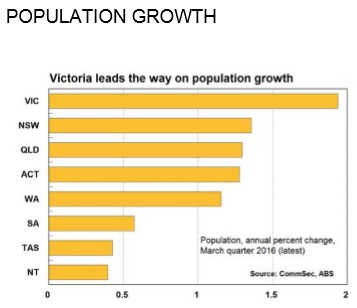
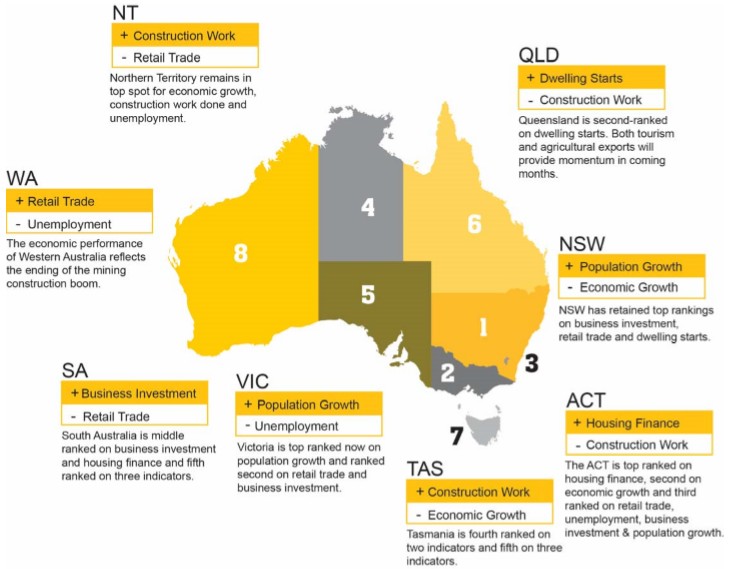
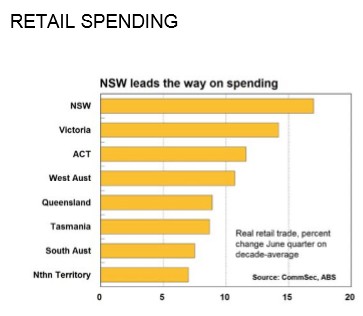
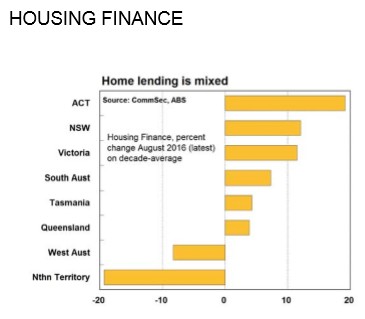
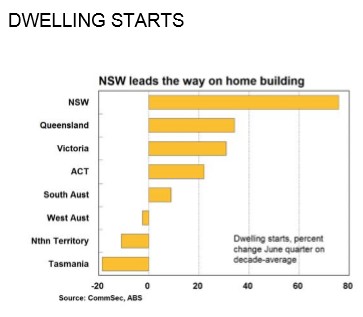
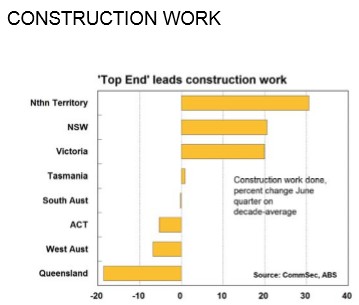
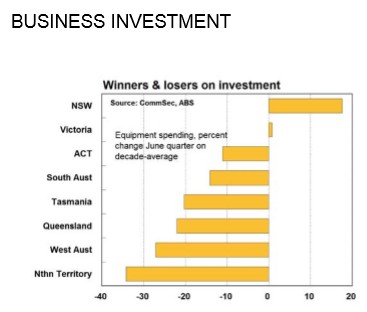
CommSec has released its latest State of the States report, which once again ranks New South Wales and Victoria on top due largely to strong population growth, housing, and debt-fueled consumption:
Each quarter CommSec attempts to find out by analysing eight key indicators: economic growth; retail spending; business investment; unemployment; construction work done; population growth; housing finance and dwelling commencements…
NSW has held on to the position as the best performing economy, supported by strong construction activity.
Victoria remains solidly in second spot, but may consolidate or improve its position over the coming year.
The ACT economy remains in third spot on the economic performance rankings with higher home prices and home loans adding momentum.
The Northern Territory economy is still being supported by commercial and engineering activity but economic momentum is weakening.
Similar to the ACT, South Australia is being assisted by stronger home prices and home loan activity.
The Queensland economy has scope to lift, supported by home building, tourism and rural exports.
The Tasmanian economy has improved over the past quarter in relative terms. Population growth is close to the fastest annual pace seen in five years.
The economic performance of Western Australia reflects the ending of the mining construction boom.
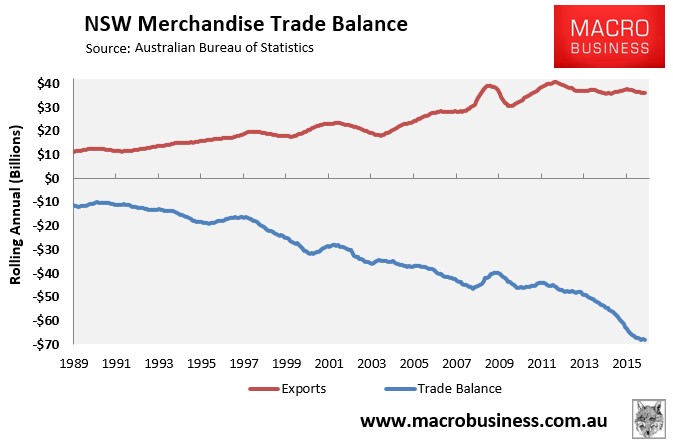
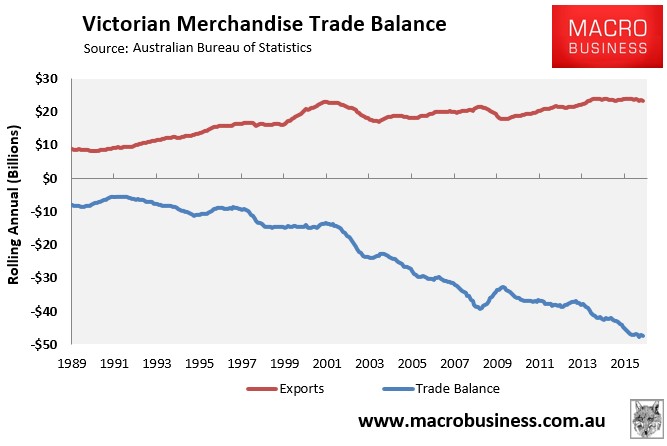
So to summarise, the main areas driving both New South Wales’ and Victoria’s economies are population/housing bubble-related, each of which requires the accumulation of more imports and debt, and a deteriorating current account balance, rather than genuine sustainable growth.
Anyone disputing these facts only needs to look at the below charts showing the stalling of export growth amid the sharply deteriorating merchandise trade balances in each state:
Advertisement
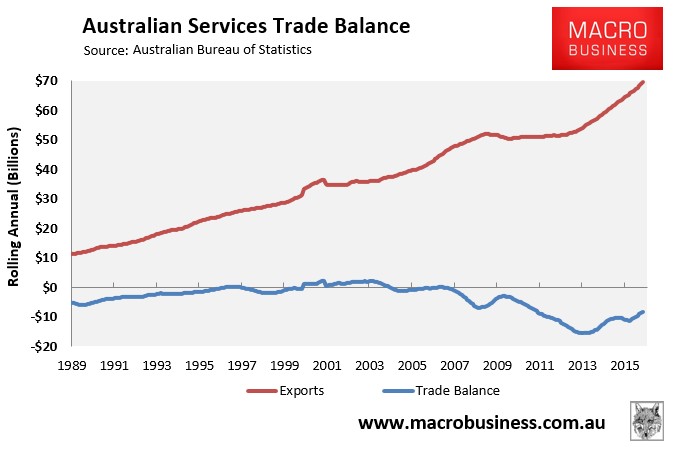
While I don’t have individual state data on services trade, at the national level it too is stuck in deficit:
Advertisement
In short, both New South Wales and Victoria are running ponzi-based economies so that the FIRE sector located in Sydney and Melbourne can make more money.
Meanwhile, the infrastructure deficits in both states, along with congestion, housing affordability and overall liveability worsens each year as more and more people flood into the city and push against bottlenecks amid woeful planning.
Advertisement
It is precisely the wrong kind of ‘economic boom’ that Australia should be pursuing: one that places headline growth ahead of improving productivity, sustainability and per capita living standards.
Leith van Onselen is Chief Economist at the MB Fund and MB Super. He is also a co-founder of MacroBusiness.
Leith has previously worked at the Australian Treasury, Victorian Treasury and Goldman Sachs.