
Australia’s independent infrastructure umpire, Infrastructure Australia, has launched a scathing attack on road-based infrastructure investment undertaken by Australia’s governments, arguing that it has been “hideously inefficient” in a new leaked report. From The Canberra Times:
More than $20 billion a year of national road funding is being spent in a “hideously inefficient” manner, according to a leaked assessment by Australia’s independent infrastructure umpire…
“The unhealthy focus of road agencies appears set on ‘getting, controlling and spending’ more taxpayer money, rather than questioning efficiency or value to the motorist and governments,” the report says…
The report, which claimed Australia has a “gambler’s addiction to roads”, said national road spending is now outstripping revenue raised through road-related taxes and charges, warning “Australia’s thirst for roads” would come at the expense of other services as the gap continues to widen. In the four years to June 30, 2012, road spending outstripped road revenue by $4.5 billion…
“The current Australian system assumes that roads are an answer to most transport problems and seeks more and more funding to that end, with little consideration of alternatives…
“They were almost universally poor, in that they lacked any cost-benefit rigour whatsoever…
The Infrastructure Australia report echoes similar sentiments aired last week by the Productivity Commission, whose report into the provision of public infrastructure presented a scathing assessment of the governance, selection and execution processes by Australia’s governments, and cited many examples of where “inadequate project selection… have led to costly outcomes for users and taxpayers”.
Taken together, both reports highlight the desperate need for improved governance around infrastructure investment decisions, as well as the importance of undertaking comprehensive cost-benefit analysis and then ranking and choosing infrastructure projects based on their net benefits to the economy and society.
Without radically improved processes, Australia will continue down the same wasteful path and continue to select projects that represent poor value for taxpayers. It will also encourage continued infrastructure pork barreling over well-targeted and productive investment.
As an aside, Infrastructure Australia’s claim that road spending is now outstripping revenue raised through road-related taxes and charges highlights the short-sightedness of the Howard Government’s freezing of fuel excise indexation in 2001, and the need for the Budget’s re-indexing measure to pass the Senate.
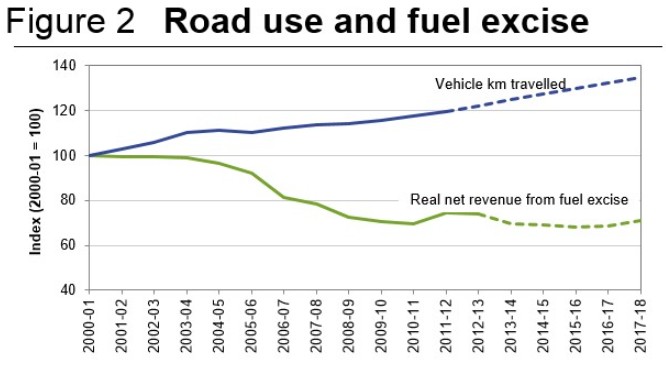
Had fuel excise not been frozen at 38.1 cents per litre in 2001, then the Budget would today be some $5 billion per year better-off, and road-related taxes and charges would more than pay their way.
unconventionaleconomist@hotmail.com