HSBC’s Paul Bloxham today offers a lesson in how to get on with life during a commodities bust:
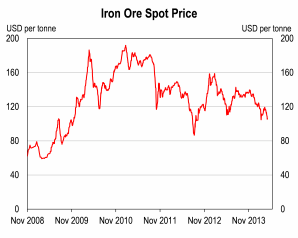
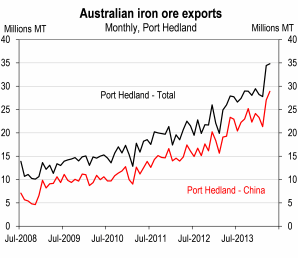
Iron ore exports continue to ramp up strongly, despite China’s recent slower growth. Today’s data from Port Hedland showed that export volumes to China reached a new record high in April and are 50% higher y-o-y. The strong volume response is contributing to a fall in iron ore prices in recent months, but at USD106 tonne, Australia’s producers still have significant margins. Export volumes are expected to continue to rise this year, given new capacity that is coming on line. We expect prices to average USD119 a tonne this year, which combined with strong volume growth, implies that Australian income growth should be supported by iron ore exports in 2014.
Iron ore is Australia single largest export, accounting for 21% of Australia’s total exports and around 4% of GDP. Port Hedland, in Australia’s far north, is the world’s biggest iron ore port, and a key driver of Australia’s economy. Recent data on iron ore exports from Port Hedland continue to show strong demand for Australia’s iron ore from China, despite slower growth in the Chinese economy in recent months. Port Hedland’s total iron ore exports volumes rose by +34% y-o-y: exports to China rose by +7% in April and by +50% y-o-y (Figure 1).
Continued strength in Australian iron ore exports to China may surprise some observers, given weaker growth in China recently. However, there are at least two factors to keep in mind. First, while China’s growth has weakened, much of the slowdown has been in manufacturing, while growth in infrastructure investment — which is the key driver of demand for steel — has remained strong and is expected to continue. Second, Australia is the lowest cost producer of iron ore, so that even if overall demand for iron ore slows, other producers are likely to see cuts before there is a reduction in demand for Australian iron ore.
Australian official forecasts are for export volumes to rise by +19% in 2014. Today’s numbers are, in fact, running ahead of this assumption. However, even assuming that growth does slow back to the rate expected by officials, income growth will still be boosted this year, as long as prices do not fall further (Figure 2).
Indeed, while iron ore prices are currently around USD106 a tonne, our colleagues in the equities team are forecasting iron prices to average USD119 a tonne this year (see Keen, A et al ‘Metals quarterly: Q2 2014’, 28 April 2014 ). This would be a -13% fall from last year’s average of USD136 a tonne. This would still leave iron ore prices high relative to history, at 800% above their 1990s average level, consistent with our view that the commodity prices super-cycle will be ‘more super’ and ‘less cycle’ (Bloxham, P. and Richardson A. ‘Global commodity prices: More super, less cycle’, 5 September 2013).
Combining official forecasts for volumes with our view on prices suggests that iron ore exports could contribute +0.3ppts to Australian income growth this year, following an estimated contribution of around +1.1ppts last year. From a volumes perspective, iron ore is expected to contribute around +0.8ppts to Australia’s GDP growth in 2014 (that is, around one-third of the overall +2.8% GDP growth we expect this year comes from iron ore exports).
While Australia’s mining sector is no longer booming, the ramp up in exports that is underway means that the sector is continuing to be a support for growth.
Bloxo has simply assumed that the iron ore price will remain strong and then drawn all sorts of happy conclusions about how wonderful that will be, which is a simple case of circular argument and bullish bias.
The iron ore price has averaged almost exactly $119 so far this year. But the second half looks more troubled. On the demand side, we’re well into peak steel season (through July) yet the price is now 10% below $119, Chinese inventories are high, and the Chinese property market bust is yet to pass through to construction rates with no sign that authorities are going t let up on monetary and prudential tightening. Given over half of Chinese steel goes into residential property, this represents a huge headwind for steel production in the second half. Infrastructure stimulus will help but it is a much smaller market. In Q3, there is a seasonal destock as that will will arriving as demand is hurting and iron ore rice already low.
Advertisement
On the supply side, as much 120 million new tonnes are entering the market before year end. India is also returning early next year. The only possible offset is a Ukrainian meltdown, which would take out 30 million tonnes in a extreme scenario.
In short, a balanced appraisal of the second half gives you a likely iron ore average price of $100, dragging down the average to something like $105 for the year. This could get a little boost if China’s authorities blink in Q4 and stimulate property.
In short, assuming away the iron ore price dynamics is not an argument for why Australia is booming post mining boom.
David Llewellyn-Smith is Chief Strategist at the MB Fund and MB Super. David is the founding publisher and editor of MacroBusiness and was the founding publisher and global economy editor of The Diplomat, the Asia Pacific's leading geo-politics and economics portal.
He is also a former gold trader and economic commentator at The Sydney Morning Herald, The Age, the ABC and Business Spectator. He is the co-author of The Great Crash of 2008 with Ross Garnaut and was the editor of the second Garnaut Climate Change Review.